Years ago, as a student, I worked as a care assistant at Muckamore Abbey. When I read of the recent report on the hospital detailing abuse and gross failures in management, I wondered what had changed since my short time working there; to the human forms that I had fed, dressed, became frustrated with – not that I expect any of them were living today – and to the nature of the place now so blackened by the catalogue of mistreatment of those under their care.
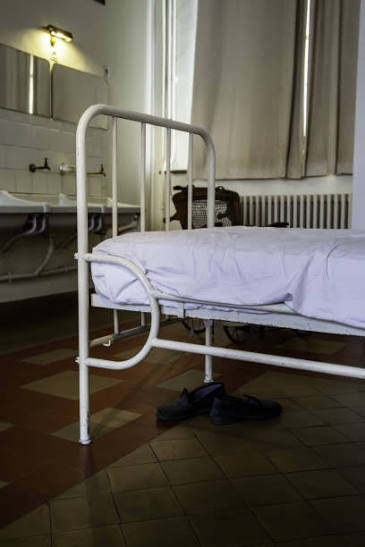
Today Muckamore Abbey Hospital is described as: providing treatment for adults with severe learning disabilities, mental health needs, forensic needs, or challenging behaviour. Back then, I was an engineering student in my early twenties, and I felt lucky to get a summer job there. The National Insurance I paid then contribute to my UK pension today. The London alternatives that year were on a building site or door-stepping suburbia for Encyclopedia Britannica. The induction for the latter was enough to send me home.
I don’t intend to compare those weeks to the shocking conditions outlined in the report, of which I’ve read only a brief summary, but to recount some of my experience then and how it still resonated with me when I read what happened. (See Note at the end for a very brief introduction to the Muckamore Report)
The temporary summer staff that year were a mix of male and female students. One benefit of the job was on-site accommodation. Outside working hours were, as you would expect, filled with music, stories, boy-girl games and nights out. Live rock bands played each week in the nearby Deerpark Hotel: The Move, the Small Faces, Skid Row. We walked everywhere, larked about on the roads, pushed each other into hedges, daring the brave to lie in a dark haunted graveyard on the Dublin Road. We drank and smoked a little, listened to Bob Dylan, though I recall Rory, an older Queen’s student, poo-pooing Dylan’s growing status, saying that Barry McGuire’s Eve of Destruction, which he kept playing and playing, was a much better protest song. I think he was also making a political point as he talked about civil rights.
How did I deal with those first few days in the Hospital Ward? I don’t know. Act normal, I suppose. Do what I’d seen those around me doing growing up, act normal, as the troubles got a capital T. And the worst years of the war approached. Try and figure it out later.
I was shocked by the scenes in the ward those first few days, images that are seared in my memory. Of humans the like of whom I’d never seen before. The worst cases, misshapen, motionless beyond belief, eyes and mouths twitching, made grunting sounds. Outside and beyond anything I had considered as human, left traumatised, without training or warning as to what to expect. Yet like the others, I complained mildly, went to bed, got up the next day, had breakfast, and walked the paths through cut grass lawns to the hospital ward.
What I remember about any induction was making beds, the detail of neat hospital corners drilled into me by a Belfast nurse. Her smoothed accent slipping into guttural curses to the amusement of anyone listening. My tasks were general cleaning up, changing beds, assisting in the dressing and washing of the patients, most of whom were incontinent and all were non-verbal. A few days into the job, I took on many of these tasks without supervision and was asked to attend patients for their ECT (Electroconvulsive Therapy) sessions. For the most part, I suspect, given many tasks the full-time staff were happy to avoid.
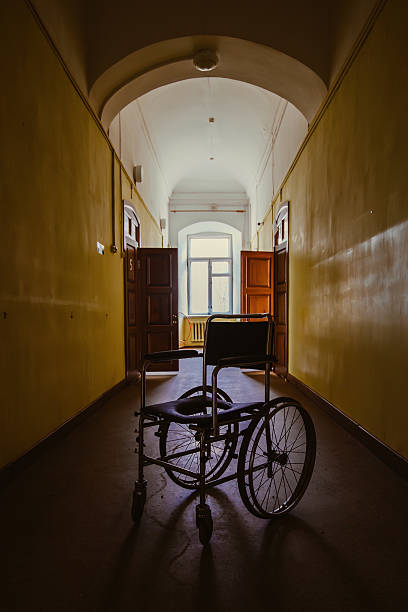
With one patient, feeding of mealtime paste was always challenging with my spoon regularly swiped aside. His gloved hands prevented him from scratching his face raw. As I pulled up a chair beside him, he would swing his arms in random loops, I presume in expressions of excitement. Requesting him to stop had no effect. Much of the food ended up on the floor. This would go on forever, it seemed, until there was no more mash in the bowl and the cleaning would begin. One lunchtime, particularly frustrated, I used a towel to tie one of his arms to the chair’s armrest. This made feeding him much quicker, each mouthful taken with gusto.
A roar came from the day room door. A male staff nurse, one with a sharply cut head of ginger hair and matching personality, shouted, Stop that! You can’t restrain him! Take that off. Chastened and embarrassed, I untied his arm and resumed my slow task. What I’d done was forbidden. No one told me, or coached me in these duties, beyond the rudimentary.
One free afternoon, harbouring a career as a pilot, I booked a training flight with Woodgate Aviation at Aldergrove Airport. I walked the Oldstone Road three and a half miles on a hot afternoon. Soon I was banking a two-seat Cessna through a blue cloud-flecked sky. We flew over everything: over Muckamore, over the Antrim Hills, Lough Neagh, green fields with specks of cattle and sheep, over troubled towns with their plotting killers, banked over the Braid River that snaked through Ballymena and back onto the tarmac between airliners braking to a quiet rocking stop. Afterwards I walked the same sweaty roads back to the hospital accommodation and an evening’s craic.
So, what might have changed to cause this awful scenario to develop at the hospital in the 2000s? Here’s what I think. At least one major change has taken place in the management of UK government services since then: the introduction of a corporate metrics approach into the civil service by Margaret Thatcher during the 1980s and 90s. It was first used in government by Robert McNamara in the 1960s to help win the Vietnam War, using enemy fatalities as the measure of success. Despite its obvious failure – and it’s now referred to as McNamara’s Fallacy – it has been widely used as a government’s management tool. Often, these metrics are proxies for things that cannot be easily measured, like the quality of a service, for example. The rollout of this philosophy was complemented by a continuous drive for value for money.
In 1971, Charles Goodard coined the adage: when a measure becomes a target, it ceases to be a good measure. That’s because we try to achieve the targeted measure by any means possible, by gaming it. The end goal of the management measure that might be aimed at improving value for money or the quality of care, becomes, in the sweat at the coal face, irrelevant. This measure-and-set-targets approach has impacted all our lives. And I suggest it is one of the major reasons for a drop in the quality of care in many of our institutions and in government services.
But back to the coal face, I can imagine carers on the hospital ward with a fixed time to feed patients under their charge, the lunchtime clock running, other duties calling, temporary restraint becomes necessary, then acceptable, and a blind eye is turned. And improved staff-to-patient targets are met. Frustrations vented become the everyday, and a culture evolves where the unacceptable becomes acceptable. That’s all very simplistic, yet most of us can understand it, or have some experience of how something similar might evolve in another environment.
What my time at Muckamore Abbey Hospital Ward has left me with is the shock of it: how out of my depth and untrained I was, attempting to care for people I never knew existed, who came from the homes of friends and neighbours, their lives hidden from us and left to the toil of state workers. Some things have changed for the better.
End
NOTE If you not familiar with the the 2026 health care report here’s a very brief background: Muckamore Abbey Hospital is a Northern Ireland state hospital near Antrim, described as providing treatment for adults with severe learning disabilities, mental health needs, forensic needs, or challenging behaviour. The June 2026 report highlighted a culture of regular abuse of vulnerable patients and a lack of appropriate oversight and management. Patients experienced physical injuries including black eyes, broken bones, bruising, and inappropriate or excessive restraint. Possible criminal cases are pending.
A link to the report at:
https://www.mahinquiry.org.uk/publications/muckamore-inquiry-report-june-2026-0
PDF version here

