This is the first landing for my writing. The regular posts cover a variety of subjects and styles: fiction and family and social history. A few have been published elsewhere. Why the curlew or crotach? Known for its long, elegantly curved bill and its haunting call, the curlew’s call, once common on wetlands a generation ago, is now is seldom heard – like many of the subjects in this blog.
This blog arose from previous family history posts, a few loose ends that had puzzled me. The first two of these are tidied up with the answers that were in plain sight, I hadn’t realised their significance. The last is perhaps frivolous.
Firstly, I only recently realised that both my parents grew up in families dealing with the consequences of their collapsed family enterprises.
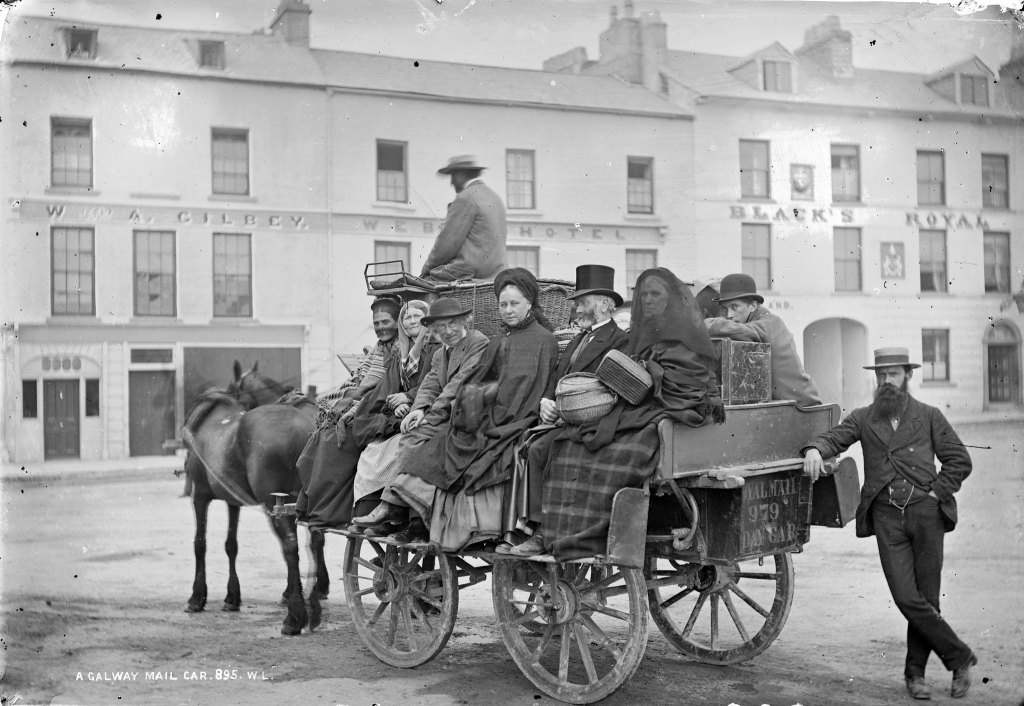
Hugh McWilliams, paternal grandfather, had a thriving coach-building business which collapsed with the rise of the motor car.
Richard and Annie Davis’s County Leitrim family was thrown into a crisis of debt when Richard’s business partner absconded to North America with the assets of their cattle business.
These early decades of the 1900s saw major political tension and flux, which culminated in Irish independence and partition. While both families were Unionist, with connections to the Orange Order, they ended up on either side of the new border.
Each family adapted to changed circumstances. Hugh and Lizzie abandoned their home and Hugh’s workshop for a smaller two-up two-down house. Hugh went out to work as a jobbing carpenter, and it was said that he became somewhat of a recluse. Richard and Annie’s family was deeply in debt for many years, finally reclaiming the last of the mortgaged farm in the 1940s. These decades proved exacting for the growing family of nine, compounded by the loss of toddler Maureen in 1923 and Herbert at nineteen in 1939. Despite their prosperous-looking two-story slated house overlooking a main road, neighbours could easily tell the family was in dire straits, and spending had been cut to the bone.
The second insight was that Robert McWilliams, my great-grandfather’s second marriage in 1867, noted as a civil marriage that could have been in a registry office, was to Eliza Bamber, fifteen years his junior. Eliza was pregnant at the time and Ann, their first child, was born four months later. Ann died of TB at the age of nineteen.
Is this a likely explanation of my Aunt Martha’s single acknowledgement of him with a shake of her head and a look of disgust? And the reason for our strongly Presbyterian family’s disinterest in their ancestors and relations? Were they ashamed of their past? Nothing is known of Robert’s first marriage or how it ended.
James Boyle, writing in 1834 in the Ordinance Survey Memoirs says: Ballymena people are a rather moral race – though the number of public houses there being 107, would lead one to suspect otherwise – they are indeed fond of whiskey and too many indulge in it. On Saturday evenings the number of drunkards on the streets is disgraceful, but they are mostly from the country.
Robert was from the country. He moved into Ballymena following his second marriage and joined Second Ballymena Presbyterian Church, where I suspect he became an earnest member, and raised his family in strict faith and observance.
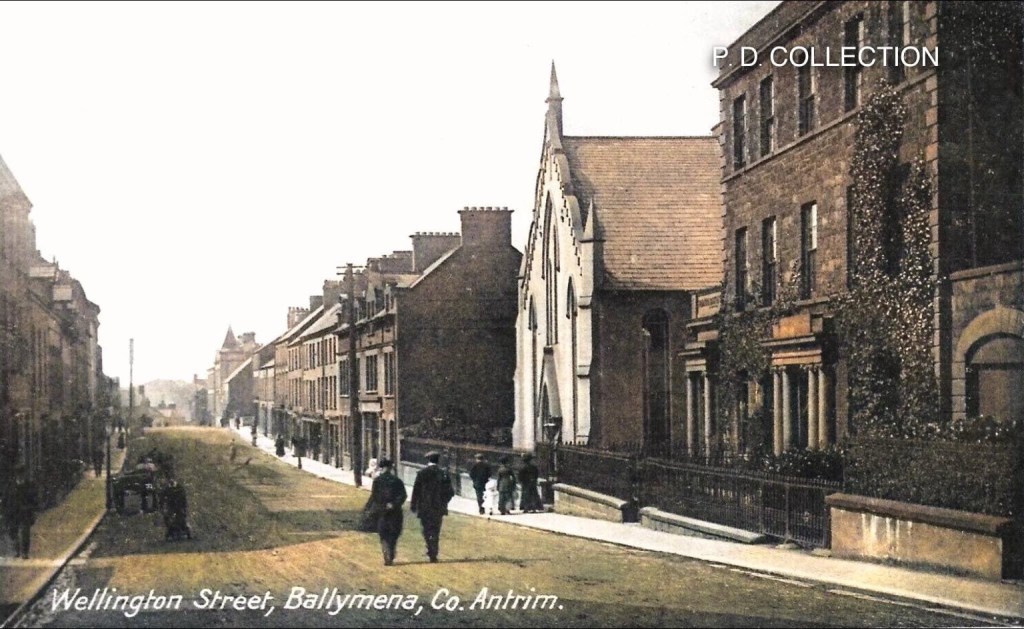
Robert and Eliza’s church, second building on the right, when they moved to Ballymena after their marriage in 1867, living a short walk away in Alexander Street.
The major expansion of all churches in Ireland and beyond during the mid 1800s was driven by zeal to rescue the general populace from sin and immorality, mainly drunkenness and promiscuity. Shame and guilt proved significant drivers of the increase in church numbers and the subsequent period of new church building. Robert and Eliza were among these new converts.
Lastly, a memory from my grandfather’s knee, where Granny often fed me buttered bread with sugar. One evening, Granda raised a finger to one nostril and blew some offending material out the other and into the wide hearth. Funny how some things stay with you.
So, what it this called? – blowing mucus, snot, down one nostril. It’s common among farmers and outdoor workers, among cyclists and runners. A male thing, perhaps? Searching in English, only slang turns up, a farmer’s blow, which seems appropriate, and a snot rocket. There’s no medical term I can find.
So far, nothing in Gaelic, but the closest might be Smuga a chaitheamh amach, (SMUH-guh uh KAH-huv uh-MOHKH ) to expel snot – a phrase my mother might well have remembered with her achievement of a Silver Fáinne medal. I’ve asked around Buncrana with one positive reply – in West Africa’s Yoruba, the word is, fumu, short and explosive, as it is.
Some time ago, I wrote a few blogs about my great uncle Herbert Charles Gillmor. These earlier stories tell of his family near Dromahair in County Leitrim, of his injuries in WW1, his emigration to Canada as a European pioneer, and of his untimely death in 1960. His Goodfare neighbours sent me some of their memories of Bert. One is printed here and there is a link to the others. In Ireland, he was called Bertie and Bert when he emigrated to Goodfare in Alberta, Canada.
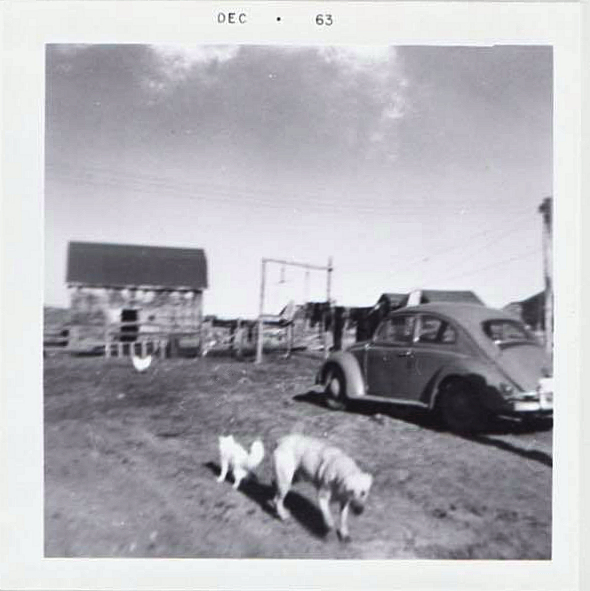
Bert’s farmyard after his death. (Raymond Wardill)
I heard my grandmother, Annie Davis, refer to him a number of times as ‘poor Bertie’. As the eldest, she may have carried some sense of responsibility towards him, and indeed Annie and Richard called their first son after him. If Bert’s experiences in the Great War left him damaged or dislocated, he appeared to have lived a full life for over thirty years in his small rural community.
In Goodfare those who remember him described a successful hard-working farmer, tall and muscular, and a good friend to his neighbours. He never married and didn’t like to spend money, though he knew how to have fun, one said. He was also generous to the local school and community. As one of the first wave of European settlers, he was given two sections of virgin forest and scrub on lands taken from native peoples. He cleared these for agriculture and kept cattle and horses. For many years, he used a horse or horse and buggy to get around and was the first to have a motorised truck. One neighbour said he would take off for days at a time and no one knew for sure where he had gone. One woman speculated that he went to town and that as a single man, he had needs that had to be satisfied. However, it was also said that no such rumour had ever circulated in their small community. The nearest town to the rural settlement of Goodfare was Beaverlodge, twenty one kilometres away and there was a First Nations reserve near Horse Lake some six km north of his farm.
What drove Bert to his tragic decision was never clear. In May 1960 he was found in his truck a few days after taking his own life. Raymond Wardill, whose father bought Bert’s place after his death, says they thought that Bert had never paid any tax, and when the tax man finally caught up with him, it drove him to his sad end. Bert, he said, always worked in cash, and as children, they believed there were hoards hidden around the farm. They would often go looking but found nothing.
I recall my grandmother saying that Bertie had accumulated significant lands over his farming lifetime. But when his estate was distributed, the nephews and nieces were surprised that there was so little. The final accounts give no indication of where the bulk of the estate went. She said this could only be explained by the actions of a native woman and her family, which she must have heard about from his letters. But ‘the tax man’ collecting his dues is perhaps a simpler explanation. Interestingly, all these recollections are filtered through the ears of children two generations after Bert.
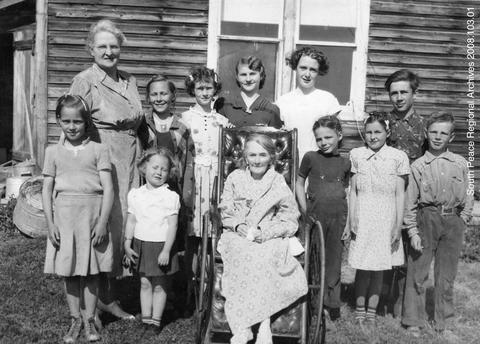
The following story about moving Bert’s horses is one on a number sent to me by Eileen Hommy and her daughter Svea. Eileen’s father was a Norwegian pioneer whose land sections were next to Bert’s. Other stories from Eileen and her sister Evylen can be read here: they include, Bert’s Cattle, Christmas Dinner, Stealing Bert’s Tobacco and Warming up at Bert’s. First, a photograph of Eileen, sister and other characters in the story below, at Southwell School.
Southwell School students and teacher c1949 “In the late 1940s Southwell School District held white elephant sales to raise money for Red Cross. Red Cross matched the money to provide a wheelchair for Mrs. Pretzer who lived beside the school. Back row, l-r: Mrs. Gladys Park, teacher, EileenTollefsrud, Florence Southwell, Mary Olychuk, Gloria Cavanagh, Arthur Tollefsrud. Front Row: Evelyn Tollefsrud, Roberta Weller, Mrs. Pretzer (in chair), Ruth Pool, Jeanette Chandler, Kenneth Pool. Southwell School District 4470 was located north-west of Hythe. Mrs Pretzer died in 1953.” From South Peace Regional Archives
A Daring Adventure with Bert’s Horses
It was June, and my older brother Arthur was still going to Southwell school along with my younger sister, Evelyn and myself. I would have been 8 years old, almost 9, so that would make it 1949.
The only teacher at our one-room log school was Mrs Park. The school was about ½ mile from Bert’s homestead. That day Bert stopped by the school to ask Mrs Park about taking Arthur, who had just turned 12, to come and help him move his horses from one pasture to another. He had 14 or 15 head of horses if my memory serves me correctly. These were wild, unbroken horses. Unfortunately, Arthur had stayed home to help Daddy that day.
Bert, a tallish, muscular man who wore blue overalls and a cap, asked Mrs Park if she thought “The Girl” was up to it. He told Mrs Park that it wouldn’t be too difficult as the horses were up by his house, and she would just need to go around and bring up the rear, to drive them into the gate, which he would close behind them. So, it was decided that I would go.
Bert’s farmhouse was a log cabin of some sixteen feet by fourteen, larger than most, and with a wood stove that kept it cosy even when winter temperatures dropped to 30 below. Sometimes, when it was very cold, Bert brought us in to warm ourselves on our way to school. That was very nice.
By the time I got my horse Betty, out of the barn at the school, Bert was already on his way. I rode Betty bareback. Arriving there I turned sharply left to get around behind his horses. When Betty whinnied Bert’s horses started kicking, biting and rearing up. They were trying to get at Betty who was unfamiliar to them. Then they started to stampede. Instead of going towards the gate, they galloped in the opposite direction towards the creek. Betty raced in hot pursuit. There was no way I could hold her back. I can still see and hear Bert waving his hat and yelling “Girl! Come back!”
In June, the snow is melting in the Rocky Mountains, and our creeks and rivers are swollen. Raging torrents with deadwood and many uprooted green trees are taken downstream. Bert’s horses plunged into the roaring creek and my horse followed. There was nothing I could do. The opposite bank was too steep so the horses swam downstream to a low spot about 200 yards on the far side. I was half sitting, half laying across Betty’s back, holding onto her mane with my right hand and pushing the logs and trees away from us with my left. Betty was panicking and blowing loudly. Her nostrils were flared and I knew as soon as we got to the bank that she would race off again, trying to catch Bert’s horses. They had climbed out of the creek and galloped away.
By the time we got out to the river bank Bert’s horses were out of sight. Betty was running hard and I had to let her go. I figured she would find them. Not that I could have stopped her even if I had wanted to. She ran for about ½ a mile, going through some big poplars, heading towards Eddie Schweitzer’s place to the south. Before I knew it, Betty had turned and was heading back towards the creek. We were now much further downstream. I could see the tracks in the mud where Bert’s horses had crossed. Betty plunged into the creek again. It was a good crossing spot, not so terrifying this time.
When we got back up on the bank Betty galloped towards Bert’s house. His horses had run back into the meadow where they came from, and on out through the gate into the new grass. Bert had been looking for me and Betty and was somewhat panicked. I am sure he had visions of telling my Dad, a big Norwegian and a good neighbour, that his daughter had drowned in the creek, helping him move horses. When he first saw me, he banged his fists on his knees, shouting, “Good job, girl! You’re still on your horse! My God, what am I going to tell your Dad.”
After that, I went back to school because I had to get Evelyn. Bert came with me to explain to Mrs Park why I was soaking wet. Then I guess Bert headed to our farm to explain to Daddy what had happened. When Evelyn and I arrived home he had already been and gone. He had given Daddy $5 saying, “The girl had earned it.” That was an enormous amount of money at that time. With it, I remember getting new shoes and new pants, and I am pretty sure Evelyn did, too. On my Mom’s advice, I told Daddy to keep the rest to buy something for someone else. We were a large family.
In the end, Bert got his horses moved, and I was $5 richer. At school, Mrs Park commended me on a job well done. At home, my Dad told me never to do it again. And I have never had such an exciting afternoon.
End
By Eileen Hommy with minor edits from SMcW.
Eileen and Evelyn’s full set of stories are here. Click.
Thanks to Eileen (nee Tollefsrud) Hommy and her sister Evelyn Harding, in Beaverlodge for the bulk of the stories. And Eileen’s daughter, Svea Isherwood for recording and sending me the stories.
Also thanks to Raymond Wardill for his recollections. Raymond’s father purchased Bert’s farm after his death.
And to Walter and Thelma Pfau, neighbours whose family regularly sold stock to Bert and who clearly had an affection for him.
Finally, thanks to all in the Goodfare community who helped me collect these stories.
 The Curlew's Call