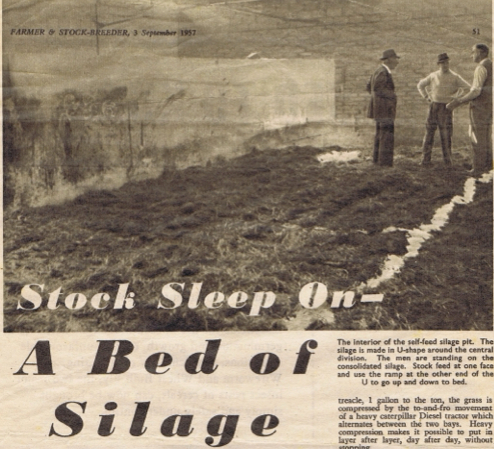
In the photograph below, taken in summer 1957, my father stands on the bed of silage, legs akimbo, hands on his hips, looking knowledgeable, he hopes, while to the left, my grandfather in his show-day suit, shirt and tie, observes this farm innovation on hitherto unseen industrial-scale agriculture. Both men wear hats. The third man is Gerard McGuckian of AA McGuckian’s Ltd at their 700-acre farm near Antrim. Granda is making plans to take this new idea back to the Free State. In the lower picture, you would be forgiven today, thinking he could be checking his phone, but more likely he is making a note or filling his pipe with that crooked finger the child on his knee thought was permanently bent for the purpose.
My father, Tommy McWilliams, was a bread-man, and as far as I know, his farming experience was limited to his family’s Ballymena town allotment; and maybe to picking spuds in the surrounding farms. His father-in-law of six years, Richard Davis, had a collection of small hungry farms in North Leitrim, insignificant by comparison to the McGuckian’s spread on the fertile shores of Lough Neagh. However, in Leitrim, granda was a progressive farmer and built the first silage pit there.
Granda was impressed with the scope of his son-in-law’s contacts, and by a progressive Northern Ireland. Daddy was chuffed with the day’s work, though I’ve no idea how he made contact with the operators of such a large farm. It was most likely coincidence that the Special Reporter from the Farmer and Stockbreeder visited on the same day as they posed for the camera. It’s also my guess it was during the 12th fortnight when Daddy got his annual holidays, and granda and granny were on their one and only visit to Ballymena after the recent birth of Nigel, then few months old.
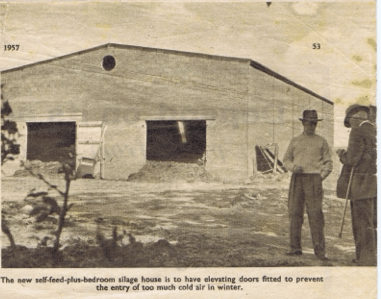
Nigel asked me recently if I had a copy of a picture he recalled seeing among the various family records. If it was anywhere, I had it. He was right. The scanned 1957 newspaper article with these pictures was easily found and emailed to his small olive farm in Spain within an hour of asking. The Special Reporter – no name was used – was likely drawn to the novel self-feed silage system for wintered stock, and the fact that the cattle lay on A Bed of Silage.
About 1975, after finishing a course at Greenmount College, Nigel landed a job with agitech company, Masstock, which had been set up on this same Antrim farm by the next generation of McGuckians, Paddy and Alistair. They had a contract to develop dairy farming and milk and yoghurt sales in Saudi Arabia. These were large irrigation-based units, technology- and investment-heavy.
Nigel was one of the first two Irish workers joining the operations manager on their base in Durma, west of Riyadh. Two years later, the first milk flowed from the imported cows.
Presently, Nigel and Angelika work a small olive farm and their Airbnb southwest of Seville; Nigel has retained enough Arabic to get on well with many people of North African extraction who work in the olive and soft fruit industry there.
The connection between the farming article, with its pictures of my father and grandfather, and Nigel appears to be another coincidence.
The Masstock staff and workers who went out to those arid lands are planning a 50-year reunion, hence the interest in a copy of this rare reportage on an earlier McGuckian enterprise.
Back in 1957, my grandfather’s silage pit at Boggaun was the first in the area. After a couple of disastrous attempts at silage making, it lay unused for many years, built with a design flaw. Had he waited, it would have incorporated sloping sides that ensured the rush-covered grassy heap compacted and didn’t rot. As youngsters, we played in the empty concrete galley. Our Uncle Cecil later used it with a plastic cover, not available until the mid-1960s, to make middling silage from his fields with shallow, dauby soils.
My father remained a bread server and retired to live happily near my granda’s place, care-taking Nigel’s farm while he continued to work in Saudi Arabia.
Masstock Systems and McGuckian brothers expanded their agribusiness beyond Saudi Arabia and in 2008 Masstock was bought out by Irish agribusiness company Origin. The milk and dairy industry did little to liberalise Saudi Arabia.
Nigel and the young men and women who went to Saudi Arabia working in the scorching desert, turning some of it green, living with restricted movement and no – limited? – alcohol, made the best of it; as I hope they will at their reunion.
A full version of the Farmer and Stockbreeder article is available on request.
PDF version here.