Loose Ends.

This blog arose from previous family history posts, a few loose ends that had puzzled me. The first two of these are tidied up with the answers that were in plain sight, I hadn’t realised their significance. The last is perhaps frivolous.

Firstly, I only recently realised that both my parents grew up in families dealing with the consequences of their collapsed family enterprises.
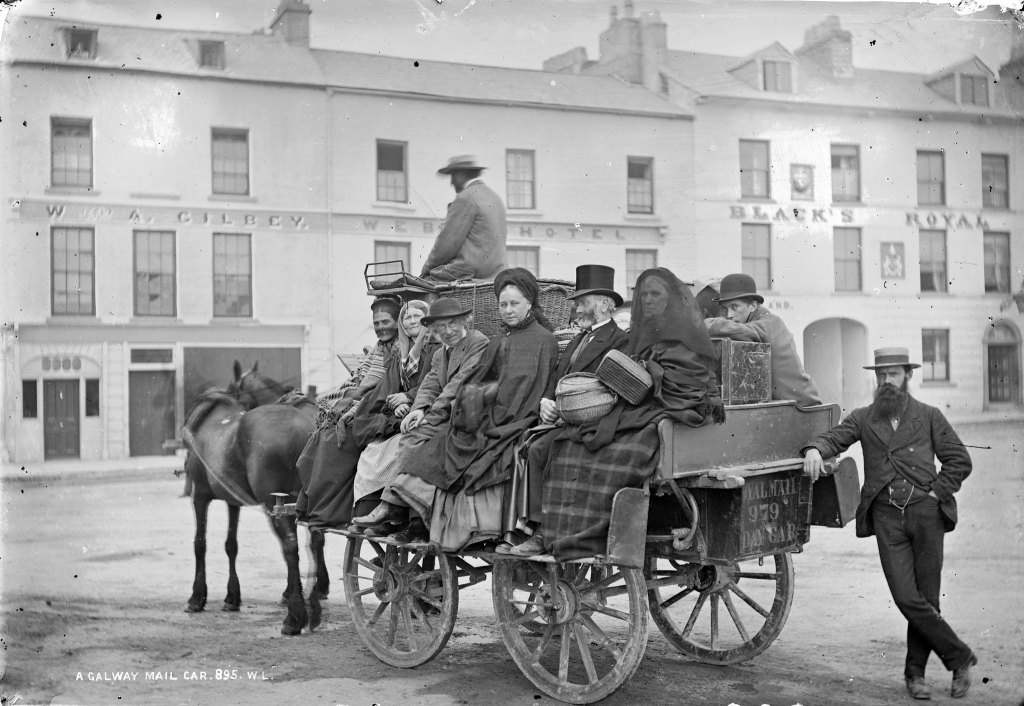
Hugh McWilliams, paternal grandfather, had a thriving coach-building business which collapsed with the rise of the motor car.

Richard and Annie Davis’s County Leitrim family was thrown into a crisis of debt when Richard’s business partner absconded to North America with the assets of their cattle business.

These early decades of the 1900s saw major political tension and flux, which culminated in Irish independence and partition. While both families were Unionist, with connections to the Orange Order, they ended up on either side of the new border.

Each family adapted to changed circumstances. Hugh and Lizzie abandoned their home and Hugh’s workshop for a smaller two-up two-down house. Hugh went out to work as a jobbing carpenter, and it was said that he became somewhat of a recluse. Richard and Annie’s family was deeply in debt for many years, finally reclaiming the last of the mortgaged farm in the 1940s. These decades proved exacting for the growing family of nine, compounded by the loss of toddler Maureen in 1923 and Herbert at nineteen in 1939. Despite their prosperous-looking two-story slated house overlooking a main road, neighbours could easily tell the family was in dire straits, and spending had been cut to the bone.

The second insight was that Robert McWilliams, my great-grandfather’s second marriage in 1867, noted as a civil marriage that could have been in a registry office, was to Eliza Bamber, fifteen years his junior. Eliza was pregnant at the time and Ann, their first child, was born four months later. Ann died of TB at the age of nineteen.

Is this a likely explanation of my Aunt Martha’s single acknowledgement of him with a shake of her head and a look of disgust? And the reason for our strongly Presbyterian family’s disinterest in their ancestors and relations? Were they ashamed of their past? Nothing is known of Robert’s first marriage or how it ended.

James Boyle, writing in 1834 in the Ordinance Survey Memoirs says: Ballymena people are a rather moral race – though the number of public houses there being 107, would lead one to suspect otherwise – they are indeed fond of whiskey and too many indulge in it. On Saturday evenings the number of drunkards on the streets is disgraceful, but they are mostly from the country.

Robert was from the country. He moved into Ballymena following his second marriage and joined Second Ballymena Presbyterian Church, where I suspect he became an earnest member, and raised his family in strict faith and observance.
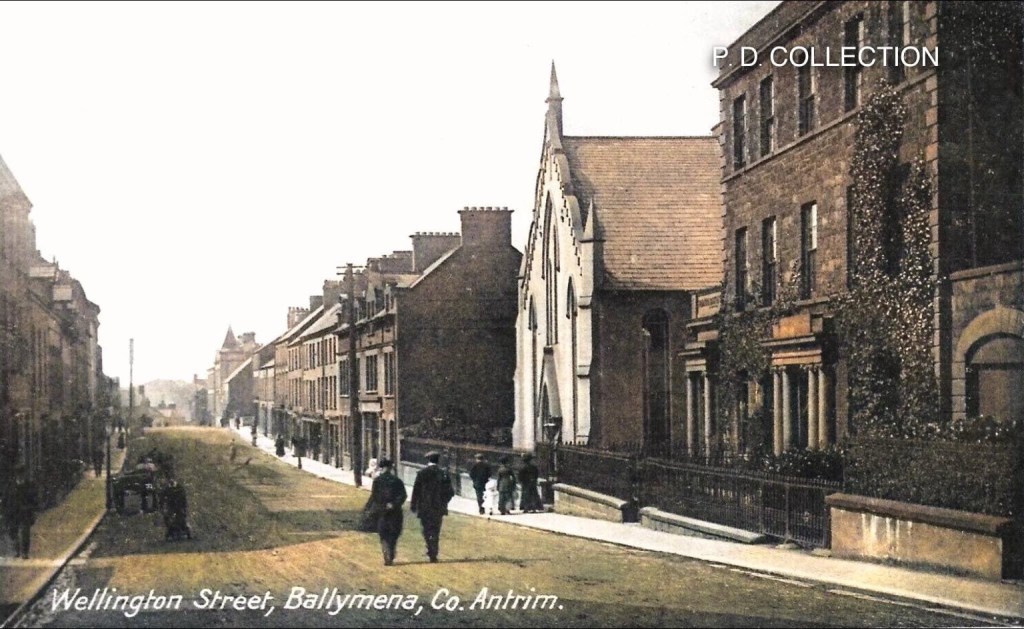
Robert and Eliza’s church, second building on the right, when they moved to Ballymena after their marriage in 1867, living a short walk away in Alexander Street.

The major expansion of all churches in Ireland and beyond during the mid 1800s was driven by zeal to rescue the general populace from sin and immorality, mainly drunkenness and promiscuity. Shame and guilt proved significant drivers of the increase in church numbers and the subsequent period of new church building. Robert and Eliza were among these new converts.

Lastly, a memory from my grandfather’s knee, where Granny often fed me buttered bread with sugar. One evening, Granda raised a finger to one nostril and blew some offending material out the other and into the wide hearth. Funny how some things stay with you.

So, what it this called? – blowing mucus, snot, down one nostril. It’s common among farmers and outdoor workers, among cyclists and runners. A male thing, perhaps? Searching in English, only slang turns up, a farmer’s blow, which seems appropriate, and a snot rocket. There’s no medical term I can find.

So far, nothing in Gaelic, but the closest might be Smuga a chaitheamh amach, (SMUH-guh uh KAH-huv uh-MOHKH ) to expel snot – a phrase my mother might well have remembered with her achievement of a Silver Fáinne medal. I’ve asked around Buncrana with one positive reply – in West Africa’s Yoruba, the word is, fumu, short and explosive, as it is.

An oil change with Martini Rosso

One summer evening when I was seventeen, around the time of my first driving test, I lifted the bonnet of our Austin 1100, my father in the kitchen at his dinner after coming in from work. I was wondering how all the parts of an engine worked after reading about it. After pouring over colourful diagrams of pistons that reciprocated so fast, of the carburettor that mixed petrol and air, and spark plugs that fired exactly on time. This complicated machine was here in our garage. I felt heat coming off the engine, that ticked as it cooled.

            What are you doing? he said coming in through the side door. It’s just had a service. No need to lift the bonnet. Leave it alone.  I didn’t try to explain, not expecting him to see my point of view, since he chastised me for listening to The Beatles. That was after John Lennon offended his religious beliefs, saying they were more popular than Jesus. My musical taste was on the wrong side of heaven’s gate and I wasn’t for turning.

After that, I had to be sneaky. Make sure he wasn’t around when I traced the wires from each spark plug, the four of them connected to the distributor cap. I unscrewed a spark plug another evening, hoping to see the gap where the spark jumped to ignite the fuel, to shine a torch into the hole in the dark cylinder. The spanner slipped, breaking the top off the plug. In a panic, I cycled round the town until I found a replacement in Fyfes. Then relieved to screw it into place, tighten it home with care, and more relieved when the engine kicked miraculously into life and settled into a steady note.

Anything technical, my father avoided like a disease. In his opinion, the simplest of repairs needed a trained man. Yet, I did a few fixes behind his back, most of the time dodging his rancour. A few years later, I went off to study engineering.

&&&

His father said Tommy would take up a trade, like each of his own generation: a coach builder, cabinet maker, shoe maker, dress maker, seamstress. They were never out of work. The country relations were labourers, but we’d left that behind.

Tommy worked the family allotment. Practical enough it seemed. Moore’s garage was looking for apprentices and he would give it a try. The Second World War was still raging with its nightly blackouts. So, why not? There was some slagging at the start but he’d had money in his pocket, that meant a lot.

But something happened in those first weeks. It wasn’t good. A big mistake? Two, maybe? On one of those flashy Humbers? More likely an Austin Ten or Morris Eight. Dropped an engine from a hoist and cracked the case? Forgot to put engine oil back after a service? It cost a fortune to fix. The slagging got worse. Hold that brush tight young fella. Ya know he washes his hands in grease. Here! Catch! The foreman put him on something else. He soon left. Embarrassed to say the least.

He tried driving for a while. Then landed a job as a bread server, with Morton and Simpson’s bakery. A Comer van out on the road all day with no one to bother him. He got on well with customers with his easy chat. His bread and cakes sold well, so he stuck with it. But so too did his fear of fixing anything mechanical.

&&&

One year into my engineering degree, I went on a summer trip around Europe with five school friends. It was a big adventure. Colin’s father gave us their car – a new Renault 12 – some said that was foolish. They had toured on the Continent and didn’t see any problems for us. It would need its first oil change at 5,000 miles. I would do it, I said, it’s straight forward.

I tasted my first Martini Rosso somewhere in the south of France. At a campsite sheltered among coastal pines. The air coming off the azure sea, a sandy heat of scented pine, dried grass and succulents. The first sip of that sweet herb-laced wine, forever carrying a promise of sophistication and camaraderie, and the sensuous Mediterranean. While the car’s cargo, our belongings, lay scattered over the backseat, on the ground and in the small tent.

The oil change came due in Luxembourg. Squeezed under the vehicle, I loosened the bung and spilled the clear oil onto the grassy campsite floor – that’s what you did then. There were a few onlookers interested in the new model Renault, and wanting to help. Then I topped up the oil, and next morning we were on our way towards Calais. Job done.

It started while I was driving. That first short squeal in lower gears. That became longer and unavoidable. I may have broken out in a sweat. It awoke the others. I kept on driving. Into a small town to stop with a long tearing screech. A Renault garage’s reply was instant – Allez! Angleterre! Allez!  Our muted talk was of getting home. No more Martini Rosso.

We squealed to a crawl for finger-waving gendarmes, crossing pedestrians, traffic lights, and at last, and worst of all, into the hollow amplifying sound-box of the Dover-bound ferry.  Every head turned towards us. And I was driving.

Then we sat for ten days in a campsite, walking Canterbury, while the Renault garage tried to figure out and fix the problem. The solution, a new gearbox, later located in Newcastle, finally arriving by train after a bank holiday weekend. The car’s gearbox had no oil. Gears were ceased. The cause of the leak was unknown. Renault would make a final decision in the coming weeks.

For hours we drove quietly northwards, took the Stranraer ferry, back to Ballymena and into the car’s space on the driveway of Colin’s house in Fisherwick Gardens. After a clean and a wash, the Renault 11 looked, and sounded, like it had never left. Never tasted Martini Rosso.

The final outcome? Nothing. I had drained the gearbox. Predictably, it ceased.  I was embarrassed, of course. Renault covered the costs. I said nothing. And qualified two years later, with a degree in aeronautical engineering. And a few years later, Colin’s father and I laughed over the story. I only wish my own father’s experience had left him as easily. That he could have told his story and laughed about it.

End

pdf version here

Tribute to Fathers Everywhere

By Adenike Anifowose

Dedicated to Jimoh Anny

The strength, unwavering love, support and endless sacrifice of a remarkable man – Father is being celebrated on the occasion of Father’s Day.

A good Father is not the kind of man that will need an applause or recognition for what he does for the Children. He didn’t put the stress on his face for everyone to see but behind every house rent, every meal on the table, every school fee, and other expenses, he was standing tall doing longer hours at work to meet up with the bills and other demands.

He set aside his own dreams for the children to achieve their own.

The spirit of hard work was imbibed from Father. He taught the meaning of hard work with great examples. He comes back each day with sore hands and tired faces but he never let this discourage him from asking how the day went or fixing whatever got spoilt in the house.

There are times we do not understand why he denied himself some life luxuries or why he wears same old clothes for years but as we grew up, we began to realise that his no-no to himself was because of a yes-yes for us.

He was our silent fan, our first protector and a great foundation. Though we didn’t hear him say the words but we know he deeply loved us.

On this occasion, we don’t just celebrate a Father, we honour a man who carried the weight of a family with quiet dignity. A man who gave everything he had, so we could have a better life.

Thank you, Fathers, for your sacrifices, your strength, and and your love. You are the reason we stand tall today. And as we celebrate you this Father’s Day, know that everything we are, and everything we hope to be, is a reflection of you.

Happy Father’s Day to all men out there.

(I met Adenike through Sanctury Runners on the weekly 5k Park Run. She lives in Buncrana, County Donegal.)