This is the first landing for my writing. The regular posts cover a variety of subjects and styles: fiction and family and social history. A few have been published elsewhere. Why the curlew or crotach? Known for its long, elegantly curved bill and its haunting call, the curlew’s call, once common on wetlands a generation ago, is now is seldom heard – like many of the subjects in this blog.
Looking through photographs and postcards for the last series of blogs, ‘Silent Soldiers’, I came across a number that are worth recording here. They are from the early 1900s and were found in the Davis farmhouse at Boggaun in County Leitrim. They appear to be keepsakes collected by my grandmother Annie Davis (nee Gillmor) and by Alex Davis, her brother-in-law who returned to his homeplace after for some years living at Corballis, Co Meath.
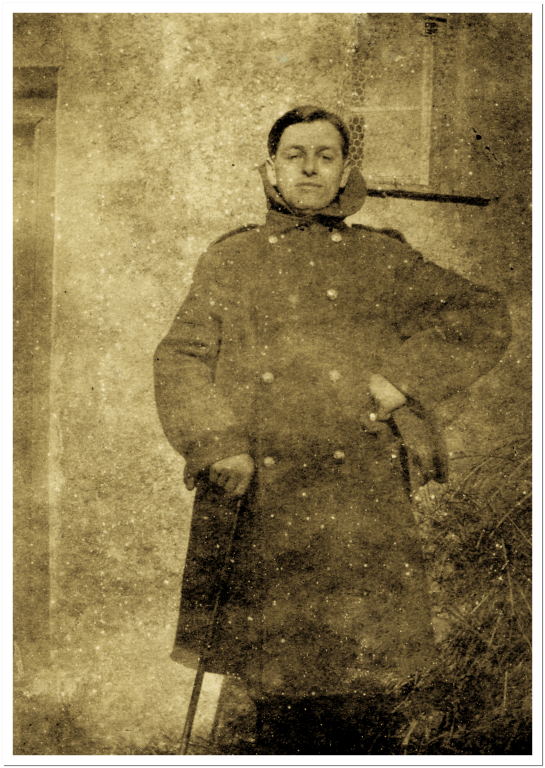
Referring to the last blog on the WW1 experience of Bertie Gillmor, the back of this photograph notes “Jack in Bertie’s Coat”. Jack was Bertie Gillmor’s younger brother, seen here posing in Bertie’s great coat, with his cap and walking cane. The photograph was taken at the rear of their home at Boihy following Bertie’s discharge from the Irish Guards in 1919.
—OO—
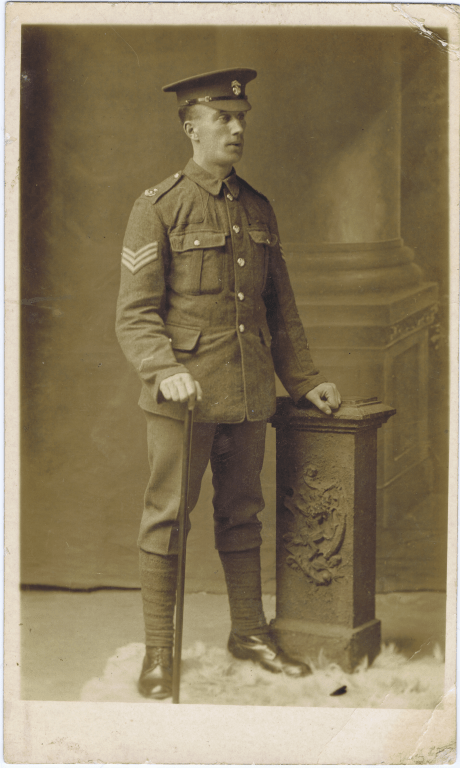
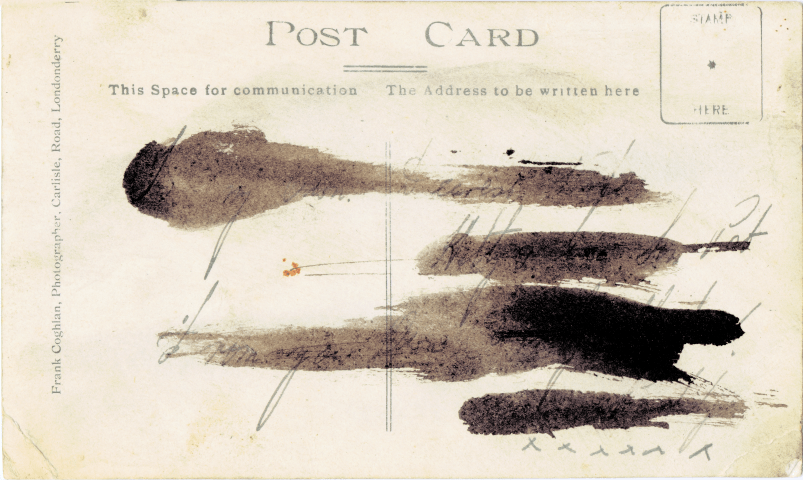
At first this striking WW1 photograph was thought to be that of Bertie Gillmor. However, following a review by volunteers at ‘the great war forum’ it appears that he was a sergeant in the Inniskilling Fusiliers. A search revealed the most likely candidate as John “Jack” Young Foster, a County Cavan relation of the wife of Alex Davis, Margaret née Cartwright. His uniform displayed badges for overseas service and marksmanship. The regiment was sent to Ebrington Barracks, Derry in 1916 after serving in Serbia, Greece and Egypt, and left again for France in December of that year. The photograph was taken by “Frank Coghlan, Carlisle Road, Londonderry”.
The poet Francis Ledwidge was also a member of this regiment and wrote many of his poems during this time in Derry. Neither man returned to Ireland. John Foster died of his wounds in France in April 1918.
Why the writing on the back has been inked out is a mystery; someone did not want it to be seen or read. The words “To my son and dearest wife Kitty and son Pat” can just about be made out.
—OO—
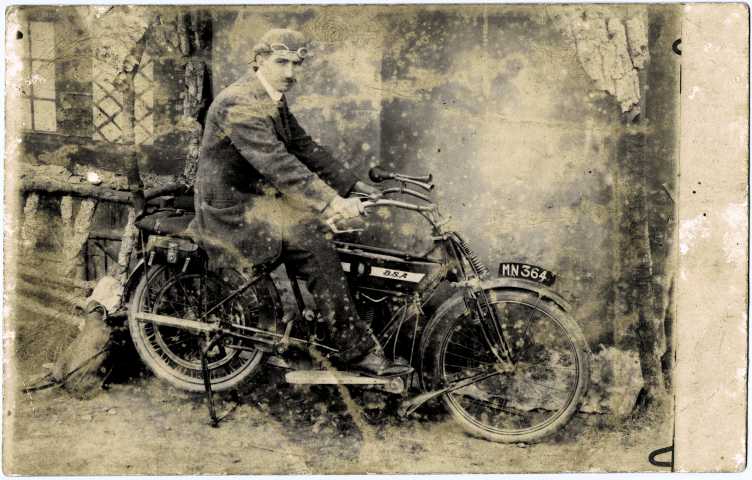
This post card was addressed to Miss Gillmour (misspelling of Gillmor), my grandmother Annie, and was probably sent by an admirer around 1910. The post mark is ‘Sligo’ but the photographer is ‘Josie Roth, The Lady Photographer’ from the Isle of Man. The motor bike has an early Isle of Man registration number.
—000—
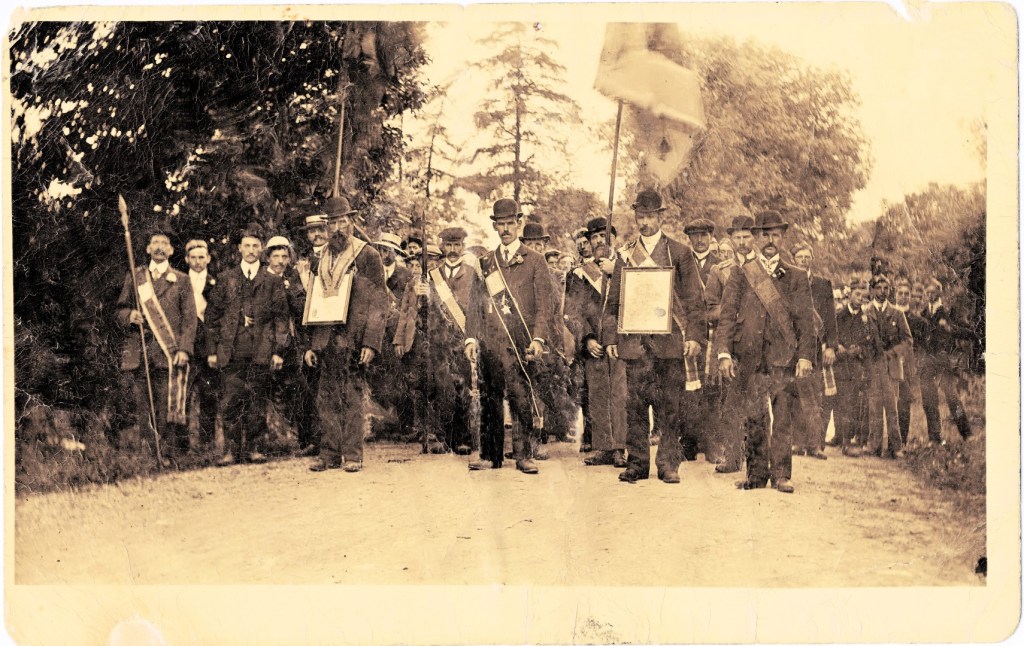
This fascinating picture postcard is of an Orange Lodge march is post marked Newtowngore, south Leitrim, 1909, a time of anti-Home Rule agitation. (Home Rule was intended to give a greater independence to Ireland within the UK but was generally not favoured by the Protestant community in Ireland.) The serious looking men with their Orange regalia are flanked by young men, some wearing pillbox hats like those of the Boy’s Brigade.
The card is signed by “W. T.”, likely to be William Taylor, and addressed to John Davis, referred to “Jas” on the card. John Davis, eldest brother of my grandfather’s generation, had moved from the Newtowngore area of south Leitrim area to Corballis, Dunore in Co Meath around 1906. William followed him and like John built a house there, marrying John’s sister-in-law Margaret Cartwright. When William died John’s brother Alex married Margaret. Living a stone’s throw apart, the Leitrim brothers had a stormy relationship which ended up in court when John sued Alex for damages caused to his prize horse.
—OO—
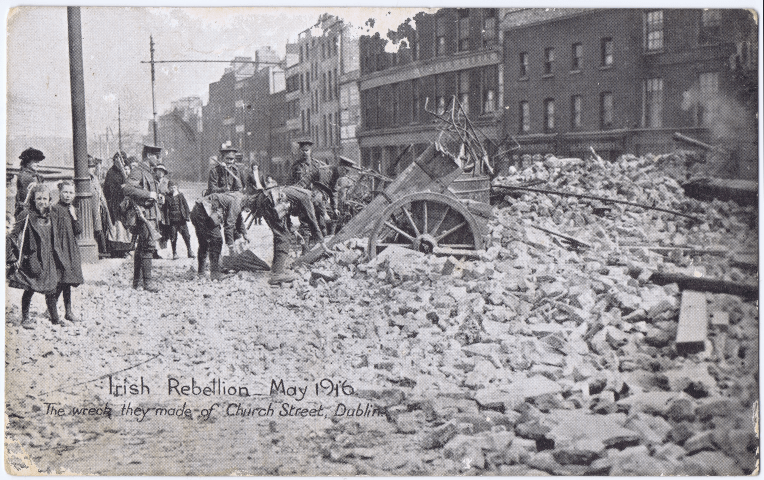
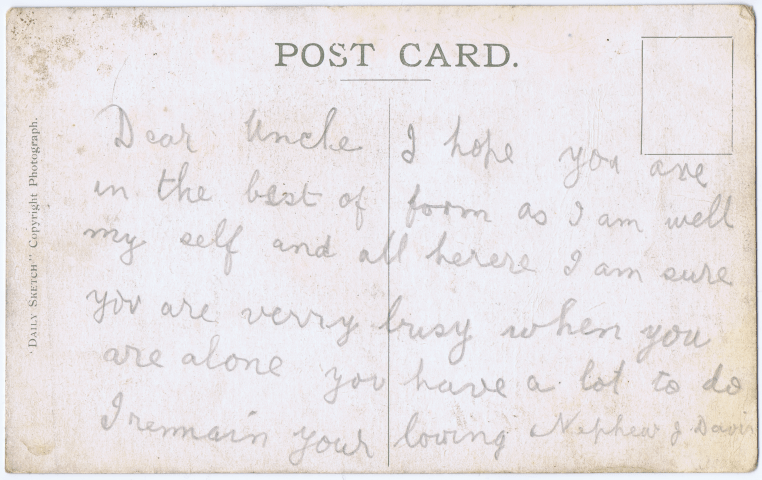
This final post card depicts the aftermath of the Easter Rising or referred to as the ‘Irish Rebellion May 1916. The wreck they made of Church Street, Dublin.’ It was written and sent by James Davis, eldest son of John and Anna Maria Davis, Corballis, Dunore, Co Meath, to his Uncle Alex who lived close by. Sometime after Margaret’s death Alex moved back to his home at Boggaun in County Leitrim and perhaps the card refers indirectly to her recent death. James emigrated to Alberta in Canada with Bertie Gillmor in the early 1920s, and settled in Daysland.
Herbert M. (Bertie) Gillmor, my grandmother’s favourite brother, survived three years with the Irish Guards during WW1. He was born at Boihy near Manorhamilton, County Leitrim in 1893. While in the trenches in France, Annie, his sister worried about him, reading the war poets and poems of that time, following the fortunes of that awful war. Later I often heard her refer to “Poor Bertie”. Hospitalised three times with significant injuries he was finally discharged from the army in August 1918 a few months before Armistice Day. Two years later, as a European settler, he was clearing virgin forest to farmland at Goodfare in northern Alberta.
A formal photograph of Private Bertie Gillmor in the uniform of the Irish Guards.
The second eldest of six surviving brothers and three sisters, Bertie volunteered to join the Irish Guards, an infantry regiment, in November 1915 at Boyle, County Roscommon. A recruitment campaign running since the start of the war was countered by Irish republican activists. In total some 150,000 Irishmen volunteered over the course of the war, and in Ireland and Great Britain combined almost one in four of the male population joined up. The story told here takes place over three years during World War One and is not an attempt to paint Bertie’s hardship and suffering; the facts speak loudly enough for us to imagine the imprint left on a young man in his early twenties.
In July 1916 after completing his training, the tall young soldier travelled by train to Southampton and then by troop ship across the channel to Harfleur, to join the Second Battalion of the Irish Guards at a large base camp near Le Havre. The third phase of the Battle of the Somme was beginning. During the first days of the Battle of Flers -Courcelette in mid-September, his regiment were ordered to attack from their trenches into heavy German machine gun fire. There were many casualties, and Bertie was wounded in his right arm. His injury was complicated by broken bones and with many other casualties he was returned to England a few days later. He spent most of following three months in a South London hospital before being discharged and returned to his regiment.
His comrades meanwhile had been at the front line of the battle, suffering great loss of life. When he joined them towards the end of the year, they had been withdrawn from the front on a rest period and would not see military action again until the following summer.
One night in April 1917 Bertie was in the company lines shaving. The wash house was dimly lit and while passing his glass to another soldier he cut himself deeply on the hand. He was taken to a field hospital and treated. However, the wound went septic, and he was soon on his way back across the channel to Warley Military Hospital at Brentwood. This time it was a short stay, and he was discharged a week later. That was not end of it however, and his superiors suspecting that the injury was self-inflicted, summoned Bertie to a Court of Enquiry the following month at Warley Barracks. Two witnesses to the incident, Private J. Maher and Private J. Crilly were also present in Brentwood, and as a result their testimony together with Bertie’s, the injury was judged to be the result of an accident, no fault of his own.
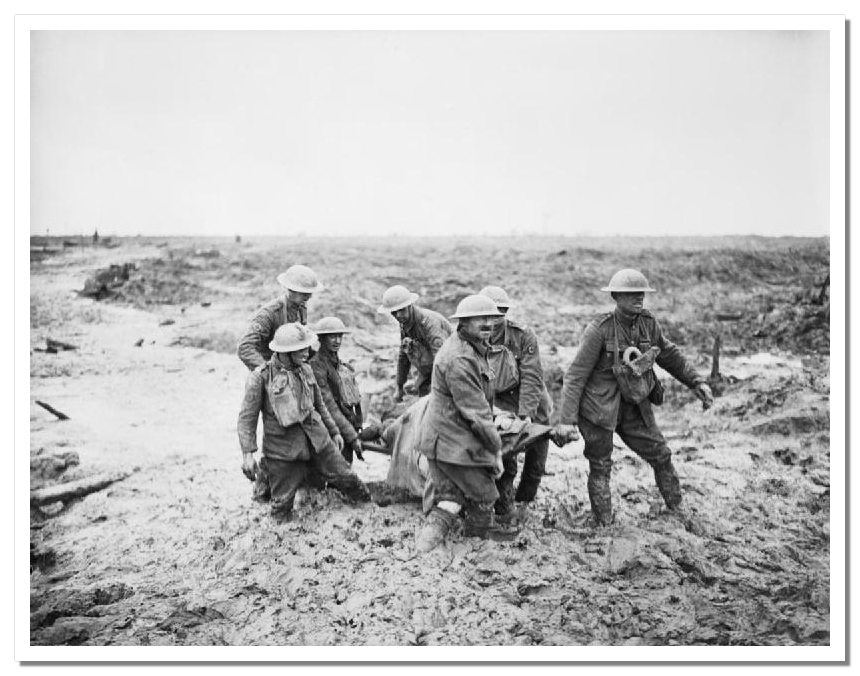
Stretcher bearers in the mud with an injured soldier at Pilcken Ridge, Ypres, Belguim, September 1917.
By the end of June 1917, he was back again with Second Battalion in northern France where they were deployed in the Battle of Pilcken Ridge near Ypres on the Western Front. He escaped this bloody period with only a minor injury. In August after being appointed Lance Corporal he was sent to Herzeele near Dunkirk for a “bombing course”; possibly his previous injuries coming to bear. The Irish Guards had seen considerable action during first half of 1917 with major losses, and from August to early December they were withdrawn from the front.
In early 1918 Bertie was in action again when was severely wounded in the back, noted on his casualty form as “shell wd back” and “g. s. w. back sev”. After spending two months in a large hospital, the converted Hotel Trianon in Le Tréport in Normandie, he was transported back from a beautiful seaside town to England for the third time. He spent a further two months in The King George Hospital at Waterloo in London from where he was discharged in May and given 10 days leave. He never crossed the Channel again.
While his battalion were involved in the hostilities up until the end of the war a few months later, and continued to suffer high casualties, Bertie he was given a “free warrant” in August 1918 at Shoreham in London and, claiming no disability, his war was over. After some months basic educational training he was demobilized from the Army Reserve in early 1919.
A photograph post card scripted “To Bertie”.
On the back of this postcard of a young woman it says: “To Bertie”. These photograph postcards were popular in the early 1900s. On this one the printed text is in French and English, as was Bertie’s formal photograph above. The handwriting shows a name, possibly “Wyma S Zeare”, the card most likely a keepsake from the young woman he met during his time in hospital by the sea at Le Tréport.
Returning to County Leitrim, the young man of twenty-five, a survivor of trench warfare, may have felt out of place, dislocated. His Protestant community were still reeling after the Easter Rising and the ongoing War of Independence, and then Sein Féin’s landslide electoral victory. A notice in Irish newspapers offering free land in Alberta, Canada to those willing put their backs into it, would again draw him far from home.
End
Notes:
The photograph of Bertie copied here is from Christine Jordan, Bertie’s niece. There is a similar, less formal one of Bertie in a collection belonging to my Grandmother which includes the young woman shown here. In this collection there are also a number from Alex Davis, who has appeared in previous blogs, including some from his wife. Many of these are interesting in themselves and will be published in upcoming blogs.
Details of Bertie’ army service, uniform and regiment details and were confirmed and sourced with the help of those volunteers at www.greatwarforum.org
William was eight years old when the first hostilities broke out between the British and the Boers in 1880 as the Scramble for Africa was underway. At the time he was walking a mile or so over the fields to a very small school near the Bonet river at Cloonaquin. There he heard stories of the ‘valiant’ efforts of the British and their soldiers to ‘civilise’ Africa. The school was funded by a local landlord, John LaTouche for his Protestant tenants.
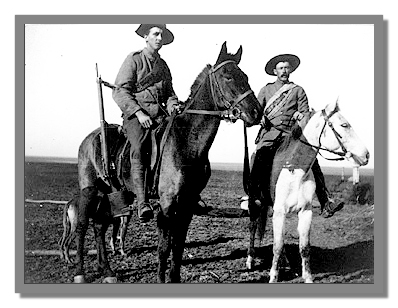
Two members of the South African Constabulary set up in 1900.
The Boers won the initial encounter setting up the South African Republic and the Orange River Colony. Almost twenty years later conflict broke out again over the same territories in what became known as “The Boer War”. This time the outcome was different, the British won, and William would play a part in the establishment of the new colonies.
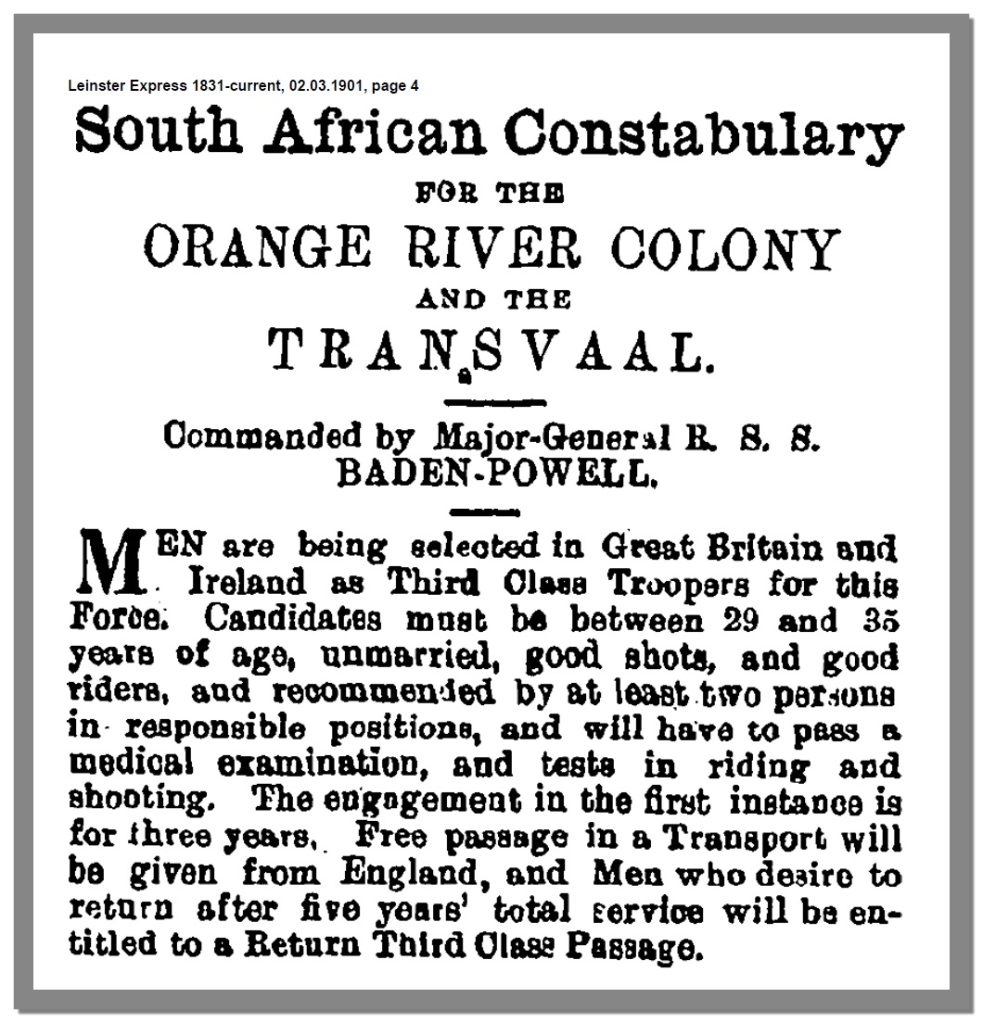
After his bothers Robert and James joined the army William spent the next fifteen years living and working on the farm at Boggaun with his father, James, his remaining brothers Alex and Richard and his sister, Mary Jane. What prompted him to leave after this time? There had been adverts in the local newspapers recruiting for the South African Constabulary (SAC) with the promise of assisted settlement for those who wished to stay after their term was over. Recruitment to Irish-based regiments had stopped at the time due to fears of rebellion in Ireland; a concern that the Irish would take an example from the defiant Boers. Given that there had been a number of difficult years with low farm incomes, coupled with the family’s unease at the Nationalist campaign for change and the growing clamour for Home Rule, perhaps William was drawn by the opportunity of a life elsewhere; as had many others before him from the Boggaun farm.
Leaving behind the love of his life, perhaps with vows already made, William set off on the long journey by train across Ireland, down through England to Southampton where the assembled recruits boarded troop ships to South Africa. The steamer had about 200 men, small by comparison to the larger and more frequent army ships, taking men, horses and heavy equipment to the southern Africa. The last batch of recruits for the South African Constabulary left England in June 1902, likely with William onboard. He arrived in Cape Town over two weeks later, the sea voyage initiating him to a new life with new friends. But he was ill-prepared for the experiences of Africa in the aftermath of the Boer War.
An advert placed in the Leinster Express in Mrach 1901.
When they landed in Cape Town the war had ended a few months earlier. The new recruits to Baden-Powell’s police force travelled for days northwards by train to the newly named Transvaal Colony. Conditions here were grim. Two years previous a “scorched earth” policy was instigated by Kitchener, a Kerry-born General, destroying food supplies, animals and crops, housing and infrastructure, and brought the various populations in the Boer colonies to their knees with starvation and desperation. Before Williams’s arrival the SAC recruits had been used as a military force to help defeat the Boer campaign of guerrilla warfare.
Concentration camps had been established by the army, one for Boers and one for Africans. While the vast majority of the Boer men were sent overseas, some 27,000 women and children died in these camps, the vast majority under sixteen. Control of the camps was removed from the army in 1901 after a humanitarian outcry and political pressure at home. Conditions improved in the Boer camps but not in those holding black Africans; however, it would be some decades before institutionalised apartheid was established.
When William began his training at their base at Modderfontein, the South African Constabulary were acting more as a regular police force operating in the conquered territories – previously the South African Republic and the Orange River Colony. There was a policy to recruit large numbers of farmers in a belief that they could better deal with the rural Boers. Historian Albert Grundlingh stated that a “considerable number of ploughmen, farm workers and other members of the rural underclasses in Britain thus found their way into the SAC.” While most of the Constabulary were British some 11% were Irish with others recruited from far flung colonies of the Empire. As a police force, their task was challenging “Mostly unfamiliar with the customs of the country and unable to speak Dutch, they had to manage the subjugated and ill-disposed Boers, many of whom had lost homes and possessions in the war, and who spoke only Dutch.”
William’s post card to his brother Alex in 1925 on his return voyage to South Africa.
William returned home to Ireland in 1907 after completing his term, and married Elizabeth Ellen Henry from Derrynoveagh, a small townland about a mile from the Davis farm. The Henry family had a shop there, near the present day Manorhamilton GAA pitch, and traded in various agricultural goods at a time when these townlands had significant populations. William’s youngest brother, Richard, my grandfather, was a witness at their wedding in Manorhamilton Parish Church. The couple returned to South Africa shortly afterwards intending to settle there. It is likely that he availed of a return passage at the end of his term in the Constabulary.
The SAC disbanded by 1908 with many joining the Transvaal and Orange River Colony Police. William was in Ireland again during 1924 and was on his way home by ship in February 1925, according to a post card to his brother (Aleck) Alex. There is no record of any subsequent contact over the intervening years.
Among the many Irish men who fought in colonial campaigns in Southern Africa was Belfast-born James Craig who became the first Prime Minister of Northern Ireland. Bertie Gillmor, my Grand Uncle, joined the Irish Guards in 1915 (see the next and previous blogs). The Irish Guards were established by Queen Victoria in 1900 to commemorate the Irish contribution to The Boer War, ironically the regiment recruited many more Irish men who would perish in World War One.
End
Notes
William Davis was born at Boggaun, County Leitrim 1872 and died in Pretoria 1950.
Text on back of post card addressed to Mr and Mrs Aleck Davis, Corballis, Donore, Drogheda, Meath Ireland: Dear Bro and Sister. On board ship on opposite side moving towards Canary Islands which we are due to reach tomorrow morning. Having pleasant voyage and weather. Had very cold snow storm on leaving England on Friday morn. Crossed the Bay of Biscay without mishap. Hope all are well. From Wm 30 Feb? 25
“Poor South Africa! Will no nice English people ever come out here?”—The South African Constabulary of the Second South African War, by Johan Fourie, Albert Grundlingh and Martine Mariotti. Stellenbosch Economic Working Papers: 04/15. An informative paper on the SAC, Pdf copy here
James Davis joined the Army in 1885. Searches of the military archives throws up no record of him. It is likely that he enlisted in the Royal Artillery in Derry, as did his younger brother the following year.
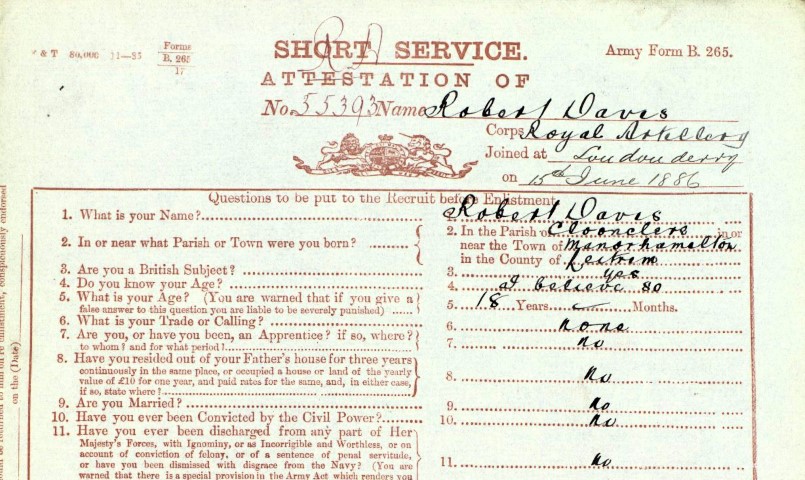
Robert Davis attestation form.
James appears to have been discharged a few years later after he developed tumours on his knee. He died at the young age of 26, in the winter of 1894 in the new farmhouse at Boggaun, having suffered from bone cancer for a number of years. My Grandfather, Richard was only three or four years of age when the brothers enlisted and had little recollection of them. James is buried in Manorhamilton Parish Church.
Robert signed up to the Royal Artillery in Derry a year after his brother. Elward Burnside recorded my grandfather, Richard’s recollections of Robert as “on police force, twice married, died County Sligo”. A little research shows that although he died relatively young at 47, his life was considerably more tortuous than these few brief words suggest; in fact, his colourful life may in have led to the rather abridged recollection of him.
When the brothers enlisted the rural economy was shrinking with a general collapse in farm prices, and their large family would have been under some considerable stress. Looking through police recruitment records for their Uncle, Thomas Davis, who joined the Dublin Metropolitan Police thirty years earlier, it is interesting to see the number of men from surrounding townlands who were recruited at the same time, neighbours among them. It is likely that there was a similar pattern when the brothers signed up.
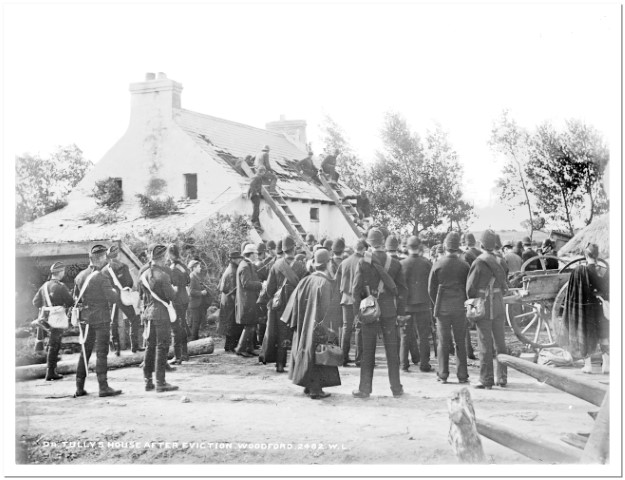
As part of their training, the brothers would have gone on long route marches, their presence an attempt to control the ‘lawless countryside’ eager for land reform. Evictions in Ireland remained high throughout the 1880s, running as some three and half thousand per year, until land reform legislation was enacted towards the end of the decade. These evictions saw the army and police back up the landlords and their bailiffs in what the Nationalists saw as an ‘unholy trinity’.
Eviction at the house of land activist ‘Dr’ Tully 1916.
For whatever reason Robert did not remain in the army for his twelve-year enlistment and after three years moved to the police force, the Royal Irish Constabulary (RIC). His RIC’s service records show that he was posted to Longford in 1889, Belfast 1890, Cavan 1901 and Armagh 1905, from where he retired as ‘medically unfit’ with TB in 1911 at the age of 42. These probably indicate administrative regions as the constable was stationed in Castleblaney barracks in December 1900 when he married Mary Draffin.
Mary, a Presbyterian, was born in the Castleblaney workhouse where her father, Samuel was the Master. On the night of the 1901 census Mary records herself as being ‘head of the family’, and a ‘married farmer’ living at Corfad near Ballybay; her husband was probably stationed in Castleblaney barracks that night. At that time, she had a large, thatched cottage with many outhouses suggesting a sizable farm. Mary died suddenly of a heart attack in 1904. It appears that the farm was not left to Robert.
Robert remarried in 1906 in Lurgan. His second bride was Anna Maria McTernan from County Sligo, suggesting he kept up regular contact to the north west of the country. Anna Maria was Roman Catholic. They were married in the Church of Ireland parish church in Lurgan. When he was discharged from the police, they retired to Easkey in County Sligo where he farmed on his wife’s family lands until his early death from TB in 1915. There were no children.
Robert is buried in Manorhamilton Parish church. Anna Maria died in 1922 and she willed her estate for the repair of her local Roman Catholic churches and for ‘masses to be celebrated for the repose of the souls of the said deceased, her husband, parents, brothers and sisters’. She is buried in County Sligo.
Over the course of researching these blogs I have discovered that four of my great uncles joined the British Army in the late 1800s and early 1900s. There was never any mention of them in the family, nor of their actions during tenant evictions, Empire building and World War One. In the first of four blogs I will endeavour to sketch out the social and political circumstances of their times. All were born near Manorhamilton in north County Leitrim.
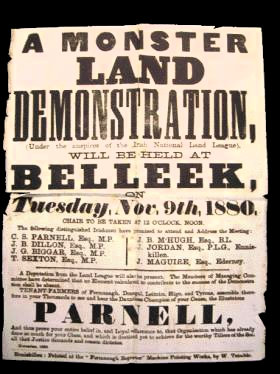
Land League poster 1880, speakers include at least two from a Protestant background.
My grandfather Richard Davis is recorded saying that his older brother James joined the army in 1885. Another brother, Robert signed up with the Royal Artillery the following year and their younger brother William enlisted in the South African Constabulary in 1902. My grandmother’s brother Bertie Gillmor, who has appeared elsewhere in these blogs, signed up with the British Army in 1915, taking part in the Battle of the Somme the following year.
This was a period of great upheaval and change would have clearly influenced the course of the Davis family at Boggaun. With the Famine and the ensuing evictions – which all but saw the disappearance of the landless class, the labourers on small tenant farms – came a greater demand for land reform. Many vacant farms were taken up by existing landlords to graze stock, further increasing land inequality. The Land League was established, following the outbreak of The Land War in County Mayo in April 1879, to coordinate and progress agrarian agitation and reform. Two years later it was suppressed by the government but re-formed under a different name with Charles Stewart Parnell at its head. Effectively the land war continued with the additional focus on the attainment of Irish Home Rule.
Conflict with landlords, many absentees, increased and with it, rural violence and crime. For the most part allegiances fell as you would expect; Protestants supporting the status quo and the link with England – although initially Protestant small-farmers had supported agitation for a great access to land – and Catholics supporting land and political reform championed by Parnell’s party. As the century turned political resistance hardened and fermented into the Easter Rising, the War of Independence and eventually Irish Independence in 1921.
During this time tensions were high in rural Ireland peaking in 1881 and 1886 when agricultural prices collapsed, and evictions increased. Local crimes, which were not supported by the Land League, were for the most part confined to the writing of threatening letters but best known were the boycotts of Landlords and ‘land grabbers’. These had started in a campaign ostracising the County Mayo land agent Captain Boycott in 1880. Throughout the period tenant evictions enforced by the Landlords were supported the police and the army, further convincing the bulk of the population that the government was intent on repression not reform. The Land League were particularly active in the west and north west and campaigned against police (Royal Irish Constabulary) and army recruitment.
The Land League branch in the parish of Killanummery, next to Boggaun, was the subject of a letter to the Sligo Champion in January 1881 reporting that the new branch had brought enough pressure to bear on local landlords that the majority reduced rents to tenants by fifty percent, and in some cases all arrears were written off. It is likely that rents at the Davis farm were reduced at the same time. When James joined up in 1885, there were eight siblings living on the small farm with their parents; my grandfather Richard was the youngest at three years of age, William was thirteen, Alex sixteen, Robert seventeen, James eighteen, Thomas twenty, Mary Jane twenty-one and John twenty four. With agricultural prices beginning a catastrophic fall, the older boys had few prospects for their futures.
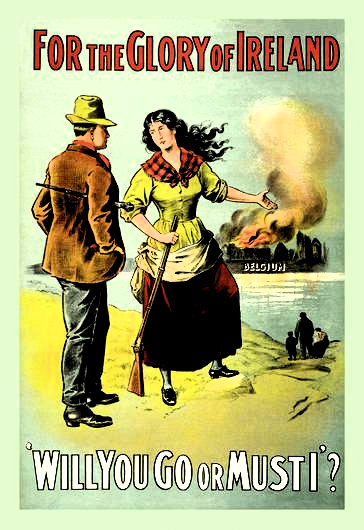
World War One recruiting poster.
Ten years later in 1895 John, the eldest brother, was married and living in South Leitrim. With his Manorhamilton friend, John McCordick they were boycotted as ‘land grabbers’ having moved onto evicted farms near Garadice lake. Whether related on not, John appeared to fall out with his parents around this time. RIC records of the time show details of the boycott against John and his family. The case was mentioned in the press and in the House of Parliament in Westminster, to highlight the mess of the Irish land policy and evictions, and exemplifying McCordick, suggesting he was fraudulently trying to avail of an evicted farms relief scheme which was operating at the time.
The next blog will focus on James and Robert Davis.
End
Note
‘The Land League’ here refers to the ‘The Irish National Land League’ established in 1880 and, following its suppression, ‘The Irish National League’ established to take its place in 1882.
Maggie Long worked in Gillmor’s shop in Dromahair at the same time as my mother, Ena, during the late 1940s. She was originally from Ballybofey, in County Donegal and had worked in the household of Lofty Bothwell in Fermanagh before coming to Dromahair to work there as a servant. This song tells of her courting by John “Sonny” McCauley, and of the humorous impact of the bicycle on romance during the 1940s.
Maggie Long on her wedding day June 1951.
I’ve changed the name in one line to ‘We’ll hire Wally Davis and his new taxi car.’ which was a line remembered by one of my cousins from a song heard on a visit to Manorhamilton with their father Wallace Davis in the 1960s. It was most likely sung in a version of this song.
In the song, John McCauley’s estimate of Maggie’s age as being ‘around thirty’, was somewhat amiss. Years later when Maggie received her first pension and Johnny discovered her real age, she turned out to be considerably older than him. Shocked, and rather than continue to live with the shame of it in Creevelea, Sonny up sticks and they moved north to Ballybofey, where they lived out the rest of their days, being known as a “couple of characters”.
John and Maggie on their wedding day June 1951.
The Courtin’ of Maggie Long

My name’s John McCauley, I'm from Creevelea.
I’m courtin a girl from Ballybofey.
She’s aged around thirty, she’s both handsome and strong,
And her name now I’ll mention, she’s one Maggie Long.

To tell you the truth it was love at first sight,
And I dream of her always by day and by night.
I’ll never be happy ’til I see the day
That I’m married to Maggie from Ballybofey.

I met her in Newbridge out there at a dance.
Her attractive appearance I saw at a glance.
When a foxtrot was called, we were soon on the floor.
For dancing her equal I ne’er saw before.

I immediately asked her if I’d see her home.
She said ‘Right you be for I’m out on my own.’
I said ‘Get your coat now and we’ll make no delay
For its a long way from here to Ballybofey’.

She put on her coat and we stood near the door.
She says ‘Have you ever been down there before?
For in case that you haven’t we might go astray
So I’ll mention some towns we’ll pass through on the way.’

‘We’ll first have refreshments in Drumkerin town.
From there to Manorhamilton we won’t find going down.
Kinlough and Bundoran we’ll pass through them all
And next to Ballyshannon in old Donegal.’

From there to Ballintra is ten miles or so,
Then Donegal Town, not too far more to go,
Across Barnesmore Gap and we’re most of the way
And the next town we’ll meet will be Ballybofey.’

Now I looked at my bike and the back wheel was flat.
Says I ‘I’m not game for a journey like that.
The night is so bad and the journey so far
Sure we'll hire Mat Roddin. He has a new car.’
(or We’ll hire Wally Davis and his new taxi car.)

Says she ‘If you like sure we needn’t go down?
Cause I’m working in Gillmor’s in Dromahair town.’
So I pumped up my bike and it ran fairly free
And we soon pulled in at the Hotel, Abbey.

We spent a full hour there and we both ate our fill.
Then we took a stroll down by the sawmill
And ’twas there by the road in a shed full of hay
That I first courted Maggie from Ballybofey.
ENDS
Notes
The author of the song is unknown. The words are recorded by Padraig Fitzpatrick. Photographs and further information on the couple are from John Long.
This piece would have served better as an introduction to the series on the young lives of my mother, Ena Davis, and her siblings, starting out on their independent lives, rather than occurring, as it does, at the end. Following this will be a short piece based on a song which humorously reflects life during this period.
Reco,Ena, Jack and Cecil c 1948.
Ena and her siblings were looking to their futures; their world was opening up. The 1930s and 1940s brought the bicycle, bus, car and taxi to rural Ireland expanding horizons beyond local townlands and parishes. The gramophone, cinema and the wireless brought new experiences in music, pictures and news. These young people were eager to get out there into these new times.
However, the period was seen by the clergy and many national leaders as a time of moral decline and increasing depravity in the general population. The rise in nationalist fervour across Europe, coupled with the Gaelic cultural revival and a religious zeal drove efforts to stop the rot in Ireland. External cultural influences were seen to be the root cause; the very things that fascinated young people at that time, jazz and modern dancing. The inherent racism of the Nationalistic era was obvious in the claim that jazz music, and the ‘suggestive and demoralising’ dancing it inspired, was a black, pagan influence, ‘borrowed from the language of the savages of Africa.’ and foisted on pure Gaelic culture.
On New Year’s Day 1934 Fr. Conefrey and a group of parishioners marched down Main Street in Mohill, County Leitrim at the start of what was labelled as The Anti Jazz Movement. While the movement quickly ran out of steam, unlike jazz itself, the wheels of opposition were turning and the upshot was the Dance Hall Act of 1935, licensing all public dances through the district courts.
There was another pressure that would see an attempt to stop the young Davis family from taking part in these new recreations, and to row back the coming jazz era in Protestant communities.
If debates about the self-governing Home Rule bills had put the wind up Protestant families in Ireland, the Ne Temere decree by the Catholic church of 1908, brought the first winds of a hurricane. Ne Temere required that all children of a mixed marriage be brought up as Catholic. This was generally supported by the Irish State and legal system. Protestant families in a minority community felt it would be their end; numbers would decline, lands would be lost. The infamous case, which made international news, of a young couple Agnes (Presbyterian) and Alexander McCann (Catholic) in Belfast, just after the introduction of Ne Temere, confirmed suspicions when Alexander ran off with their two children, after Agnes refused to be “properly” married under the terms of the new decree. She never saw her children again.
So, Protestant communities circled the wagons. The message was simple, marry your own. Anyone marrying outside the community brought shame to themselves and their families and were frequently ostracized. The impact of the decree was felt for decades to come. The whisperings heard in my grandparent’s kitchen were likely to be about these impacts; who had left the fold, what farms that passed to the other side, and indeed stories about their son and brother – my Uncle Wallace – who had been banished from the family for marrying Rita, a Catholic.
Jack, Cousin Corrie and Reco c 1945.
So how did this small community encourage boy-girl contacts that might end in straightforward Protestant marriages. While some marriages were arranged this practice was dying out. More important were the local socials, Protestant only socials. They took place in church, school and orange halls of the district. Organised by the older men of the community, they who would sometimes have to evict the odd Catholic lad who managed to get in, although some were ‘deemed suitable’. Catholic socials, which were larger and open to all, had an illicit attraction.
The socials were simple affairs with dancing to a small band, servings of tea and buns – non-alcoholic like all such events of the time – and with the appropriate mix of young people including the young Davises. The band played traditional tunes for set dances and games such as ‘The Waves of Tory’ and ‘The Farmer Gets a Wife’ but also more popular music being played on the new Radio Luxembourg. Unlike the Catholic socials and dances they were not held on a Sunday, at a time when strict Sabbath day observance was the norm. Reco and Cecil, the eldest, cycled miles to socials in Lurganboy, Dromahair, Carrigeencor, and Manorhamilton and back, while Ena’s social life was under the watchful eye of her cousin’s family in the Dromahair shop. Phyllis, Alf and Wallace would join them as travel became easier.
After the introduction of the Dance Hall Act, local Garda enforcement was often accompaniment by a Parish priest. There was a sudden growth of parochial halls while many simple structures appeared on the edges of towns and villages, built by entrepreneurs seeing an opportunity. Typical of the time was Glenfarne’s corrugated-iron “Nissen Hut” – of WW1 army design – built in 1934. It would later become The Rainbow Ballroom, and better known as the Ballroom of Romance in its heyday in the 1950s and 1960s. Initially Reco, Cecil and Ena, the older siblings of the Larkfield family, were forbidden from attending these Sunday evening dances. While their friends dressed up for a night out, a frustrated Reco and Cecil would cross two fields to their neighbours, old James and Maggie Maguire, and spent each Sunday evening with them in their small corrugated-iron three roomed home.
Ironically, the Dance Hall Act put an end to many traditional music activities in houses and at crossroad, forcing them into a controlled and commercialized environment. Thus, the ceilidh – large musical ensembles in big wide-open spaces – was born at the expense of the older traditional culture. As the crowds at the dance halls continued to grow so did the number of dance bands playing around the island.
Tess McManus and Jack Davis at Tess’ sister Bridie’s wedding 1963.
Phyllis trained as a nurse in Belfast and was independent earlier than her other siblings. The first in the family to own a car, she had enjoyed the fun and excitement of nights out around the City. On her regular visits home, she was instrumental in overcoming her mother’s resistance to Sunday entertainment. Her father Richard was more broad-minded, encouraging Phyllis and a car-load of passengers, to make their first Sunday-night trip to the cinema in Manorhamilton. In Belfast Phyllis had heard Omagh’s showband, The Melody Aces and when they headlined in The Rainbow Ballroom in Glenfarne, she took off with Cecil to dance the night away. The Rainbow was now attracting large crowds and was full of friends and neighbours, with others from Fermanagh, Leitrim and Cavan, arriving by all means of transport. The Melody Aces would play to packed crowds at The Rainbow Ballroom for many years to come. Phyllis drove home, her car packed. One of the car’s occupants that night was Padraig Fitzpartick, a good friend and neighbour of the Davis family. Padraig would meet his wife Bridget at the same Ballroom of Romance over a decade later. A song from this era, often sung by Padraig, “The Courting of Maggie Long” is presented in the next blog.
END
Notes
The Anti Jazz Movement and The Dance Hall Act 1935:
‘Different and the Same: A folk history of Protestants in Independent Ireland’, Dierdre Nuttall. This works explores the folklore, traditions and narratives of the Protestant minority in the Republic of Ireland. With the support of the National Folklore Collection, Deirdre Nuttall investigates the cultural, rather than simply faith-based, aspects of the group, incorporating folk history, custom and belief and identity. A unique work including memories of socials, gatherings and dances.
The second and final part of Ena’s move from her home in County Leitrim to Bellaghy and then finally to County Antrim where she settled in Ballymena.
Ena, right, with friend Issie in Magherafelt c 1949.
The shop on the corner of Main street and Mullaghboy Road in Bellaghy had recently transferred to Jim Hutchinson from his wife’s family, Vance. Jim’s brother Tom would shortly leave the town and set up Tayto Crisps in County Armagh. It was a busier town than Dromahair and the shop and yard bore a strong resemblance to Gillmor’s. At the time Wallace, Ena’s brother was working on a farm in Co Antrim, and her sister Phyllis was coming to the end of her nurse training in Belfast, and they all met up often.
Bellaghy in County Derry was a very different place to her home in County Leitrim where the tensions of the War of Independence had eased, or at least had been buried, and the new Irish Free State was to a large degree stable. The Irish Government had decided to make a complete constitutional break from the UK Comonwealth, finally enacted in April 1949 when The Republic of Ireland came into being. This further encouraged any southern Unionists sitting in the fence to reconsider emigration and it also heightened fears of abandonment among northern Unionists. The UK attempted to allay these fears guaranteeing Northern Ireland’s position in the UK until a majority voted otherwise and by the visit to Belfast of their Princess Elizabeth, soon to be Queen. But discontent was steadily building and in the early 1950s the IRA began its Border Campaign. Mid Ulster was not adrift from these tensions.
Tommy McWilliams was a daily visitor to Hutchinson’s shop delivering fresh bread and cakes. He worked for Morton and Simpson, a Ballymena bakery and confectionery, and quickly struck up a rapport with Ena over the counter. As well as her good looks, perhaps he was taken by her exotic southern brogue, of which he had some experience when lay-preaching in Co Cork a few years earlier. He courted her, suggesting she write to her Sligo boyfriend and give him the bad news. As the relationship grew, he visited Ena’s home where his humour and northern swagger left an impression. It also helped that he was familiar with the ways of farming life, gleaned from the many rural families and farms he visited on his delivery run.
Ena and Tommy at Lough Gill, Co Sligo c 1950.
Ena and Tommy were married in Manorhamilton Parish Church in July 1950. On the morning of the wedding, as was the local custom, John McPartland, a good friend of Ena’s father, arrived at the bottom of the lane to discharge a few gun shots in celebration. Tommy’s father and mother, sisters and cousins attended the wedding and reception in Sligo, and it is likely that the day was full of surprise for them given their strong religious-based abstinence of alcohol and tobacco. Shortly afterwards Ena moved to Ballymena.
Ballymena was a large town, predominantly Protestant and mainly Presbyterian, Tommy’s family church. The accents were different to Ena’s and the unfamiliar religious norms and expectations would have been difficult to fathom. Church attendance and sabbath observance were noted in the community, as was testimony of religious practice and personal salvation. It was a long way from the more liberal attitudes of Ena’s Church of Ireland, which was regarded by many Ballymena Presbyterians as a church tending towards Roman Catholic practices. You could be forgiven for thinking that with her accent, she may have easily been taken for ‘the other side.’ For years she sought to change our regular use of the Braid’s Valley’s broad affirmative ‘Aye’ to ‘Yes’.
While none of Ena’s family had been active Orangemen for at least two generations, Tommy’s father was a member of his local Lodge and as a young man had been jailed for defying a marching ban. In Manorhamilton the two communities worked together and mixed easily, albeit that the minority Protestant community needed their Catholic neighbours more than the other way round. In Ballymena there was effective segregation, which was culturally, religiously and politically sanctioned.
Ena with children, Ivor, Nigel and Elaine playing to the camera at Portrush c 1968.
Ena had just over a year to adjust before her first child was born in the Cottage Hospital and the coming years would be dominated by child rearing and housekeeping. With her gregarious nature, whether in the hospital or at home, she would take the first step and introduce herself to neighbours, often becoming their lifelong friend. And likewise, in her eighties, living in Portrush after the death of her husband, Tommy she showed great resilience building up another circle of friends.
Tommy did not involve himself with childcare or housework and his time off was largely taken up by his role of Church Elder – a religious counsellor. To some degree this insulated Ena from the strictures of their church – the redemption of women’s souls could wait a while, until their maternal duties eased. When we got older, she became involved in the Church’s women’s group.
From the outset of their marriage Ena maintained a close connection to her family and home in County Leitrim. A pattern of three and four annual visits quickly became established and soon we were drawn into the life of her family at the Larkfield farm.
In Ballymena Ena’s skills, learned from her mother, were at the core of our household. Jam making and cooking, knitting and bargain hunting – for thrift rather than fashion or flavour. And always “ask for discount” she advised; sometimes to our embarrassment as a simple purchase would get complicated and drawn out. She frowned on the attitudes of her in-laws who tended to “spend it when you have it” while she was saving to fund some plan or other, be that their first mortgage or later a small business venture.
Her family had for generations a drive to better their lot, to advance through some scheme or other, and Ena was no different. She perceived this attitude in contrast to what she saw in her husband and his family, with little appetite for change or risk. So as her family grew, she wanted more; be that a few hundred laying hens, a part time job, a small business, or to go back to study; only the latter of which she never achieved.
When Ena and Tommy retired it was to a farm, recently purchased by my brother Nigel near Dromahair, a few miles from Ena’s Boggaun home. Their first task, with little experience, was to manage the renovation of the old farmhouse, where the cattle had taken up residence the previous winter. They lived there for over 20 years, amongst good neighbours and a wide group of friends.
Ena and her husband Tommy are buried in the graveyard at Dromahair Parish Church in Co Leitrim.
This is the last in the series of stories focused on my mother, Ena, and her siblings as they grew up and left home. Ena Davis first worked in Gillmor’s shop in Dromahair, then in Hutchinson’s shop in Bellaghy in County Derry, before marrying Tommy McWilliams and settling in Ballymena. The story is in two parts. At the end of Part 2 there are links to other of Ena’s stories.
Ena, centre, with a friend in Gillmor’s Yard, Dromahair, c 1946.
Ena left Masterson National School in Manorhamilton at thirteen in 1937, having previously gone with her siblings to Mullaghduff National School, a short walk from their farm. Leaving Masterson’s five of her siblings were between the ages of five and twelve and her labours were needed at home, where the family still struggled with its financial debt. She was keenly aware of their straits, and the measures demanded by their mother, Annie, to keep the family afloat. Their frugal self-reliant lifestyle left its imprint on Ena and all her siblings. Extremely limited household cash, homemade clothes and bed linen, all belied the outward prosperous look of the large two-storey slated house.
Had secondary school been an option – The Manorhamilton Tech had not opened at that time – she would have chosen to go but it is likely the needs of her family would have prevailed. Her school achievements at Masterson’s, particularly in Irish and her contributions to The Schools Collection, a 1937 folklore collection, attest to her diligence and love of learning.
In the early 1940s her family found a position for her in Gillmor’s shop in the small village of Dromahair, owned by a cousin of her mother. Stuart J. Gillmor’s was a general store which had been running in the village since the 1700s, supplying household, farm and hardware goods. The building, the shop and house, fronted the main street. From the Back Lane there was an entrance into a fine yard bounded by attractive stone buildings; housing a bakery, numerous store rooms and staff living quarters overhead.
Gillmor’s Yard, as it was called, was often packed with donkey and horse-drawn carts, the smell of fresh bread had drifted over the awakening village for decades. Ena lived in and cycled home the six miles each weekend. With her experience at home, she was often called upon to look after the young Gillmor children, providing a welcome change to her duties in the shop and yard. Wednesday, her regular half-day off was anticipated by excited children along her route, particularly by the pupils at her old Mullaghduff school as she passed out treats from her deep pockets.
These years were packed with new experiences and responsibilities; at Gillmor’s a serious attitude to work was expected. While she knew many around the area, she made new friends among the staff sharing and supporting some in unexpected challenges and grief. With girlfriends she went to socials and dances, and in summer to nearby agricultural shows.
Wallace, Ena’s brother, with friends in Magherafelt, 12th July c 1949, likely taken by Ena.
The late 1940s in The Irish Free State did not signpost a rosy future. The disastrous consequences to the Irish economy of the 1930s Economic War with the UK resulted in high tariffs on agricultural exports with farming going into an irreversible decline. The loss of rural employment with nothing to replace it forced a mass exodus of young people, most leaving for the UK. The numbers grew through the 1940s and 1950s. Large swathes of Ireland, particularly in the west, emptied, leaving numerous abandoned homesteads.
Many of Ena’s family, friends and contemporaries left for the large cities of England and further afield, while there were those, mainly from the Protestant community, who felt their prospects were as good in Northern Ireland. In 1948 Ena and her friend Izzie, both working at the Dromahair shop, moved to Hutchinson’s shop in Bellaghy, Co Derry where their families had found work and accommodation for them.
“Ena’s going now.” Her father Richard said, his neighbour noting the undertone of loss at the imminent departure of one of his favourite children.
In this story Reco and Cecil make a trip to Sligo on a horse and cart in wintertime. Reco is twenty-two years old and Cecil is nineteen.Whatever your means of travel it is some 16 miles from Boggaun to Sligo, avoiding steep hills, and the return is shorter by 3 miles if you take the route over Benbo Mountain.
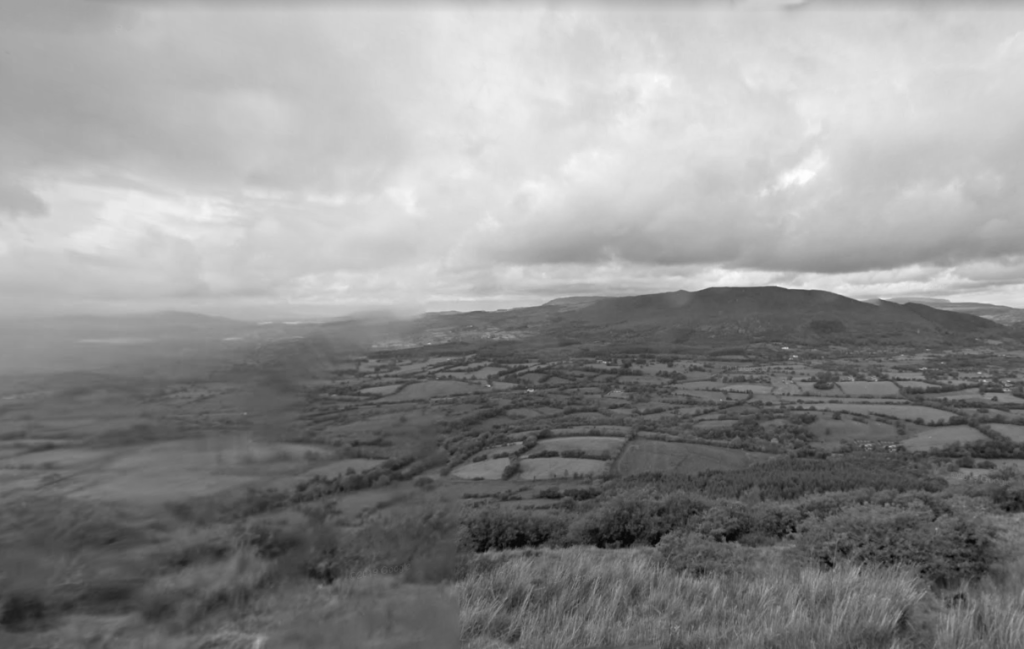
A shower passes over Benbo Mountain, seen from O’Donnell’s Rock. Image from Google maps.
Their Mother Annie sees them off to the bog.
“After days of rain, it finally stopped. Before lunchtime Reco and Cecil set off to the bog on two empty carts, the horses well fed. I made them up a basket with eggs, bread and bottles of tea. They would need it when they got to the top of O’Donnell’s Rock. There’s be no shelter up there, a cold wind always blows, worse in November. Maybe they’ll hunker down behind the turf stacks for a while. I was up there once, in the summer but it was enough, I’ll happily leave it to the men. It’ll be after dark when they get back, there’s not much daylight now. And tomorrow they’ll have a longer and harder day, if they can get through the floods.”
Their Father Richard sends them to Sligo Town.
“There’s a powerful price to be got for turf, what with the curse-ed Germans sinking all the coal boats. Arragh, we should’ve gone into the war with England, this neutral thing’s a cod, we’ll pay for it yet, mind my words. I bought extra turbary up on O’Donnell’s Rock these last few years, it’s paying black gold now. Reco and Cecil are taking two load to Sligo tomorrow morning and we might get another two off next week if the weather holds. It will be a long day for them, but they are young, there’ll be no loss on them. The radio forecast says it’s to stay dry and I’ve arranged for their cousin to meet them in the town and make sure all is well. Anyways, I had harder in my day.”
A neighbour meets them on a flooded Sox Line.
“I met the two boys coming out of the Bonet flood water on Sox Line. I was coming home from Dromahair with a bag of flour on the bar of the bike. They were taking the long road to Sligo, on account of the full carts. Cecil looked soaked and miserable. Apparently, he was leading the horse through the flood, couldn’t see the edge of the road and fell into a pool of water. Must’ve have come up over the top of his head by the look him. His over coat was hung on the cart, dripping and he was shaking the water off him like a drowned dog. Reco and himself wrung out the big coat. No heat in the day either. I told him to come to the house dry off, but he would hear nothing of it.
‘I’ll take a sup of the warm tea, and if I’m still cold I’ll call into Ena in Gillmor’s shop in Dromahair.’ He says.
I don’t think he ever did. A hardy young buck he was. There’s nothing to bate the good woollen clothes when you get a wettin like that.”
Their cousin meets them in the Market Yard.
“The midday Angelus was still ringing when they came into the packed Market Yard.
‘What took ye so long?’ I asked them. ‘I’ve been here this hour.’
‘Arragh, Cecil fell into the flood coming over Sox Line, held us back a bit.’ Said Reco.
When they found a place to park the cart, Reco pointed to the town and said to Cecil.
‘Go down there and into the first place you smell a hot dinner. Don’t come back without getting something into to you.’
He put the nose bags on the horses and we chatted, all the while hoping for a quick sale. The yard was full, with a good few loads of turf but the boys had the right black stuff and was it sold before Cecil came back. I got away fairly handy and I’d see then again around Christmas”
A woman from the town buys their turf.
“Myself and a neighbour woman bought the two loads. The turf was the best, hard and black and would keep the fires lit and the cooking done well into next year. Grand young lads they were, not a complaint between them, unlike my fella. We lived close by the Market Yard in James Street, so at least they didn’t have to go too far before unloading. They carried the turf in creels through the house to the small yard at the back and the both carts were emptied in just over an hour. I had tea and a few rashers ready for them when they were done, but they hardly sat down to eat it, said they wanted to be on the road with over two hours to get home. I felt sorry for the two of them having to set off into the darkening evening with such a long way to go. But they were lucky, after the days of rain we’ve had, it was a dry and they had a bit of a moon.”
Phyllis waits for them to return home.
“I heard the dogs bark as they turned into the lane. It was after six and thick dark. I saw their lamps from the window and heard the carts rattle up the lane. The youngest, Jack started shouting their names.
‘Reco! Cecil! Reco! Cecil!’
Earlier, after I got home from The Tech, we all got their jobs done before it got too dark. Mammy had a big dinner ready for them. They were famished when they came in. We were full of questions, but they just ate and ate without a word. It was only after they were finished and sat back from the table that we heard Cecil’s story.”
End
Notes: This story was given to me by Padraig Fitzpatrick. I have told it through six imagined voices.