An oil change with Martini Rosso

One summer evening when I was seventeen, around the time of my first driving test, I lifted the bonnet of our Austin 1100, my father in the kitchen at his dinner after coming in from work. I was wondering how all the parts of an engine worked after reading about it. After pouring over colourful diagrams of pistons that reciprocated so fast, of the carburettor that mixed petrol and air, and spark plugs that fired exactly on time. This complicated machine was here in our garage. I felt heat coming off the engine, that ticked as it cooled.

            What are you doing? he said coming in through the side door. It’s just had a service. No need to lift the bonnet. Leave it alone.  I didn’t try to explain, not expecting him to see my point of view, since he chastised me for listening to The Beatles. That was after John Lennon offended his religious beliefs, saying they were more popular than Jesus. My musical taste was on the wrong side of heaven’s gate and I wasn’t for turning.

After that, I had to be sneaky. Make sure he wasn’t around when I traced the wires from each spark plug, the four of them connected to the distributor cap. I unscrewed a spark plug another evening, hoping to see the gap where the spark jumped to ignite the fuel, to shine a torch into the hole in the dark cylinder. The spanner slipped, breaking the top off the plug. In a panic, I cycled round the town until I found a replacement in Fyfes. Then relieved to screw it into place, tighten it home with care, and more relieved when the engine kicked miraculously into life and settled into a steady note.

Anything technical, my father avoided like a disease. In his opinion, the simplest of repairs needed a trained man. Yet, I did a few fixes behind his back, most of the time dodging his rancour. A few years later, I went off to study engineering.

&&&

His father said Tommy would take up a trade, like each of his own generation: a coach builder, cabinet maker, shoe maker, dress maker, seamstress. They were never out of work. The country relations were labourers, but we’d left that behind.

Tommy worked the family allotment. Practical enough it seemed. Moore’s garage was looking for apprentices and he would give it a try. The Second World War was still raging with its nightly blackouts. So, why not? There was some slagging at the start but he’d had money in his pocket, that meant a lot.

But something happened in those first weeks. It wasn’t good. A big mistake? Two, maybe? On one of those flashy Humbers? More likely an Austin Ten or Morris Eight. Dropped an engine from a hoist and cracked the case? Forgot to put engine oil back after a service? It cost a fortune to fix. The slagging got worse. Hold that brush tight young fella. Ya know he washes his hands in grease. Here! Catch! The foreman put him on something else. He soon left. Embarrassed to say the least.

He tried driving for a while. Then landed a job as a bread server, with Morton and Simpson’s bakery. A Comer van out on the road all day with no one to bother him. He got on well with customers with his easy chat. His bread and cakes sold well, so he stuck with it. But so too did his fear of fixing anything mechanical.

&&&

One year into my engineering degree, I went on a summer trip around Europe with five school friends. It was a big adventure. Colin’s father gave us their car – a new Renault 12 – some said that was foolish. They had toured on the Continent and didn’t see any problems for us. It would need its first oil change at 5,000 miles. I would do it, I said, it’s straight forward.

I tasted my first Martini Rosso somewhere in the south of France. At a campsite sheltered among coastal pines. The air coming off the azure sea, a sandy heat of scented pine, dried grass and succulents. The first sip of that sweet herb-laced wine, forever carrying a promise of sophistication and camaraderie, and the sensuous Mediterranean. While the car’s cargo, our belongings, lay scattered over the backseat, on the ground and in the small tent.

The oil change came due in Luxembourg. Squeezed under the vehicle, I loosened the bung and spilled the clear oil onto the grassy campsite floor – that’s what you did then. There were a few onlookers interested in the new model Renault, and wanting to help. Then I topped up the oil, and next morning we were on our way towards Calais. Job done.

It started while I was driving. That first short squeal in lower gears. That became longer and unavoidable. I may have broken out in a sweat. It awoke the others. I kept on driving. Into a small town to stop with a long tearing screech. A Renault garage’s reply was instant – Allez! Angleterre! Allez!  Our muted talk was of getting home. No more Martini Rosso.

We squealed to a crawl for finger-waving gendarmes, crossing pedestrians, traffic lights, and at last, and worst of all, into the hollow amplifying sound-box of the Dover-bound ferry.  Every head turned towards us. And I was driving.

Then we sat for ten days in a campsite, walking Canterbury, while the Renault garage tried to figure out and fix the problem. The solution, a new gearbox, later located in Newcastle, finally arriving by train after a bank holiday weekend. The car’s gearbox had no oil. Gears were ceased. The cause of the leak was unknown. Renault would make a final decision in the coming weeks.

For hours we drove quietly northwards, took the Stranraer ferry, back to Ballymena and into the car’s space on the driveway of Colin’s house in Fisherwick Gardens. After a clean and a wash, the Renault 11 looked, and sounded, like it had never left. Never tasted Martini Rosso.

The final outcome? Nothing. I had drained the gearbox. Predictably, it ceased.  I was embarrassed, of course. Renault covered the costs. I said nothing. And qualified two years later, with a degree in aeronautical engineering. And a few years later, Colin’s father and I laughed over the story. I only wish my own father’s experience had left him as easily. That he could have told his story and laughed about it.

End

pdf version here

Ulster-Scots is it?

An essay – revised August 2025

A couple of years ago, I had a short story published in an Ulster-Scots book, Yarns. It was about a fictional character, loosely based on a distant relative, who underwent a religious conversion during the Ulster Revival, transforming from a wastrel to a devout Christian man. It was written in a mid-Antrim dialect of English, but revised into Ulster-Scots and published under my name, without any acknowledgement to the translator. The revision seemed minor, but I struggled to read and understand much of the new version. This unease has returned to me occasionally, alongside a reticence to assert Ulster-Scots as a distinct language and culture. Here, I have tried to throw some light on these misgivings: what are the roots of Ulster-Scots, and indeed what would make it a language?

The term Ulster-Scots, and its precursors, were used by early colonists in North America. These were Presbyterians from the north-east of Ireland who were initially referred to as Irish. Around the 1770s, they adopted the name Irish-Scots to differentiate themselves from Catholics and express their Scottish affinities; then it was quickly turned around into Scots-Irish.

They were libertarian Calvinists. Their allegiance and loyalty were primarily to the God-anointed King, and their libertarianism made them suspicious of parliaments and governments, prone to take restorative action when they considered it necessary. History, they later felt, justified this wariness of what often turned out to be unjust authority; notably, in the decades after their involvement in the Siege of Derry. 

The Westminster Confession of Faith, drawn up in 1646, appeared to copper-fasten a Calvinistic, strongly anti-popery religion across these islands. However, this Calvinism all but disappeared among modifications to establish the Church of England, and later, as the Protestant Ascendancy became dominant in Ireland. The Presbyterians’ refusal to accept this new religious authority reduced them to second-class citizens, barely above the native Irish.

As a result, tens of thousands of Presbyterians left Ulster in search of a new world in North America. They led wars against indigenous American tribes, colonising their lands, making a name as frontiersmen and European pioneers. During the American Revolution, they took the rebel side with gusto. Captain Johann Henricks, a British Army officer, said of them, ‘Call it not an American rebellion, it is nothing more than a Scotch Irish Presbyterian Rebellion.’ And they were also influential in the formation of the United States Constitution. The Second Amendment – the right to bear arms – is an outworking of their Calvinistic libertarianism and the suspicion of government. In the United States there was no use of the term Ulster-Scots until much later when it migrated from Ireland.

The self-descriptive term has morphed over the years from Irish into Ulster-Scots. The Ulster-Scots Agency says the term has been in use since 1640. The Ulster-Scots Language Society was established in 1992. I grew up speaking a mid-Antrim dialect of modern English, a rough tongue my mother might have called it, and used many words that appeared in recently published dictionaries: Ulster-Scots grammar and dictionaries by Fenton and Robinson, and Dolan’s Dictionary of Hiberno-English and in Share’s Slanguage. Fadge, I’m glad to see, which is common now in the Ulster fry, is in these dictionaries as griddle-cooked potato bread, although the word’s origin appears unknown. A cross-over food, perhaps?

Few outside Ireland, and those who describe themselves as Ulster-Scots, are familiar with the term. In recent years, particularly since the implementation of the Good Friday Agreement, Ulster-Scots has moved centre stage and been at the core of contentious political issues. Is it or is it not a language? A language that is part of a distinct culture? As in many things here in Ulster, your answer to these questions defines your identity: Protestant or Catholic.

So, what is a language? Does it define a distinct culture? English? Mandarin? Spanish? Mayan? Surprisingly, academics don’t appear to have a clear definition. Max Weinreich is attributed with the statement, ‘A language is a dialect with an army and a navy.’ That sounds rather trite until you think about it. Chamber’s Dictionary defines language as: human speech; a variety of speech or body of words and idioms, especially that of a nation; any manner of expressing thought or feeling. A friend reminded me, I’m using language to try to describe what language is. Tricky indeed.

The border regions of France and Belgium speak mutually understood French and German dialects, as do the border areas of Germany and Denmark. Then, what about Scottish Gaelic and Irish Gaelic? They are very close. Yet central governments decide what is the nation’s official language, and what language school books are printed in, for example.

While Weinreich’s statement about language carries weight, it assumes an authority that corrals and overrides the interests of minority languages. However, the scale of a country’s territory can demand different solutions. India, for example, has twenty-eight official languages and many secondary ones.

Many regional dialects and languages are closely tied to identity, and language rights are common at the forefront of political conflict. Within Europe, in recent years, there has been a growing interest and support for minority languages. However, there seems to be a natural tension between the desire for a centralised and national language, or languages, while the reality of our lived experience is an ever-changing patchwork of dialects and languages, however defined.

For most of human time, sea routes carried trade in goods, and as an unintended consequence, language and culture. The centuries-old sea routes on the Sea of Moyle up to Scandinavia, down the Irish Sea, were dominant when our inland routes were practically non-existent.  Traders and raiders carried languages and dialects of the Gael and Vikings, Saxon and Norman, the skill of linguists among them easing communication and reducing suspicion. Words and phrases were exchanged along with goods.

At the beginning of the seventeenth century after Ulster, the last Irish Gaelic stronghold, had been razed by an English scorched-earth policy, it was left almost devoid of people, and the native tongue had all but disappeared.  New languages, dialects and cultures were carried by the incoming lowland Scots and English during waves of plantation. To a small degree, these same Scots carried a version of Gaelic westward. Certainly, it was used by Presbyterian preachers wanting to convert the remaining native Irish. Ironically, it turns out that many of these Scottish settlers also carried Irish Gaelic genes, the legacy of Irish raiders who had remained in Scotland centuries earlier.

Wesley Hutchinson, a Professor Emeritus at the University of the Sorbonne Novelle, has published extensively on Ulster-Scots. Like me, he is a native of mid-Antrim and has an affinity with the words he grew up using; words he, too, was often told were wrong. Hutchinson examines the historical evolution of Ulster-Scots into its recent politically driven form, which he describes as a binary cultural “brand”. He makes an interesting distinction between the Ulster-Scots stereotype, which he says is predominantly male, militant and uncompromising, and its literary and theatrical culture, more inclusive and less binary. He offers the latter as an avenue to a more inclusive future. In an interview on NVTV Belfast following the publication of his 2019 book ‘Tracing the Ulster-Scots Imagination’, he concludes, when pushed, that Ulster-Scots is a Scots dialect, of Scot-English, I presume. I would agree, but adding some Hiberno-English, Old English and Irish Gaelic to the influences.

Regional accents and dialects have become more common across our media channels, though, to many, they don’t rank highly on a scale of culture. Which is ironic given the root of the word culture itself: the tilling of the earth and in the plough’s coulter. The working of the earth, which is the very birthplace of dialects and languages.

On reflection, then ‘A language is a dialect with an army and navy’ sounds not too far wide of the mark.  Dialects and languages, like clouds, gather, mingle and diffuse, blending and continuously changing shape. And so, with Ulster-Scots. I hope all this bletherin doesn’t make your head birl. And it sounds like herding cats to me. But then I like cats.

Notes on references:

The Scots-Irish: The Thirteenth Tribe, Ulster Ancestry, Robert James Williams, facebook post 2019. Available at the link.

Marianne Elliot, Watchmen in Sion: The protestant idea of liberty, A Field Day Pamphlet, 1985.

Tracing the Ulster-Scots Imagination (Belfast, Ulster University), Wesley Hutchinson, 2018. Wesley Hutchinson works almost exclusively on issues connected with Ulster-Scots history, literature and identity.

Presbyterians and the Irish Language, Roger Blaney, Ulster Historical Foundation, 1996

A Dictionary of Hiberno-English, Terence Patrick Dolan, Gill and Macmillan, 1998.

Slanguage – a dictionary of Irish Slang, Bernard Share, Gill and Macmillan1997.

The Hamely Tongue, James Fenton, The Ullans Press, 2014. First published 1995.

Ulster-Scots, a grammar of the traditional written and spoken language, Philip Robinson, The Ullans Press, 1997.

Chamber’s Dictionary, 2024.

Tribute to Fathers Everywhere

By Adenike Anifowose

Dedicated to Jimoh Anny

The strength, unwavering love, support and endless sacrifice of a remarkable man – Father is being celebrated on the occasion of Father’s Day.

A good Father is not the kind of man that will need an applause or recognition for what he does for the Children. He didn’t put the stress on his face for everyone to see but behind every house rent, every meal on the table, every school fee, and other expenses, he was standing tall doing longer hours at work to meet up with the bills and other demands.

He set aside his own dreams for the children to achieve their own.

The spirit of hard work was imbibed from Father. He taught the meaning of hard work with great examples. He comes back each day with sore hands and tired faces but he never let this discourage him from asking how the day went or fixing whatever got spoilt in the house.

There are times we do not understand why he denied himself some life luxuries or why he wears same old clothes for years but as we grew up, we began to realise that his no-no to himself was because of a yes-yes for us.

He was our silent fan, our first protector and a great foundation. Though we didn’t hear him say the words but we know he deeply loved us.

On this occasion, we don’t just celebrate a Father, we honour a man who carried the weight of a family with quiet dignity. A man who gave everything he had, so we could have a better life.

Thank you, Fathers, for your sacrifices, your strength, and and your love. You are the reason we stand tall today. And as we celebrate you this Father’s Day, know that everything we are, and everything we hope to be, is a reflection of you.

Happy Father’s Day to all men out there.

(I met Adenike through Sanctury Runners on the weekly 5k Park Run. She lives in Buncrana, County Donegal.)

The Curlew’s Call

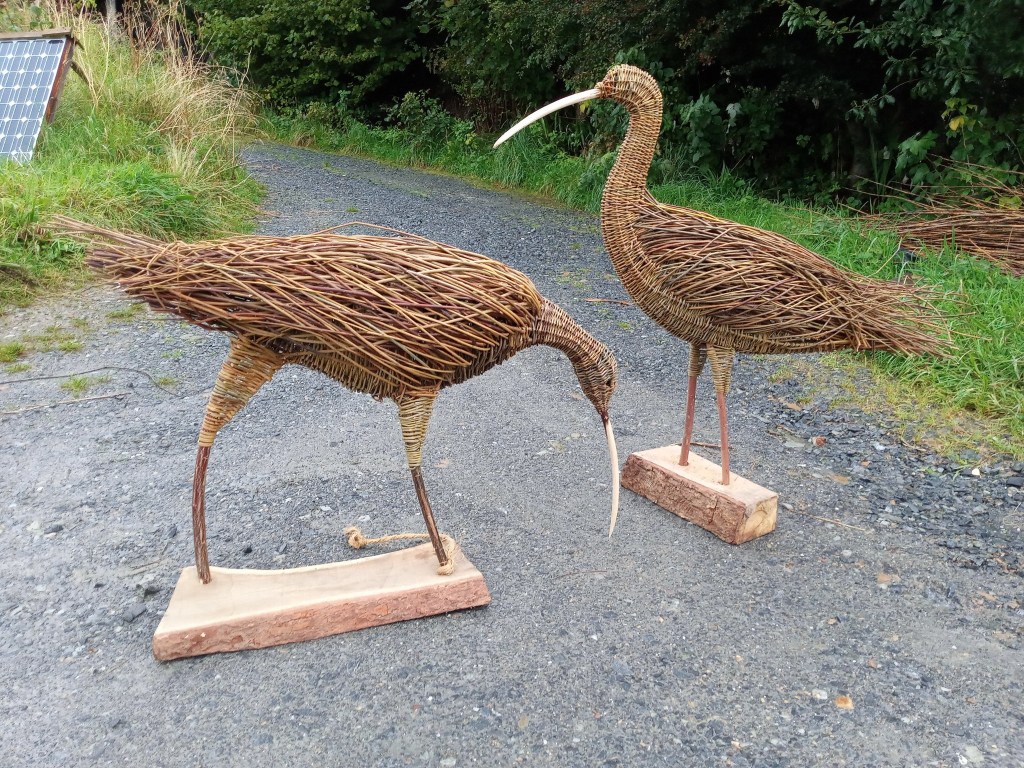
I came across Brendan Farren’s beautiful willow-sculpted curlews recently and was reminded why I called my blog thecurlewscall.

Brendan Farren, Greencastle, Co Donegal, willow sculpted curlews.

In Leitrim, your call was part of my childhood summers. When I wandered Boggaun’s high rough fields, up behind the farmhouse, where they merged into hazel woods. Looking up over Larkfield to the top of The Rock, down again in search of badger and fox trails, as you cur—lewed around me. Your call was part of the music of those magical summers.

At home in the Antrim hills, I heard you call across the mountain slopes coming off the flat top of Tievebulliagh, tramping through a stream. Camped nearby on a grassy bank, you cur—lewed us to sleep in mid-summer’s half-light, calming our teenage chatter. And later, a little to the south, on the slopes of Slemish, where the air cleared beyond the awfulness of that time, you called again, haunting and lonely.

In Inishowen, I catch a glimpse of your elegant beak, hear your occasional call by the estuary of the Crana River. Hoping that you survive and with your offspring flourish to fill the coasts and mountains again with your curlew’s call.

Christmas Lights

(From the Volunteers, a novel in draft. Christmas 1967 Steve, is 10 years old, and his parents, Sean and Audrey are struggling in their mixed-marriage while tensions rise in strongly Loyalist, Ballymoney.)

As Christmas approached, Steve’s father promised they would have a real tree. They could do better than the wee silver one that sat sagging in the window, he had said. A council mate would get one from a local forest. He winked, though Steve had no idea why. They would both put it up and decorate it together, Sean declared. His mother would gather up some decorations.

The tree arrived home on a Thursday and was put in the small backyard next to the outdoor toilet. On Friday, his father came home with a wrapped brown parcel. Before anyone could ask, he set it on a high shelf in the kitchen saying, ‘That’s for later. I’ll go and wash up. And after tea, Steve, you and me will get that tree up.’ His mother had been quieter than usual when Sean came in. Steve noticed a stiffness had entered their words.

Over the past year, his mother had been out for a number of evenings each week. She had joined a different church, one a little way outside the town. Steve would have been happy if it broke her habit of taking him to Sunday school and afterwards to church service. He’d be happy to stay at home listening to his father’s stories or to his violin, played quietly, because it was a Sunday.  But it didn’t alter her pattern. And each Sunday morning, he was dressed up and walked the short distance to their Presbyterian Church on a nearby street.

When the tree was planted into a bucket filled with stones and placed in front of the window, Steve stood on a kitchen chair and looped decorations on branches. There were a few new sparkly ones, but most were made by Doris from old glittered Christmas cards or shapes of bright material glued onto cardboard.

‘I bought the Bethlehem Angel for the top,’ said Audrey, pulling it out of a paper bag.

‘That’s beautiful mammy,’ Steve said. ‘Can I put it up?’

‘Let your dad. It’s too high.’ Sean had gone off to the kitchen and came back with his package.

‘Here, Steve, open that, very carefully.’ Steve unfolded the brown wrapping paper on the floor.

‘Ahh Santa lights! Wow!’ Steve’s glance caught his mother’s cold eye on his father, Audrey thinking he did that on purpose. He knew I had the angel.

‘Careful now. I’ll unwind them and string them on the tree. This will beat anything on the street. Or Eddie and Doris’s. They’ve nothing.’

‘You know we’re going round there next Friday?’ Audrey reminded him. Sean groaned. He had wanted to forget. ‘We’re all going.’

‘Won’t you be out at that new church of yours?’ said Sean, his voice icy. After he’d expressed initial surprise at her move to the new Free Presbyterian Church – though it had been signalled by her increasing number of comments about the need for so-and-so to be saved, which he also took to mean him – he knew there was little to be gained by arguing. It was all going in the wrong direction, he felt. Like an Armada ship in Donegal Bay, he once heard of, trailing its anchor in a southwest gale about to be pounded onto rocks.

Steve sensed an edge creep into their words. His Dad had always expressed his gratitude for the hearty plate of food Audrey had set in front of him at the end of his working day. Now, there were often no words at all. He didn’t like it, felt excluded by the absence of their whispered words. 

‘Don’t mock the Lord’s House, Sean. It would do you good to go,’ Audrey said, turning to rearrange the cushions on the settee, wondering how long ago Sean stopped trying to be part of her community. If he ever really tried. ‘Anyway, make sure you’re back in time to be over there for seven. You know we go every year.’

‘I know. I know. That man is— we just don’t get on.’

‘Eddie, isn’t the worst of them.’

‘Hmfp. Your brother’s the worst I’ve come across,’ Sean replied, under his breath. Audrey turned at the living room door.

‘Stop it, Sean! It’s Christmas. It’s time of peace and love,’ Audrey’s voice dropping, but firm. ‘We’re all going. You can leave early if you want.’ Tell your brother about peace and love, Sean thought, but didn’t say it.

East Berlin 1978

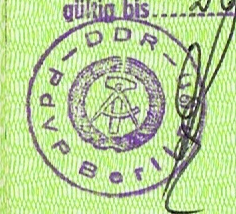
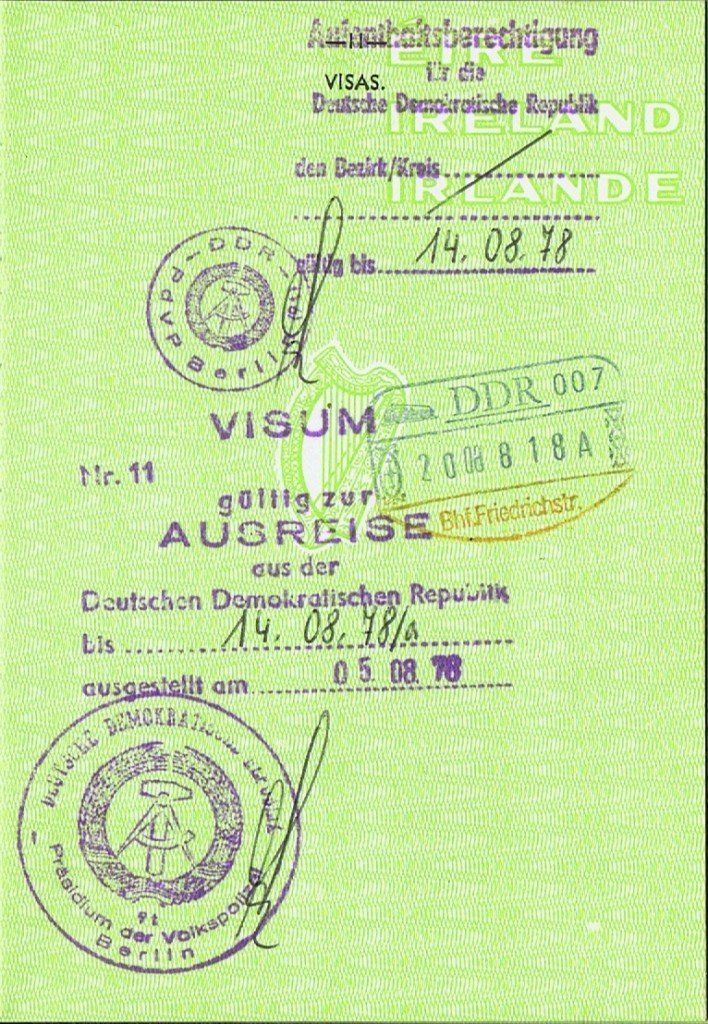
The train stopped at West Berlin’s Fredrichstrasse underground station. I stepped off into the slow queue for GDR border control. Presented my visa papers, answered a few questions and took the stairs into East Berlin. The Wall would stand for another decade. Deutsche Demokratische Republik, to give its correct name, wasn’t going anywhere. I was behind the Iron Curtain. On holiday in unfamiliar territory.

DDR Visa Stamp on author’s passport.

We were to meet outside the station entrance. An old school friend from Ballymena, now a resident of East Berlin and a presenter on local radio. I looked over the plaza, expecting to see him. A stream of small cars buzzed past, all looking similar. A few pulled in, but not the one I was looking for. It wasn’t busy; after West Berlin, it was quiet, unhurried, and a little colourless.

            There he was. A bright yellow Fait 850 with a Belfast number plate. Bought in Ballymena, driven across Europe, and now in communist East Germany, David’s Joey had proven to be a reliable motor.

            The apartment was on the first floor of a solid, modernist building. David shared its cavernous high-ceilinged rooms with six students. There was an air of bright independence, a questioning of politics and society layered with sharp humour. Most are Stasi informers, David told me.  That was difficult to believe. Frank, whom I found most personable, was somewhat more direct than the others. He’s definitely Stasi. A party member.

            A few mornings later, five of us took a train north to Rostock, to stay at a family holiday house belonging to one of the student’s. We were drinking those delicate Kölsch glasses of cold beer, accompanied by ice-cold vodka.  Repeat, repeat and repeat as we sped through the flat landscape towards the Baltic. There were many calls of prost! but none to the downfall of the DDR.

            Our troupe left the train station in search of a late lunch. It was  Saturday and the restaurants were full. We eventually found a kneipe, a simple bar that served hearty food.  The aromas that met us were of pork, of sausage and boiled vegetables. We sat at a large kitchen-like table and ordered drinks. Eric Honiker, ever present, watched from the wall. Frank genuflected as he passed him on his way to the toilet. We laughed. The other tables didn’t. The waiter deflected our drinks order with an arrogant sweep of his head. Maybe he had reason to, but it riled Frank. We waited for our food and were left dry.  Frank felt this arrogance was a distortion of a great socialist principle that elevated those who served. Eventually, when he got the waiter’s attention, he gave out an excoriating political tirade. I knew little German, but the body language was easy to interpret.

            We got our food, and more beer, with much tut-tutting from the surounding tables. It’s a kneipe for godsake was a rough translation of Frank’s comment.  There were large knuckles of pork, long sausages, boiled vegtables and gravy; plates of food that justified a good day’s labour. Frank’s genuflecting in front of Eric became more of a deep bowing, the laughter became more muted. I found it incredulous that he could have anything to do with the secret police. But perhaps I shouldn’t have been given my roots.

            Alexander Platz was enormous and modern in a 1960s way, exemplary GDR. Blue skies shone over the wide, tiled pedestrian plaza. People strolled, others taking shortcuts. During my first days, there appeared a drabness and restraint in everything and everyone, as if in a sepia print, flat shades of brown.  And now, in the city’s central plaza, life here seemed muted. However, as days passed, I registered this less and less.

            With a backdrop of the towering modernistic Fernsehtrum TV tower and squat white office blocks, we sat at the Fountain of Friendship.  Around us other young people, most an ethnic mix of students from the communist-aligned states. No papers or cans littered the square. To my question, Is there much crime? there were glancing laughs and a shaking of heads. The Stasi state was everywhere amid the sepia tones; I just couldn’t discern it. A case of not being able to see the wood for the trees.

            The greatest shock of the whole trip was on leaving. I remember it vividly as a physical assault. I exited the U-bhan station in West Berlin and was pinned to the spot by an assault of light, people, traffic, and noise, but mostly by a wall of tall neon advertising. I stood aside for a minute or two. Shocked. Waited for it to pass. Before moving towards an airport bus and my journey back to Derry.

End

Let’s Meet At Carnlough

This story was a winner at Impspired’s 2024 Soundwaves

A short story

They travelled down from Belfast separately. Feigning diversions for family errands. Ryan had put off meeting Sarah until he could get a definitive on Jamie’s whereabouts. Or rather, where he was buried. He had come to think of him now, simply as a loyalist terrorist, not as his cousin. That’s what he told himself anyway. He had searched the papers. Nothing. When he gave up, it was an article on the killing of a young woman outside a British Army base in Germany that stayed with him. The fuzzy photograph reminded him of Sarah in her student days. Something in that innocent smile, that expected life to go on and on. Sarah’s life had fractured five years earlier, Jamie, the chief suspect Ryan disclosed the last time they met. Then Ryan had pleaded Jamie’s innocence to the point of choking Sarah’s pain and anger. How petty, he later realised, one enormous mistake. And one that couldn’t be mended. Yet, she had agreed to meet again. Carnlough, her choice. This, he guessed, his last chance.

He arrived at the quiet seaside town first. Pulled his grey Ford Sierra off the Coast Road and in beside an old shed at the end of the narrow quay. Sitting in the car, his gaze wandered across the small, once-bustling harbour with a handful of modest pleasure boats and wooden half-deckers moored on the glassy water, to buddleia growing between the dirty limestone blocks of the redundant railway embankment that doubled as the seawall.  The North Channel beyond.

Next to him a decaying building. Crumbling lime mortar loosening black basalt stones. The curved corrugated roof with rust patches growing through layers of pitch. Some money needed here, he thought. Though, wouldn’t it make an attractive coffee room? Great location. A grant from The Ireland Fund, perhaps.

Ryan got out of the car into the quiet sea-chill freshness of a late spring morning. Above the solid terrace of the small seaside town, a narrow white scrim marked the old lime quarry, as the gentle hills of The Glens fell off towards the sea. He sat against the coarse stone cappings of the wall, that separated the Coast Road’s footpath from the car park. Looking around seeing how few people there were on the late spring Bank Holiday. Four strollers across the harbour on the embankment at Hurry Head was all. Customers that might sample scones and coffee. A foolish notion, he quickly concluded.

An elderly woman, slightly stooped under the weight of two large jute carrier bags, was moving slowly towards him on the other side of the low wall. She was wearing a heavy, aged tweed coat and a thick woolly hat; a small, dark, huddled form. She stopped. Put the bags down next to Ryan. Straightened for respite.

‘Hello son,’ she said to his back. And not waiting for a reply went on, ‘A Ballymoney lad that doesnea wanta spend the holiday at the Port? Cannea blame ya.’ Ryan turned to her. Studied her face for someone familiar.

‘Hello,’ he nodded, seeing deep dark lines on her face. Her green eyes radiant and alive, that held his attention. But he’d never seen her before.

‘It all goes to the Port. Portrush. Ya know?’

‘Sorry?’

‘The money. Aye, the money. The world’s ill divid. So it is.’ Steve smiled not sure where this was going. ‘It’s complicated son. Very complicated.’ She brushed down the front of her coat with her two hands as if wiping them clean. ‘Waitin for the girlfren?’

‘No, no. Nothing like that.’ She looked at him directly, latched his eyes and sighed for what she might have seen. Ryan swept back his black hair, felt how nervous he was about seeing Sarah. Each time, in fact. Yet harbouring a veiled excitement, despite the possibility that her wounds could again spill into a wild rawness,   here on the water’s edge.

Down the street, towards the redundant railway arch, a man got out of a small dark blue van trailing a newspaper in one hand. He raised the other arm to lean on the car’s roof. He was wearing a soiled navy boiler suit and a hat similar the woman’s. Ryan could see a sheen on the top half of the suit, from work, or age.

‘Ellen! Common! Common!’ the man shouted. Ellen didn’t reply. Instead, she raised an earthy hand and scratched the back of her neck with strong yellow nails. She turned to Ryan, smiled and nodded as she picked up the heavy bags.

‘Aye. She’ll be here shortly. It’ll be alright.’  Steve watched her tramp down the street away from him, feeling as though his younger self had just dropped out of another life. Back into place, but not completely. This woman, this stranger, who seemed to know more about him than he did himself.

From a distance, the man’s gaze gathered Ellen and her bags. ‘Wait! Wait!’ he called, holding up a hand. He threw his paper into the van and dragged himself and his hindering leg up the street towards her. Ryan thought about his granny and granda in Fermanagh. A fondness expressed one time that he barely remembered, after some minor row. Then, Sarah’s Mini pulled into the car park and reversed in beside him. Unbidden, an image of himself in a striped apron, at a barista coffee machine, his back to the counter, turning to see Sarah standing there with bags. Sarah pulled herself out of the car and smiled over its red roof, a look both cautious and hopeful.

‘Hi Ryan. You here long?’ Then a drawn sigh. ‘I really could do with a coffee.’

End

Bathed In Golden Light

Floating in cloud. Occasionally it gets clear and I can see you, hear what you’re saying. But not often. Where have I been these years? Lost even to myself. Tortured by barbed guilt of a bitter pleasure tasted years ago. Twisted, I scarcely know myself. Lost in layers. Seeking release from this place. How?

They told me us Protestants don’t go to purgatory. Heaven or Hell. But where else can this be? Tormented to make sense of it.  “Move on.” I hear in a million echoes. God, please make it simple – a car crash, a heart attack? A clean end. Unanswered, it tortures me. Was my sin so great? That of my ancestors?

If he came to my door, I could not open it to him. If he claimed me on the street, I couldn’t look him in the eye; walk on head down, crumpling forward. I’ve become my layers of protection, forgotten my soul. A dried-up onion, nothing left that lives. The TV runs on continuous play; with slim apology to the likes of us, still roiling in the aftermath. Avoid all mention, alert to that sense of foreboding, drop silent, feign ignorance; a few of my layered strategies.

Placed in the safety of a Protestant family business, with hope of a future, a husband, maybe a family. The work simple, friends made, summer days in the town and fairs, a tepid boyfriend chasing. 

When he came up the stairs with some question, I was lying on my bed. He was always kind to me with his easy smile, hiding a darker interest. His hand in mine, stroking my brow, we lay together while, downstairs, a family dinner was made ready. Was my naivety to blame? Is my passion unbridled? Or his warm, seductive hands? Twice and I fell pregnant.

Panic, quickly disguised by plans and promises. He could do that. Arrangements quietly made: ‘a holiday’, an adoption, return to work, and then, if I wished, to go anywhere – all costs and more covered.

Bethany, not the biblical haven I expected. Anything but. Dozens of us with similar stories treated like sheep, dirty sheep; taught to distain, ourselves, our situation, our children. Girls and women in turmoil embarking on the lonely unknow road, to separate purgatories, our sins ‘mortal’ the others told me.

Peel away the layers one by one. They are not needed now, at the end. I can see with final clarity it’s just me and the child. Cradling him, bathed in golden light. The two of us bound forever. And thus, we approach the gates of Heaven.

In memory of those whose voices were never heard.

PDF version here.

River Mill

In appreciation

I walked the millrace to its head

three hundred paces and more
stepping out the years
to when mud-splattered men
fed by their patient women
fashioned stone
of sluice gate and bridge
of nearby lime kiln

already waist-deep in history
the Boyne's victory settling
at the planter’s mill
they dug deep the levelled race
their labourer’s mutterings unheard
as wet boots shucked
to bawdy blether of passers-by

the land’s oats and grain
scythed on model fields
rid of stones to line the race
wait on religious men
to grind their daily bread
to believe in trade and progress
a better place than was given

children shout and run to
that first rush of water
following the channel
muddy at first
to the pond and sluice
life surges in their place
towards a golden heaven

a crowd strains to see
as water spills
onto the big iron wheel
labouring in its first turn
hesitant and slow
yet relentless now
stone against stone

grinding out our future
and we are moved
in this place
to read to write
to scratch out words
and listen
for distant whisperings
River Mill Writer's Retreat, Grange Walls, Co Down.

Close Shave

Then he came to shave my chest. And with him, a chill wind that blew away any remaining nonchalance. Practiced and casual, he talked in soothing Dublin tones; yet held something back, expectant, prepared perhaps, for some unwanted confession.

Not much view from this ward, is there? he asserted as the buzzing trimmer stroked my skin, his breath mint-fresh. We both knew the plans for the next few hours started with heavy sedation. The view would be irrelevant. But would the scalpel make one clean incision? How could I not feel it?

Still, you’re better in here on a day like that. Would the battery of the sternal saw be fully charged? Vibrate? Spit out fragments of my bone?

You’re from somewhere north of the Liffey? he joked, brushing the trimmer’s teeth clean, grey hairs falling, collecting on my sheeted lap. How many green scrubs and masked faces would gather around me? All at their day’s work. Tired perhaps?

I spent a summer in Donegal years ago. What a time. How do they stop, and later, start my heart? Slice it open to reveal the damaged flap of my mitral valve?  Will the surgeon hold my heart in his hand?

Primed by furuistic story lines, is it a wonder that I floated back into a disturbing brown dystopia, where comfortless and ghostly shapes watched and minded my vitals, as others lay, similarly wired and tubed, in beds held sloped in the octagonal high dependency room; of a doomed space ship stranded light years from home?

A nurse would later laugh – too many sci-fi books.

From the faint dim walls around me, diamond patterns grew into the form of dark heads and faces. They waited motionless, their distant gaze unconcerned, it seemed. Yet they were waiting. Some atonement or recompense? From me? Then left in their own silent time as they had come, morphing back into shadow. Others were to follow with disturbing regularity. Nothing was familiar. Nothing brought comfort. At night, my bed and I toured the wards, as whispering voices curled into loud and absurd conversations.

Then the opiates, too, left in their own time. And with them, the delusions began to fade into the routine of the ward: first steps tentatively taken, that first taste of Weetabix and cold milk, the stunning freshness of the first shower. Yet a dull echo of those opiate dreams remained; until, with some help, they too were gone.

And now, months later, I can write this – feeling some strange sense of nostalgia – with a steady and strong heartbeat. Restored by the magicians: the surgeons and their team.

August 2024