An oil change with Martini Rosso

One summer evening when I was seventeen, around the time of my first driving test, I lifted the bonnet of our Austin 1100, my father in the kitchen at his dinner after coming in from work. I was wondering how all the parts of an engine worked after reading about it. After pouring over colourful diagrams of pistons that reciprocated so fast, of the carburettor that mixed petrol and air, and spark plugs that fired exactly on time. This complicated machine was here in our garage. I felt heat coming off the engine, that ticked as it cooled.

            What are you doing? he said coming in through the side door. It’s just had a service. No need to lift the bonnet. Leave it alone.  I didn’t try to explain, not expecting him to see my point of view, since he chastised me for listening to The Beatles. That was after John Lennon offended his religious beliefs, saying they were more popular than Jesus. My musical taste was on the wrong side of heaven’s gate and I wasn’t for turning.

After that, I had to be sneaky. Make sure he wasn’t around when I traced the wires from each spark plug, the four of them connected to the distributor cap. I unscrewed a spark plug another evening, hoping to see the gap where the spark jumped to ignite the fuel, to shine a torch into the hole in the dark cylinder. The spanner slipped, breaking the top off the plug. In a panic, I cycled round the town until I found a replacement in Fyfes. Then relieved to screw it into place, tighten it home with care, and more relieved when the engine kicked miraculously into life and settled into a steady note.

Anything technical, my father avoided like a disease. In his opinion, the simplest of repairs needed a trained man. Yet, I did a few fixes behind his back, most of the time dodging his rancour. A few years later, I went off to study engineering.

&&&

His father said Tommy would take up a trade, like each of his own generation: a coach builder, cabinet maker, shoe maker, dress maker, seamstress. They were never out of work. The country relations were labourers, but we’d left that behind.

Tommy worked the family allotment. Practical enough it seemed. Moore’s garage was looking for apprentices and he would give it a try. The Second World War was still raging with its nightly blackouts. So, why not? There was some slagging at the start but he’d had money in his pocket, that meant a lot.

But something happened in those first weeks. It wasn’t good. A big mistake? Two, maybe? On one of those flashy Humbers? More likely an Austin Ten or Morris Eight. Dropped an engine from a hoist and cracked the case? Forgot to put engine oil back after a service? It cost a fortune to fix. The slagging got worse. Hold that brush tight young fella. Ya know he washes his hands in grease. Here! Catch! The foreman put him on something else. He soon left. Embarrassed to say the least.

He tried driving for a while. Then landed a job as a bread server, with Morton and Simpson’s bakery. A Comer van out on the road all day with no one to bother him. He got on well with customers with his easy chat. His bread and cakes sold well, so he stuck with it. But so too did his fear of fixing anything mechanical.

&&&

One year into my engineering degree, I went on a summer trip around Europe with five school friends. It was a big adventure. Colin’s father gave us their car – a new Renault 12 – some said that was foolish. They had toured on the Continent and didn’t see any problems for us. It would need its first oil change at 5,000 miles. I would do it, I said, it’s straight forward.

I tasted my first Martini Rosso somewhere in the south of France. At a campsite sheltered among coastal pines. The air coming off the azure sea, a sandy heat of scented pine, dried grass and succulents. The first sip of that sweet herb-laced wine, forever carrying a promise of sophistication and camaraderie, and the sensuous Mediterranean. While the car’s cargo, our belongings, lay scattered over the backseat, on the ground and in the small tent.

The oil change came due in Luxembourg. Squeezed under the vehicle, I loosened the bung and spilled the clear oil onto the grassy campsite floor – that’s what you did then. There were a few onlookers interested in the new model Renault, and wanting to help. Then I topped up the oil, and next morning we were on our way towards Calais. Job done.

It started while I was driving. That first short squeal in lower gears. That became longer and unavoidable. I may have broken out in a sweat. It awoke the others. I kept on driving. Into a small town to stop with a long tearing screech. A Renault garage’s reply was instant – Allez! Angleterre! Allez!  Our muted talk was of getting home. No more Martini Rosso.

We squealed to a crawl for finger-waving gendarmes, crossing pedestrians, traffic lights, and at last, and worst of all, into the hollow amplifying sound-box of the Dover-bound ferry.  Every head turned towards us. And I was driving.

Then we sat for ten days in a campsite, walking Canterbury, while the Renault garage tried to figure out and fix the problem. The solution, a new gearbox, later located in Newcastle, finally arriving by train after a bank holiday weekend. The car’s gearbox had no oil. Gears were ceased. The cause of the leak was unknown. Renault would make a final decision in the coming weeks.

For hours we drove quietly northwards, took the Stranraer ferry, back to Ballymena and into the car’s space on the driveway of Colin’s house in Fisherwick Gardens. After a clean and a wash, the Renault 11 looked, and sounded, like it had never left. Never tasted Martini Rosso.

The final outcome? Nothing. I had drained the gearbox. Predictably, it ceased.  I was embarrassed, of course. Renault covered the costs. I said nothing. And qualified two years later, with a degree in aeronautical engineering. And a few years later, Colin’s father and I laughed over the story. I only wish my own father’s experience had left him as easily. That he could have told his story and laughed about it.

End

pdf version here
East Berlin 1978

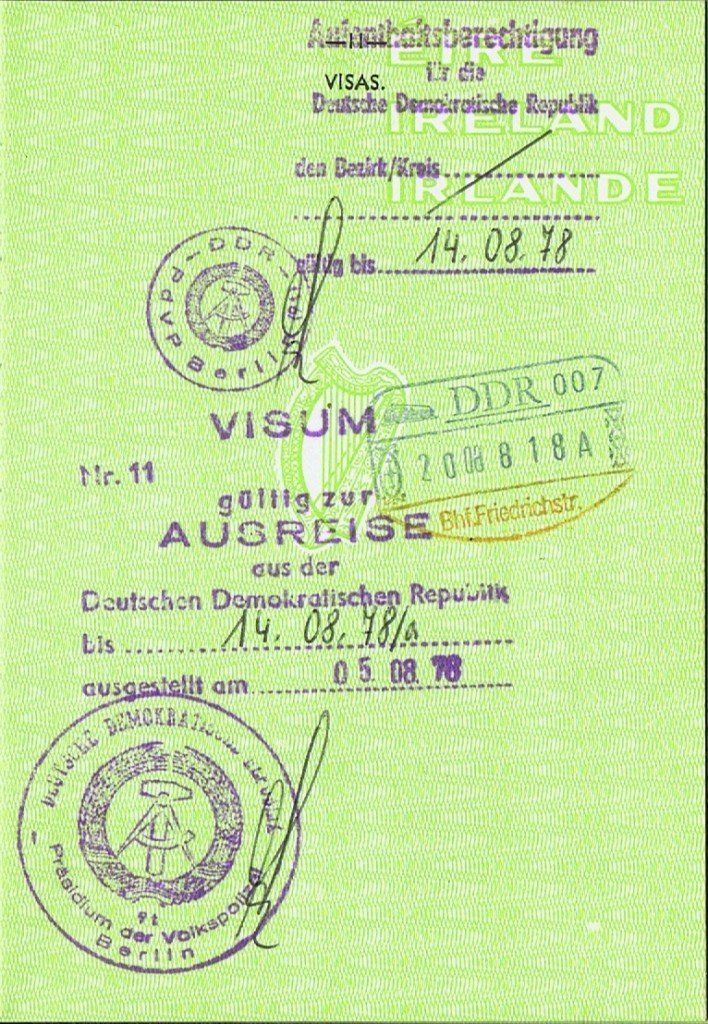
The train stopped at West Berlin’s Fredrichstrasse underground station. I stepped off into the slow queue for GDR border control. Presented my visa papers, answered a few questions and took the stairs into East Berlin. The Wall would stand for another decade. Deutsche Demokratische Republik, to give its correct name, wasn’t going anywhere. I was behind the Iron Curtain. On holiday in unfamiliar territory.

DDR Visa Stamp on author’s passport.

We were to meet outside the station entrance. An old school friend from Ballymena, now a resident of East Berlin and a presenter on local radio. I looked over the plaza, expecting to see him. A stream of small cars buzzed past, all looking similar. A few pulled in, but not the one I was looking for. It wasn’t busy; after West Berlin, it was quiet, unhurried, and a little colourless.

            There he was. A bright yellow Fait 850 with a Belfast number plate. Bought in Ballymena, driven across Europe, and now in communist East Germany, David’s Joey had proven to be a reliable motor.

            The apartment was on the first floor of a solid, modernist building. David shared its cavernous high-ceilinged rooms with six students. There was an air of bright independence, a questioning of politics and society layered with sharp humour. Most are Stasi informers, David told me.  That was difficult to believe. Frank, whom I found most personable, was somewhat more direct than the others. He’s definitely Stasi. A party member.

            A few mornings later, five of us took a train north to Rostock, to stay at a family holiday house belonging to one of the student’s. We were drinking those delicate Kölsch glasses of cold beer, accompanied by ice-cold vodka.  Repeat, repeat and repeat as we sped through the flat landscape towards the Baltic. There were many calls of prost! but none to the downfall of the DDR.

            Our troupe left the train station in search of a late lunch. It was  Saturday and the restaurants were full. We eventually found a kneipe, a simple bar that served hearty food.  The aromas that met us were of pork, of sausage and boiled vegetables. We sat at a large kitchen-like table and ordered drinks. Eric Honiker, ever present, watched from the wall. Frank genuflected as he passed him on his way to the toilet. We laughed. The other tables didn’t. The waiter deflected our drinks order with an arrogant sweep of his head. Maybe he had reason to, but it riled Frank. We waited for our food and were left dry.  Frank felt this arrogance was a distortion of a great socialist principle that elevated those who served. Eventually, when he got the waiter’s attention, he gave out an excoriating political tirade. I knew little German, but the body language was easy to interpret.

            We got our food, and more beer, with much tut-tutting from the surounding tables. It’s a kneipe for godsake was a rough translation of Frank’s comment.  There were large knuckles of pork, long sausages, boiled vegtables and gravy; plates of food that justified a good day’s labour. Frank’s genuflecting in front of Eric became more of a deep bowing, the laughter became more muted. I found it incredulous that he could have anything to do with the secret police. But perhaps I shouldn’t have been given my roots.

            Alexander Platz was enormous and modern in a 1960s way, exemplary GDR. Blue skies shone over the wide, tiled pedestrian plaza. People strolled, others taking shortcuts. During my first days, there appeared a drabness and restraint in everything and everyone, as if in a sepia print, flat shades of brown.  And now, in the city’s central plaza, life here seemed muted. However, as days passed, I registered this less and less.

            With a backdrop of the towering modernistic Fernsehtrum TV tower and squat white office blocks, we sat at the Fountain of Friendship.  Around us other young people, most an ethnic mix of students from the communist-aligned states. No papers or cans littered the square. To my question, Is there much crime? there were glancing laughs and a shaking of heads. The Stasi state was everywhere amid the sepia tones; I just couldn’t discern it. A case of not being able to see the wood for the trees.

            The greatest shock of the whole trip was on leaving. I remember it vividly as a physical assault. I exited the U-bhan station in West Berlin and was pinned to the spot by an assault of light, people, traffic, and noise, but mostly by a wall of tall neon advertising. I stood aside for a minute or two. Shocked. Waited for it to pass. Before moving towards an airport bus and my journey back to Derry.

End

Dublin in black and white

Everything during those couple of days I recall in black and white or tones of sepia. We travelled to Dublin in our first car. A black Austin Seven. It must have been summertime, Northern Ireland’s Twelfth fortnight, the only time my father had a full week off work.  While I recall more than my siblings, our common memory is of O’Connell Street.  The city was big. And O’Connell Street was as wide as a football field. Flanked by tall grey buildings, the centre of the boulevard was lined with parked cars and bicycles, with Nelson high on his column. At night, weak light from roof-level neon signs spelt out the names of Players cigarettes, of Guinness and Harp beer, facing towards the southside of the river.

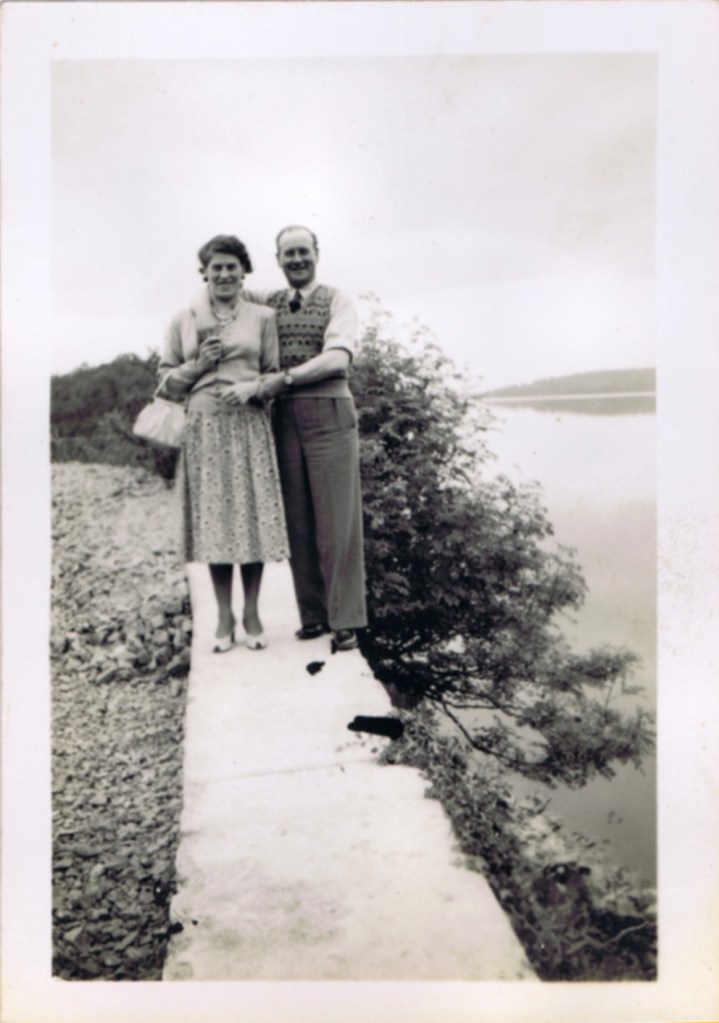
Ena and Tommy McWilliams at Lough Gill, Co Sligo. c 1950

We entered into one of the five-story buildings on O’Connell Street, on the left, less than one hundred yards north of the River Liffey. From the city footpath, we clattered up the lino-covered stairs with our bags and cases to the landing of our guest house. Leaving the parade of pedestrians, bicycles, cars, and buses, to be marshalled by black-uniformed Guards. Little light penetrated far into the building.

Our parents had honeymooned in Dublin just over a decade earlier and probably yearned for those simpler, more romantic times. Now, with four children, the youngest five, life was busy and full. A long car trip, though still a novelty, would have been a fractious affair. My father’s patience would have been sorely tested. I climbed the dark winding stairwell of Nelson’s Column with him, out onto a square platform to dizzying views of the streets below. The scene beyond folded into a low grey cloud. Nelson would stand tall for another five years or so until a maverick Republican took him down to street level.

The woman of the guesthouse offered to mind us for an evening. The younger two slept early, and myself and my brother were parked on straight-backed dining room chairs in the guest’s drawing room, in front of an incredible novelty, a television. We watched a British TV channel, the only ones that could be picked up in the years before the Irish television came on air.  A single orange electric bulb backlit the room. We watched a sci-fi episode, ‘Elegy’, part of the US production ‘The Twilight Zone’.

Mesmerised by moving pictures, we saw the crew of a grey US spaceship land on an earth-like alien planet. The three crew were shocked to find all the humans were completely motionless, frozen at their various tasks. They were eventually welcomed by a friendly figure of an old man in his large house. The scenes that unfolded of these rigid, yet realistic people became more and more creepy and scary: a town election, a beauty pageant, a farmyard, where no one moved. The crew were dined, and then poisoned by their host, and died there, right in front of us, on the screen. The final scene saw the old man, accompanied by weirdly bright happy music, dusting the bodies of the three astronauts sitting forever paralysed in their spaceship.  My first TV viewing would have been memorable, but the effect of this frightening sci-fi has left its indelible mark. I suspect that sleep that night, in a strange bed, came late.

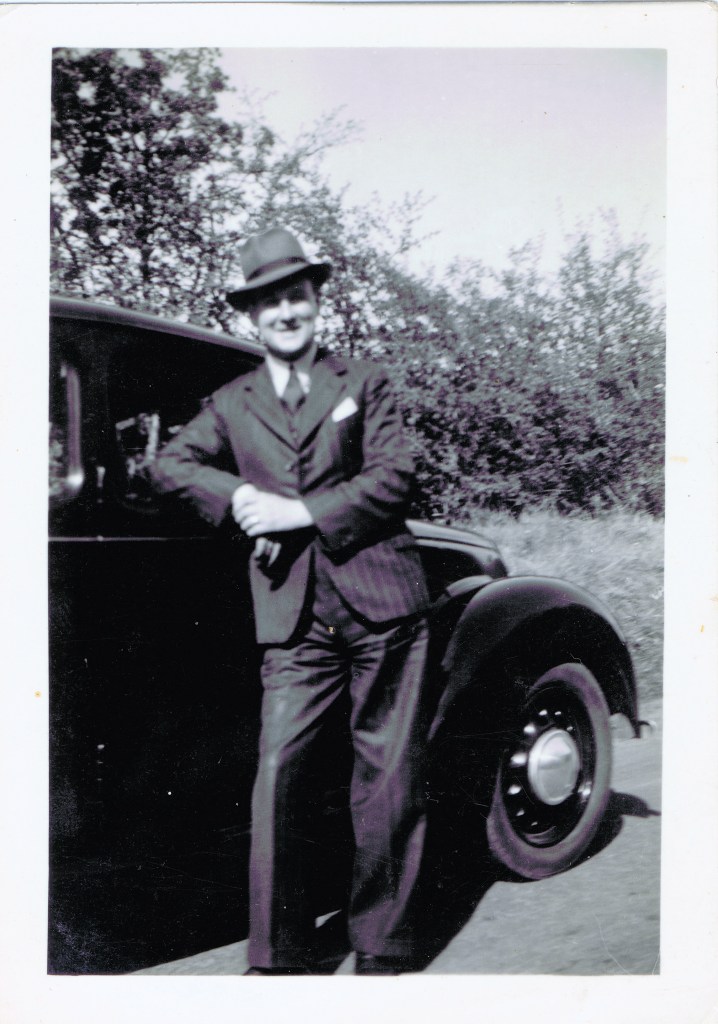
Tommy at Larkfield, boggaun, Co Leitrim with his first car, c 1960.

Outside, we didn’t see the shadowed holes left by bullets and shrapnel that peppered the walls of the buildings, and particularly the façade and portico of rebel headquarters at the General Post Office a short distance from our guesthouse. The dust had settled on the Easter Rising just over forty years previous, and Ireland was in the early years of Seán Lemass’s leadership. The city was starting to show a growing national confidence and optimism, though the rest of the country was still blighted by dark times of unemployment and mass emigration.

Did I enjoy that first trip to a city I have long since come to appreciate? Judging by these scant memories, probably not. I’ve no recollection of the drive back home. Most likely, we went west to Manorhamilton in County Leitrim. To our grandparents’ farmhouse, without electric light and running water, where we would continue the annual ritual of happy summertime holidays that remained for more than a decade.

End

Print pdf version here.