Ulster-Scots is it?

An essay – revised August 2025

A couple of years ago, I had a short story published in an Ulster-Scots book, Yarns. It was about a fictional character, loosely based on a distant relative, who underwent a religious conversion during the Ulster Revival, transforming from a wastrel to a devout Christian man. It was written in a mid-Antrim dialect of English, but revised into Ulster-Scots and published under my name, without any acknowledgement to the translator. The revision seemed minor, but I struggled to read and understand much of the new version. This unease has returned to me occasionally, alongside a reticence to assert Ulster-Scots as a distinct language and culture. Here, I have tried to throw some light on these misgivings: what are the roots of Ulster-Scots, and indeed what would make it a language?

The term Ulster-Scots, and its precursors, were used by early colonists in North America. These were Presbyterians from the north-east of Ireland who were initially referred to as Irish. Around the 1770s, they adopted the name Irish-Scots to differentiate themselves from Catholics and express their Scottish affinities; then it was quickly turned around into Scots-Irish.

They were libertarian Calvinists. Their allegiance and loyalty were primarily to the God-anointed King, and their libertarianism made them suspicious of parliaments and governments, prone to take restorative action when they considered it necessary. History, they later felt, justified this wariness of what often turned out to be unjust authority; notably, in the decades after their involvement in the Siege of Derry. 

The Westminster Confession of Faith, drawn up in 1646, appeared to copper-fasten a Calvinistic, strongly anti-popery religion across these islands. However, this Calvinism all but disappeared among modifications to establish the Church of England, and later, as the Protestant Ascendancy became dominant in Ireland. The Presbyterians’ refusal to accept this new religious authority reduced them to second-class citizens, barely above the native Irish.

As a result, tens of thousands of Presbyterians left Ulster in search of a new world in North America. They led wars against indigenous American tribes, colonising their lands, making a name as frontiersmen and European pioneers. During the American Revolution, they took the rebel side with gusto. Captain Johann Henricks, a British Army officer, said of them, ‘Call it not an American rebellion, it is nothing more than a Scotch Irish Presbyterian Rebellion.’ And they were also influential in the formation of the United States Constitution. The Second Amendment – the right to bear arms – is an outworking of their Calvinistic libertarianism and the suspicion of government. In the United States there was no use of the term Ulster-Scots until much later when it migrated from Ireland.

The self-descriptive term has morphed over the years from Irish into Ulster-Scots. The Ulster-Scots Agency says the term has been in use since 1640. The Ulster-Scots Language Society was established in 1992. I grew up speaking a mid-Antrim dialect of modern English, a rough tongue my mother might have called it, and used many words that appeared in recently published dictionaries: Ulster-Scots grammar and dictionaries by Fenton and Robinson, and Dolan’s Dictionary of Hiberno-English and in Share’s Slanguage. Fadge, I’m glad to see, which is common now in the Ulster fry, is in these dictionaries as griddle-cooked potato bread, although the word’s origin appears unknown. A cross-over food, perhaps?

Few outside Ireland, and those who describe themselves as Ulster-Scots, are familiar with the term. In recent years, particularly since the implementation of the Good Friday Agreement, Ulster-Scots has moved centre stage and been at the core of contentious political issues. Is it or is it not a language? A language that is part of a distinct culture? As in many things here in Ulster, your answer to these questions defines your identity: Protestant or Catholic.

So, what is a language? Does it define a distinct culture? English? Mandarin? Spanish? Mayan? Surprisingly, academics don’t appear to have a clear definition. Max Weinreich is attributed with the statement, ‘A language is a dialect with an army and a navy.’ That sounds rather trite until you think about it. Chamber’s Dictionary defines language as: human speech; a variety of speech or body of words and idioms, especially that of a nation; any manner of expressing thought or feeling. A friend reminded me, I’m using language to try to describe what language is. Tricky indeed.

The border regions of France and Belgium speak mutually understood French and German dialects, as do the border areas of Germany and Denmark. Then, what about Scottish Gaelic and Irish Gaelic? They are very close. Yet central governments decide what is the nation’s official language, and what language school books are printed in, for example.

While Weinreich’s statement about language carries weight, it assumes an authority that corrals and overrides the interests of minority languages. However, the scale of a country’s territory can demand different solutions. India, for example, has twenty-eight official languages and many secondary ones.

Many regional dialects and languages are closely tied to identity, and language rights are common at the forefront of political conflict. Within Europe, in recent years, there has been a growing interest and support for minority languages. However, there seems to be a natural tension between the desire for a centralised and national language, or languages, while the reality of our lived experience is an ever-changing patchwork of dialects and languages, however defined.

For most of human time, sea routes carried trade in goods, and as an unintended consequence, language and culture. The centuries-old sea routes on the Sea of Moyle up to Scandinavia, down the Irish Sea, were dominant when our inland routes were practically non-existent.  Traders and raiders carried languages and dialects of the Gael and Vikings, Saxon and Norman, the skill of linguists among them easing communication and reducing suspicion. Words and phrases were exchanged along with goods.

At the beginning of the seventeenth century after Ulster, the last Irish Gaelic stronghold, had been razed by an English scorched-earth policy, it was left almost devoid of people, and the native tongue had all but disappeared.  New languages, dialects and cultures were carried by the incoming lowland Scots and English during waves of plantation. To a small degree, these same Scots carried a version of Gaelic westward. Certainly, it was used by Presbyterian preachers wanting to convert the remaining native Irish. Ironically, it turns out that many of these Scottish settlers also carried Irish Gaelic genes, the legacy of Irish raiders who had remained in Scotland centuries earlier.

Wesley Hutchinson, a Professor Emeritus at the University of the Sorbonne Novelle, has published extensively on Ulster-Scots. Like me, he is a native of mid-Antrim and has an affinity with the words he grew up using; words he, too, was often told were wrong. Hutchinson examines the historical evolution of Ulster-Scots into its recent politically driven form, which he describes as a binary cultural “brand”. He makes an interesting distinction between the Ulster-Scots stereotype, which he says is predominantly male, militant and uncompromising, and its literary and theatrical culture, more inclusive and less binary. He offers the latter as an avenue to a more inclusive future. In an interview on NVTV Belfast following the publication of his 2019 book ‘Tracing the Ulster-Scots Imagination’, he concludes, when pushed, that Ulster-Scots is a Scots dialect, of Scot-English, I presume. I would agree, but adding some Hiberno-English, Old English and Irish Gaelic to the influences.

Regional accents and dialects have become more common across our media channels, though, to many, they don’t rank highly on a scale of culture. Which is ironic given the root of the word culture itself: the tilling of the earth and in the plough’s coulter. The working of the earth, which is the very birthplace of dialects and languages.

On reflection, then ‘A language is a dialect with an army and navy’ sounds not too far wide of the mark.  Dialects and languages, like clouds, gather, mingle and diffuse, blending and continuously changing shape. And so, with Ulster-Scots. I hope all this bletherin doesn’t make your head birl. And it sounds like herding cats to me. But then I like cats.

Notes on references:

The Scots-Irish: The Thirteenth Tribe, Ulster Ancestry, Robert James Williams, facebook post 2019. Available at the link.

Marianne Elliot, Watchmen in Sion: The protestant idea of liberty, A Field Day Pamphlet, 1985.

Tracing the Ulster-Scots Imagination (Belfast, Ulster University), Wesley Hutchinson, 2018. Wesley Hutchinson works almost exclusively on issues connected with Ulster-Scots history, literature and identity.

Presbyterians and the Irish Language, Roger Blaney, Ulster Historical Foundation, 1996

A Dictionary of Hiberno-English, Terence Patrick Dolan, Gill and Macmillan, 1998.

Slanguage – a dictionary of Irish Slang, Bernard Share, Gill and Macmillan1997.

The Hamely Tongue, James Fenton, The Ullans Press, 2014. First published 1995.

Ulster-Scots, a grammar of the traditional written and spoken language, Philip Robinson, The Ullans Press, 1997.

Chamber’s Dictionary, 2024.

The Curlew’s Call

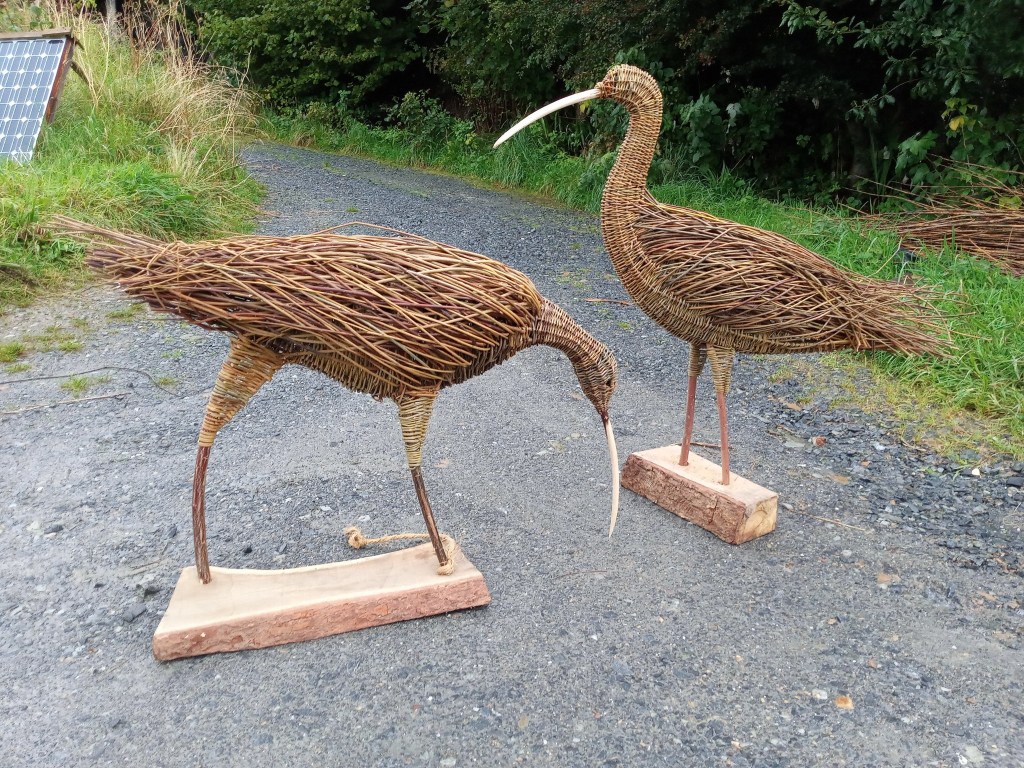
I came across Brendan Farren’s beautiful willow-sculpted curlews recently and was reminded why I called my blog thecurlewscall.

Brendan Farren, Greencastle, Co Donegal, willow sculpted curlews.

In Leitrim, your call was part of my childhood summers. When I wandered Boggaun’s high rough fields, up behind the farmhouse, where they merged into hazel woods. Looking up over Larkfield to the top of The Rock, down again in search of badger and fox trails, as you cur—lewed around me. Your call was part of the music of those magical summers.

At home in the Antrim hills, I heard you call across the mountain slopes coming off the flat top of Tievebulliagh, tramping through a stream. Camped nearby on a grassy bank, you cur—lewed us to sleep in mid-summer’s half-light, calming our teenage chatter. And later, a little to the south, on the slopes of Slemish, where the air cleared beyond the awfulness of that time, you called again, haunting and lonely.

In Inishowen, I catch a glimpse of your elegant beak, hear your occasional call by the estuary of the Crana River. Hoping that you survive and with your offspring flourish to fill the coasts and mountains again with your curlew’s call.

Dublin in black and white

Everything during those couple of days I recall in black and white or tones of sepia. We travelled to Dublin in our first car. A black Austin Seven. It must have been summertime, Northern Ireland’s Twelfth fortnight, the only time my father had a full week off work.  While I recall more than my siblings, our common memory is of O’Connell Street.  The city was big. And O’Connell Street was as wide as a football field. Flanked by tall grey buildings, the centre of the boulevard was lined with parked cars and bicycles, with Nelson high on his column. At night, weak light from roof-level neon signs spelt out the names of Players cigarettes, of Guinness and Harp beer, facing towards the southside of the river.

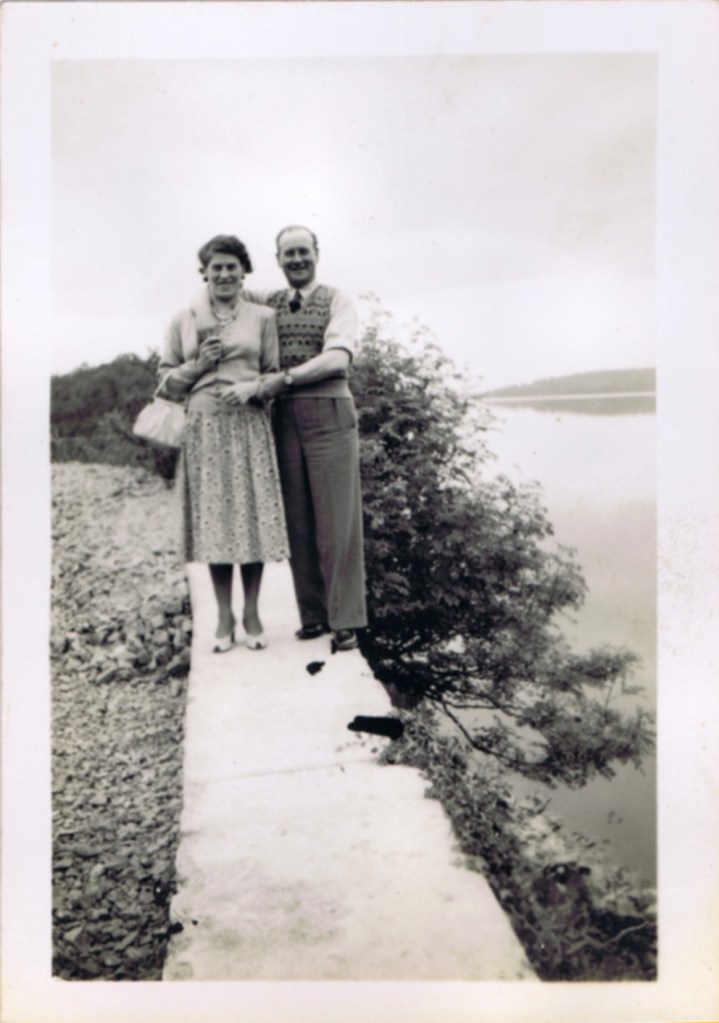
Ena and Tommy McWilliams at Lough Gill, Co Sligo. c 1950

We entered into one of the five-story buildings on O’Connell Street, on the left, less than one hundred yards north of the River Liffey. From the city footpath, we clattered up the lino-covered stairs with our bags and cases to the landing of our guest house. Leaving the parade of pedestrians, bicycles, cars, and buses, to be marshalled by black-uniformed Guards. Little light penetrated far into the building.

Our parents had honeymooned in Dublin just over a decade earlier and probably yearned for those simpler, more romantic times. Now, with four children, the youngest five, life was busy and full. A long car trip, though still a novelty, would have been a fractious affair. My father’s patience would have been sorely tested. I climbed the dark winding stairwell of Nelson’s Column with him, out onto a square platform to dizzying views of the streets below. The scene beyond folded into a low grey cloud. Nelson would stand tall for another five years or so until a maverick Republican took him down to street level.

The woman of the guesthouse offered to mind us for an evening. The younger two slept early, and myself and my brother were parked on straight-backed dining room chairs in the guest’s drawing room, in front of an incredible novelty, a television. We watched a British TV channel, the only ones that could be picked up in the years before the Irish television came on air.  A single orange electric bulb backlit the room. We watched a sci-fi episode, ‘Elegy’, part of the US production ‘The Twilight Zone’.

Mesmerised by moving pictures, we saw the crew of a grey US spaceship land on an earth-like alien planet. The three crew were shocked to find all the humans were completely motionless, frozen at their various tasks. They were eventually welcomed by a friendly figure of an old man in his large house. The scenes that unfolded of these rigid, yet realistic people became more and more creepy and scary: a town election, a beauty pageant, a farmyard, where no one moved. The crew were dined, and then poisoned by their host, and died there, right in front of us, on the screen. The final scene saw the old man, accompanied by weirdly bright happy music, dusting the bodies of the three astronauts sitting forever paralysed in their spaceship.  My first TV viewing would have been memorable, but the effect of this frightening sci-fi has left its indelible mark. I suspect that sleep that night, in a strange bed, came late.

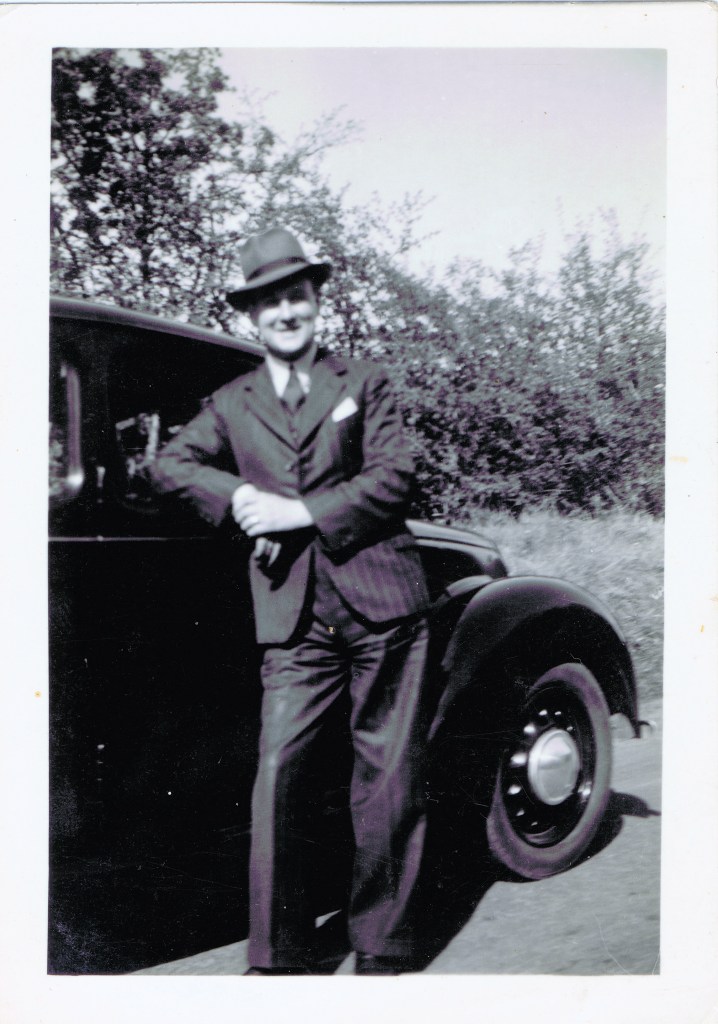
Tommy at Larkfield, boggaun, Co Leitrim with his first car, c 1960.

Outside, we didn’t see the shadowed holes left by bullets and shrapnel that peppered the walls of the buildings, and particularly the façade and portico of rebel headquarters at the General Post Office a short distance from our guesthouse. The dust had settled on the Easter Rising just over forty years previous, and Ireland was in the early years of Seán Lemass’s leadership. The city was starting to show a growing national confidence and optimism, though the rest of the country was still blighted by dark times of unemployment and mass emigration.

Did I enjoy that first trip to a city I have long since come to appreciate? Judging by these scant memories, probably not. I’ve no recollection of the drive back home. Most likely, we went west to Manorhamilton in County Leitrim. To our grandparents’ farmhouse, without electric light and running water, where we would continue the annual ritual of happy summertime holidays that remained for more than a decade.

End

Print pdf version here.

Bertie Gillmor, Goodfare Stories.

Some time ago, I wrote a few blogs about my great uncle Herbert Charles Gillmor. These earlier stories tell of his family near Dromahair in County Leitrim, of his injuries in WW1, his emigration to Canada as a European pioneer, and of his untimely death in 1960. His Goodfare neighbours sent me some of their memories of Bert. One is printed here and there is a link to the others.  In Ireland, he was called Bertie and Bert when he emigrated to Goodfare in Alberta, Canada.

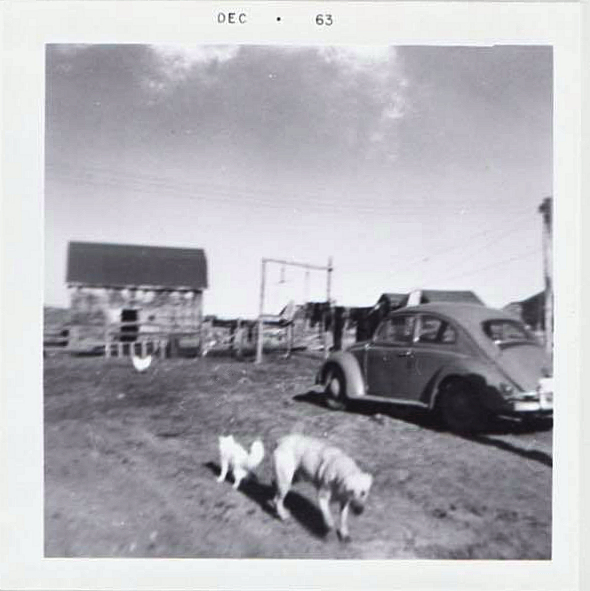
Bert’s farmyard after his death. (Raymond Wardill)

I heard my grandmother, Annie Davis, refer to him a number of times as ‘poor Bertie’.  As the eldest, she may have carried some sense of responsibility towards him, and indeed Annie and Richard called their first son after him. If Bert’s experiences in the Great War left him damaged or dislocated, he appeared to have lived a full life for over thirty years in his small rural community.

In Goodfare those who remember him described a successful hard-working farmer, tall and muscular, and a good friend to his neighbours. He never married and didn’t like to spend money, though he knew how to have fun, one said. He was also generous to the local school and community. As one of the first wave of European settlers, he was given two sections of virgin forest and scrub on lands taken from native peoples. He cleared these for agriculture and kept cattle and horses. For many years, he used a horse or horse and buggy to get around and was the first to have a motorised truck. One neighbour said he would take off for days at a time and no one knew for sure where he had gone. One woman speculated that he went to town and that as a single man, he had needs that had to be satisfied. However, it was also said that no such rumour had ever circulated in their small community. The nearest town to the rural settlement of Goodfare was Beaverlodge, twenty one kilometres away and there was a First Nations reserve near Horse Lake some six km north of his farm.

What drove Bert to his tragic decision was never clear. In May 1960 he was found in his truck a few days after taking his own life. Raymond Wardill, whose father bought Bert’s place after his death, says they thought that Bert had never paid any tax, and when the tax man finally caught up with him, it drove him to his sad end. Bert, he said, always worked in cash, and as children, they believed there were hoards hidden around the farm. They would often go looking but found nothing.

I recall my grandmother saying that Bertie had accumulated significant lands over his farming lifetime. But when his estate was distributed, the nephews and nieces were surprised that there was so little. The final accounts give no indication of where the bulk of the estate went. She said this could only be explained by the actions of a native woman and her family, which she must have heard about from his letters. But ‘the tax man’ collecting his dues is perhaps a simpler explanation.  Interestingly, all these recollections are filtered through the ears of children two generations after Bert.

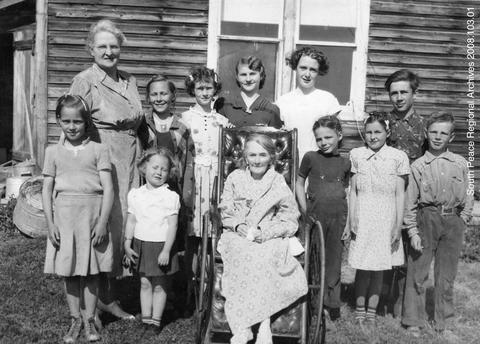
The following story about moving Bert’s horses is one on a number sent to me by Eileen Hommy and her daughter Svea. Eileen’s father was a Norwegian pioneer whose land sections were next to Bert’s. Other stories from Eileen and her sister Evylen can be read here: they include, Bert’s Cattle, Christmas Dinner, Stealing Bert’s Tobacco and Warming up at Bert’s. First, a photograph of Eileen, sister and other characters in the story below, at Southwell School.

Southwell School students and teacher c1949
“In the late 1940s Southwell School District held white elephant sales to raise money for Red Cross. Red Cross matched the money to provide a wheelchair for Mrs. Pretzer who lived beside the school. Back row, l-r: Mrs. Gladys Park, teacher, EileenTollefsrud, Florence Southwell, Mary Olychuk, Gloria Cavanagh, Arthur Tollefsrud. Front Row: Evelyn Tollefsrud, Roberta Weller, Mrs. Pretzer (in chair), Ruth Pool, Jeanette Chandler, Kenneth Pool. Southwell School District 4470 was located north-west of Hythe. Mrs Pretzer died in 1953.” From South Peace Regional Archives

A Daring Adventure with Bert’s Horses

It was June, and my older brother Arthur was still going to Southwell school along with my younger sister, Evelyn and myself. I would have been 8 years old, almost 9, so that would make it 1949.

The only teacher at our one-room log school was Mrs Park. The school was about ½ mile from Bert’s homestead. That day Bert stopped by the school to ask Mrs Park about taking Arthur, who had just turned 12, to come and help him move his horses from one pasture to another. He had 14 or 15 head of horses if my memory serves me correctly.  These were wild, unbroken horses. Unfortunately, Arthur had stayed home to help Daddy that day.

Bert, a tallish, muscular man who wore blue overalls and a cap, asked Mrs Park if she thought “The Girl” was up to it. He told Mrs Park that it wouldn’t be too difficult as the horses were up by his house, and she would just need to go around and bring up the rear, to drive them into the gate, which he would close behind them. So, it was decided that I would go.

Bert’s farmhouse was a log cabin of some sixteen feet by fourteen, larger than most, and with a wood stove that kept it cosy even when winter temperatures dropped to 30 below. Sometimes, when it was very cold, Bert brought us in to warm ourselves on our way to school. That was very nice.

By the time I got my horse Betty, out of the barn at the school, Bert was already on his way. I rode Betty bareback. Arriving there I turned sharply left to get around behind his horses. When Betty whinnied Bert’s horses started kicking, biting and rearing up. They were trying to get at Betty who was unfamiliar to them. Then they started to stampede. Instead of going towards the gate, they galloped in the opposite direction towards the creek. Betty raced in hot pursuit. There was no way I could hold her back. I can still see and hear Bert waving his hat and yelling “Girl! Come back!”

In June, the snow is melting in the Rocky Mountains, and our creeks and rivers are swollen. Raging torrents with deadwood and many uprooted green trees are taken downstream. Bert’s horses plunged into the roaring creek and my horse followed. There was nothing I could do. The opposite bank was too steep so the horses swam downstream to a low spot about 200 yards on the far side. I was half sitting, half laying across Betty’s back, holding onto her mane with my right hand and pushing the logs and trees away from us with my left. Betty was panicking and blowing loudly. Her nostrils were flared and I knew as soon as we got to the bank that she would race off again, trying to catch Bert’s horses.  They had climbed out of the creek and galloped away.

By the time we got out to the river bank Bert’s horses were out of sight. Betty was running hard and I had to let her go.  I figured she would find them. Not that I could have stopped her even if I had wanted to. She ran for about ½ a mile, going through some big poplars, heading towards Eddie Schweitzer’s place to the south. Before I knew it, Betty had turned and was heading back towards the creek. We were now much further downstream. I could see the tracks in the mud where Bert’s horses had crossed. Betty plunged into the creek again.  It was a good crossing spot, not so terrifying this time. 

When we got back up on the bank Betty galloped towards Bert’s house.  His horses had run back into the meadow where they came from, and on out through the gate into the new grass. Bert had been looking for me and Betty and was somewhat panicked. I am sure he had visions of telling my Dad, a big Norwegian and a good neighbour, that his daughter had drowned in the creek, helping him move horses. When he first saw me, he banged his fists on his knees, shouting, “Good job, girl! You’re still on your horse! My God, what am I going to tell your Dad.” 

After that, I went back to school because I had to get Evelyn. Bert came with me to explain to Mrs Park why I was soaking wet. Then I guess Bert headed to our farm to explain to Daddy what had happened. When Evelyn and I arrived home he had already been and gone. He had given Daddy $5 saying, “The girl had earned it.” That was an enormous amount of money at that time.  With it, I remember getting new shoes and new pants, and I am pretty sure Evelyn did, too. On my Mom’s advice, I told Daddy to keep the rest to buy something for someone else. We were a large family.

In the end, Bert got his horses moved, and I was $5 richer.  At school, Mrs Park commended me on a job well done. At home, my Dad told me never to do it again.  And I have never had such an exciting afternoon.

End

By Eileen Hommy with minor edits from SMcW.

Eileen and Evelyn’s full set of stories are here. Click.

Print pdf version here.

Notes

Thanks to Eileen (nee Tollefsrud) Hommy and her sister Evelyn Harding, in Beaverlodge for the bulk of the stories. And Eileen’s daughter, Svea Isherwood for recording and sending me the stories.

Also thanks to Raymond Wardill for his recollections. Raymond’s father purchased Bert’s farm after his death.

And to Walter and Thelma Pfau, neighbours whose family regularly sold stock to Bert and who clearly had an affection for him.

Finally, thanks to all in the Goodfare community who helped me collect these stories.