Colpey autumn 2021

A spinney of aspen stands out bright yellow on the hillside behind our farmhouse at Colpey. It grows on the edge of an ancient woodland that stretches a mile west to Gortcormican. If you look and listen closely, the leaves tremble in a gentle breeze; aptly named Populus Tremula, or in Irish, Crann Creathach, the tree that whispers with the world beyond. The aspen blaze briefly on the damp spring line that marks a pattern of old settlements, our farm included. Each tree is most likely suckered underground, a clone of its near neighbour, hence the spinney.
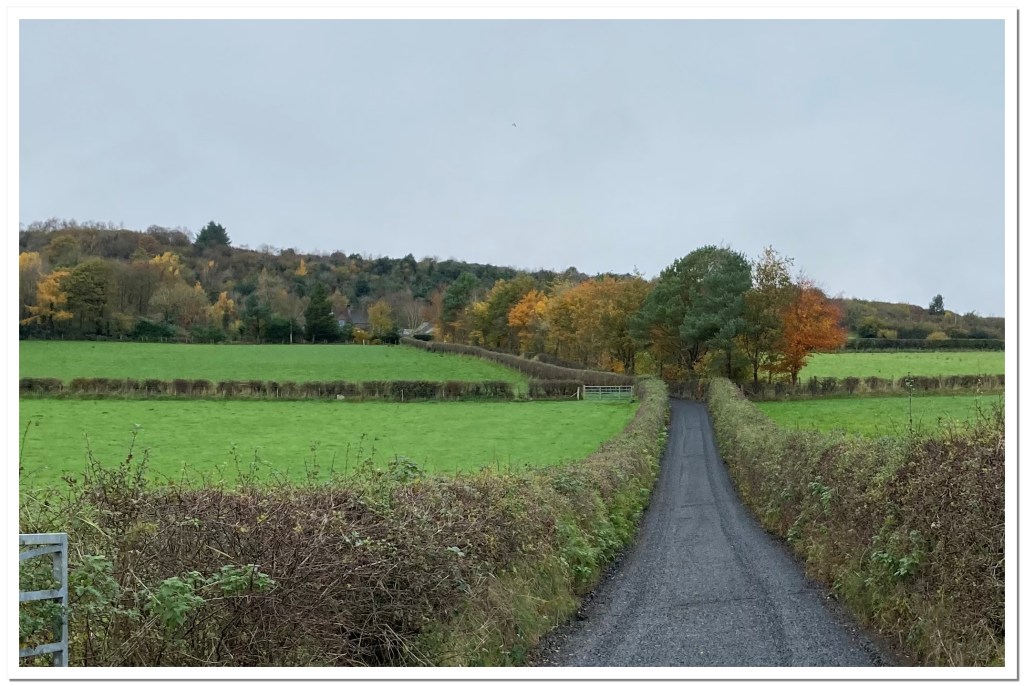
Colpey autumn 2021

On arriving, some thirty years ago, we planted thousands of trees that have now become a forest; but not the aspen, who knows how long they have been here. As the verdant shades of spring, and the reds and yellows of autumn bookend each growing year, so this autumn bookends our time living here at Colpey. Next spring, we will have moved into our renovated terraced house near the pier in Buncrana.

After the forest was planted, we established a tree nursery. At the time we had three young children, Berenice was about to return to teaching, and shortly I would be offered work at an engineering start-up, both better paid than the unknown returns from a risky venture. However, the notion of some type of farm enterprise had always attracted us and had brought us here in the first place. We had the energy, and farming the ‘25 good acres’ with its cattle and sheep seemed not enough at the time. The nursery, primarily a large poly-tunnel, was planned and set up with green hopes, to grow an annual crop of forty thousand broadleaf saplings. During the first and second years we found it impossible to discard the ten percent or so of plants that didn’t make it to saleable size. These saplings, no taller than twenty centimetres were set aside, and when time permitted, were dug into stony and rocky ground, near the aspen, where we thought they might survive. A few did, a handful of the couple of hundred we planted. They were either too small or weak to survive the rampant grasses and briars or were browsed by cattle. The nursery itself survived for about five or six years, its scale too small, the climate too wet, the soils too heavy.

The forest we planted seemed, on the face of it, simpler – and there’s a very inaccurate saying about forestry that you plant it and close the gate on it for forty years, until harvest. After a few years we had to replace hundreds of young wild cherry trees after they became infected with a canker; many of the sycamore and ash stems forked, needing to be heavily pruned; deer came to browse other young trees, and now over thirty years on, hundreds of semi-mature ash trees are dying with ash dieback disease (caused by an invasive fungal pathogen Hymenoscyphus fraxineus). Last winter many of these ash trees were replaced with sapling birch, and a new generation of deer came for the tasty green shoots. Tending the forest is good and pleasant work, and goes on. To see the forest, grow tall and full of wildlife is a wholesome pleasure.

About twenty years after we saved those small puny plants, I discovered a surviving oak tree, now over six meters tall. How had I, and the cattle, missed it all that time, although it had blended into the rest of the alders, ash and sycamores? It grows beside a track I walk regularly, into what we call ‘the rough ground’. It is tall, upright and sturdy. I gave it a hug last summer but missed its reply. A stone’s throw away is the spinney of aspen, which with the oak and rest of the trees on the hillside, will glow in shades of yellow and gold for autumns to come.

The townland name ‘Colpey’ – with only two farmsteads – or ‘Colpey Rocks’ as I have heard it called, is likely to derive from the old Irish word colpa or collop, meaning the area a cow would graze in summer; perhaps that too is appropriate for us now, alluding to an autumn movement more clement pastures.

End

Print and pdf version here.
A travelling bard.

One afternoon when I was about eight or nine, we returned to the empty farmhouse at Larkfield. There was a note under a stone on the windowsill, at the back door. It was scribbled in pencil on a torn sheet of lined paper. My mother laughed and read it out. As best I can remember, it went something like this. Certainly, it mentioned ‘tea’ and ‘the dog’s nip’.

My mother said that it was probably a travelling man, wanting a mug of tea and a slice of bread. He’d give you a note when he goes, as a ‘Thanks’. Sometimes he might want to sleep in the loft, though he had his favourite houses roundabout. He’d carry stories and recite poems. In summertime he could sleep outside, at the back of a ditch maybe. The tinkers used to come around too, with their tin cans and porringers for sale. They would mend buckets and such, with holes in them, here in the street.

I came with a blessing, and for a sup of cold tea,

Got the dog’s nip, for my trouble, ye see.

And bad cess to ye all, if ye hid from my sight.

Sure the next time I call, ye can put it to right.

Unknown travelling bard, around the late 1950s.

End

Print pdf here.

Postscript ‘Brothers at Law’

In the last couple of blogs, ‘Brothers at Law’, I told the story of brothers Alex, John and Richard, hoping to throw some light on the question as to how much this generation of the Davis family had a hunger to acquire land. Since posting these I have discovered a piece of work which gives considerable insight into the lives of Protestant tenant farmers at the time; the many pressures and influences that impacted them, and how they responded during those turbulent years.

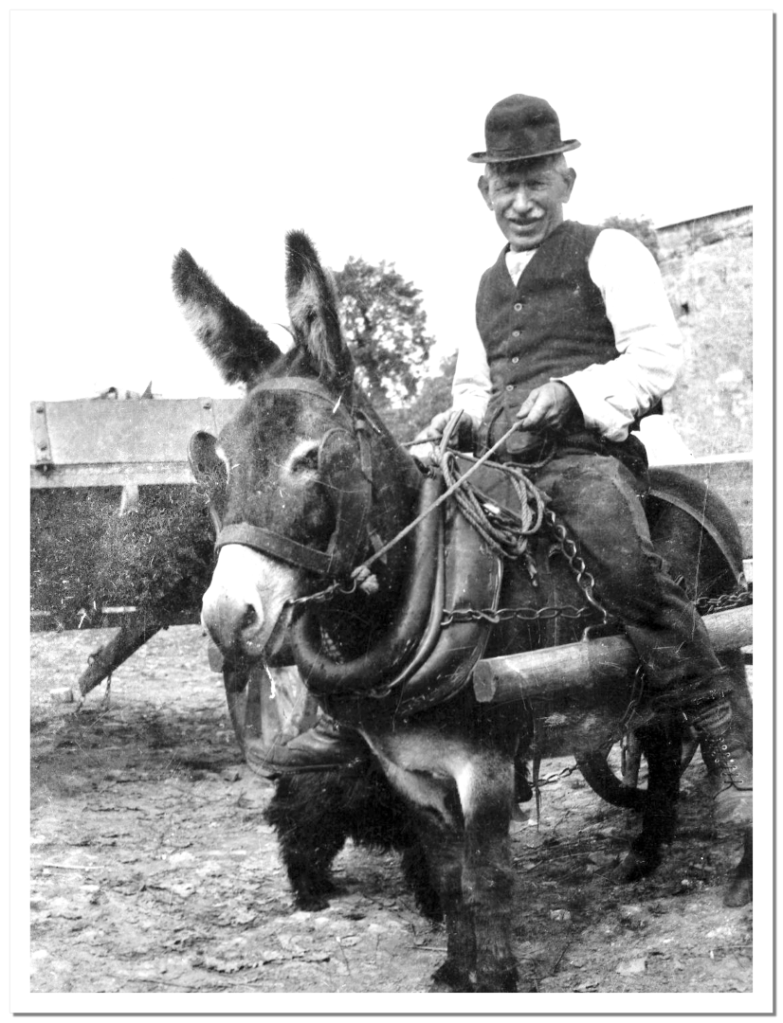
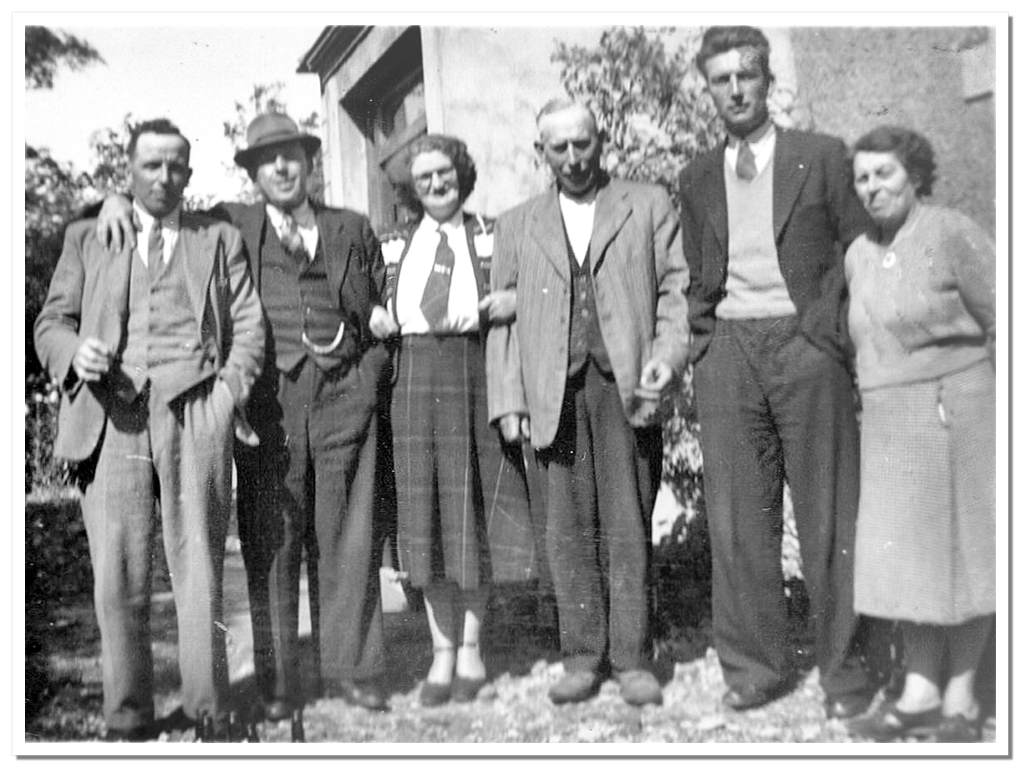
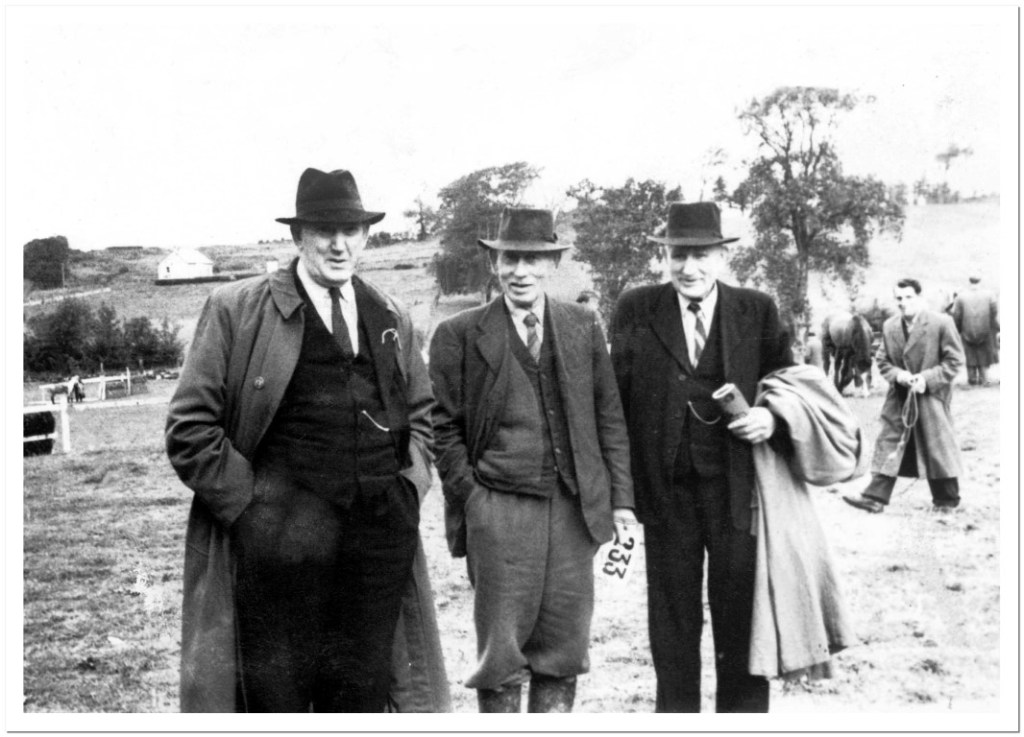
Richard Davis, centre, and friends at Manorhamilton Agricultural Show circa 1959.

But firstly, a brief mention of Mary Jane Davis, the only female of that generation. She appeared, by local recollections, to be a very strong-willed character. While her influence on her brothers can only be guessed at, it is likely to have been significant. After Mary Jane’s mother died in early 1910, she was noted on the next year’s census form as ‘head of the household’. Later that year Richard and Alex inherited the farm after their mother’s death, while Mary Jane was left a sum of money. Her imagined voice can be read in previous blogs, and I sense her influence behind the actions of Alex and Richard.

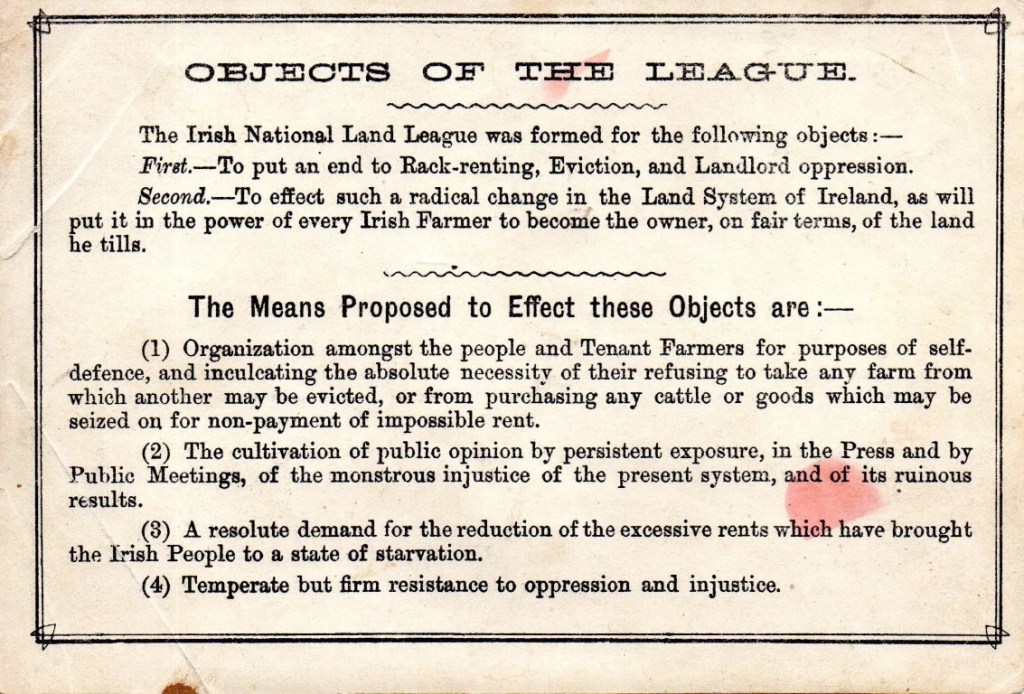
In Miriam Moffit’s chapter entitled, ‘Protestant Tenant Farmers and the Land League in North Connacht’ published in the “The West of Ireland” in 2010 (see Notes), she examines the responses and reactions of this group to the sometimes-violent campaign for land reform during the period, roughly 1870 to 1920. Her initial question was posed thus: ‘The commencement of populist land agitation in the late nineteenth century created a dilemma for Protestant tenant farmers. Was it in their best interest to support their Catholic neighbours, showing solidarity within their social class, or were they better served by aligning themselves with the landlords, thereby demonstrating a religious cohesion?’ Moffit goes on to examine the various forces at play and specifically examines the support and opposition to the Land League in South Leitrim (where John Davis and his friend John McCordick were boycotted when they took up evicted farms) and in Riverstown in County Sligo.

If you are interested in the question as to how Protestant tenant farmers, like the Davis and Gillmor families managed to live through this campaign for land reform then the full article can be read here. Moffit states that ‘Evidence from north Connacht confirms that the majority of Protestant farmers, both tenant and owner-occupiers, obeyed the law of the UIL (United Irish League, formerly The Land League) with some taking part in its organisation.’ Police (RIC) records from September 1901 showed that rents were universally unpaid in some Leitrim estates in areas with considerable numbers of Protestant farmers. The Church of Ireland Bishop, Alfred Elliot, whose diocese included all of Leitrim, complained that some of his flock were won over to the League ‘through their pocket’, ignoring religious and political ties. He also said there was intimidation of some, forcing them into withholding rents.

A Land League poster.

The resistance to the League and their actions against the Protestant famers and their families in South Leitrim and Riverstown are described by Moffit in considerable detail. In South Leitrim, the League’s boycotts and campaign were primarily directed against two Protestant families who maintained their position for some ten years. These were the families of McNeils and McCordicks, the later most likely John Davis’ friend – John McCordick and John Davis were born in the neighbouring townlands of Boihy and Boggaun. However, by 1910 John had built a house and was living with his family on his farm in County Meath.

It appeared that counter to the efforts of the leaders of Church of Ireland, aligned with Irish Protestant political forces, and the leadership of Orange Order lodges, many Protestant tenant farmers supported the Land Leagues efforts for a greater access to land in Ireland, withholding rent from the landlords and not taking up the farms of evicted tenants.

However, Moffit notes in conclusion: ‘In spite of evidence of accommodation between the communities, political leaders on both sides imbued agrarian hostilities with sectarian influences and portrayed them to a wider audience in a manner that did not accurately reflect the more accommodating situation on the ground.”

It is impossible to say how this impacted on the motivations of my grandfather’s generation at Boggaun, or indeed if it was a factor in the rift between the brothers described in ‘Brothers at Law’. However, the League’s campaign led to changes in land laws in the early years of the 1900s which enabled tenant farmers to finally purchase their lands. At Buggaun, the Davis farms, previously leased, were purchased during this time. The Land Commission, set up some years earlier became more involved in the re-distribution of estate lands, and again Alex and Richard made use of this opportunity to add to their farm. While some of the holdings re-distributed were described as ‘uneconomic’, by the mid-1920s there was an overarching sense that a greater social justice had been achieved.

From my earliest memories of visits to my grandparent’s farm, I have a sense of the good relations between the Protestant and Catholic community in north Leitrim, likely an outcome of the ‘accommodation between the communities’ during this period of land agitation.

End

Notes

Print / pdf version here.
Miriam Moffitt, ‘Protestant tenant farmers and the Land League in North Connacht’ in Carla King and Conor McNamara (eds), The West of Ireland: new perspectives on the nineteenth century (Dublin: The History Press, 2010), pp 93-116. Chapter 5 here.

Wikipedia: The Irish National Land League. https://en.wikipedia.org/wiki/Irish_National_Land_League

Brothers at Law, concluded.

Continuing the story of ‘Brothers at Law’, with John and Alex Davis, Alex’s wife Margaret and his brother Richard, involving a farm in County Meath and in County Leitrim.

By 1910, when John’s father and mother had died, he had moved to County Meath and was building a substantial house, ‘Boyne View’, after living and farming for some fifteen years in south Leitrim. In his mother’s will, his father having died the previous year, John was left 10 shillings while his brothers, Alex and Richard, inherited the family farms. John never claimed his share, probably considering it derisory, and perhaps feeling it an affront to his sense of himself as a “self-made man”. Maybe he had fallen out with his parents, or they considered him wealthy enough without any of their inheritance, we do not know.

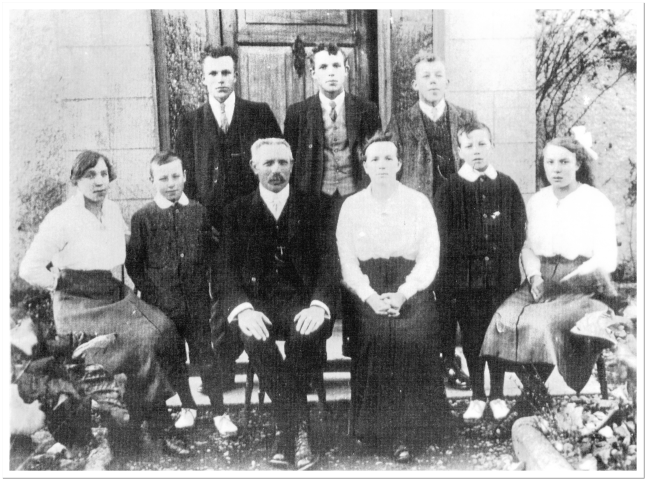
John and Maria Davis with their family outside their home at Corballis, c 1930. (James, eldest had by then emigrated to the US)

Alex married Margaret Taylor in 1918, a few years after her husband died. Margaret was John’s widowed sister-in-law who had spent time living with his family before her first marriage. Alex claimed that when he moved to Margaret’s farm, he came with nothing. This must have further stoked John’s ire towards his brother. It appears from postcards between Margaret and Alex, aged 36 and 49 respectively when they married, that they had some plan in mind, possibly that the brothers, Alex and Richard, would attain a foothold in County Meath, as John had done. For ambitious farmers in the west, a move to the better lands in the east was considered a major achievement. Significant land reform at that time had encouraged a broader ownership and, along with the breaking up of large estates, resulted in considerable land sales and transfers.

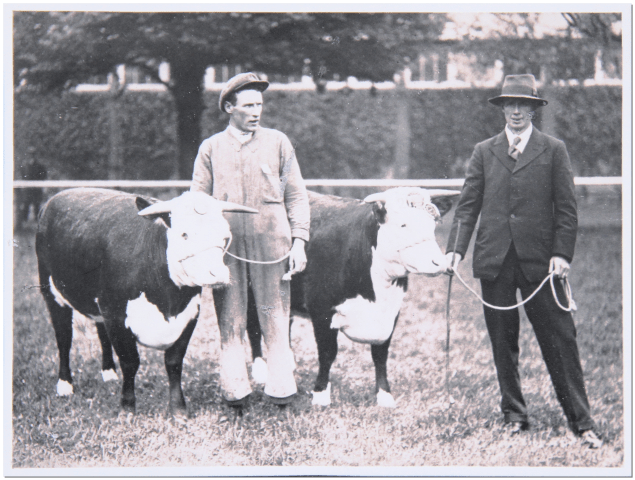
Some of John’s prizewinning stock.

A year or two after Alex arrived there, John sued him for damages to one of his horses. John was exhibiting his farm stock at various shows, including the Royal Dublin Show, and had a considerable standing within the farming community. Due to the War of Independence and then Independence itself, court work was upset for some years, and it was 1925 before John’s case came to the District Court in Drogheda. Indeed, in the previous year there was a trespass case in the courts against Margaret and Alex, which was supported by John, against the couple. Clearly there was considerable friction between the two neighbouring households. In a further unexplained twist that same year, Margaret advertised their farm for sale in a local newspaper. 

Alex Davis after returning to Boggaun c 1934.

The case, ‘Brothers at Law’, and Alex’s appeal is reported in the Drogheda Argus, 1st August and 14th November 1925. It is interesting to read it in full, particularly as the court reporter appeared to have an ear for dialogue, read it here in full. Some highlights are as follows:

Mr Tallen, representing Alex, defended the charge,

“(Alex)… had no means of any description. The debt of £34 17s 3d sued for was not an ordinary debt as between the plaintiff and defendant. They were two brothers and lived next each other. There had been a lot of bickering going on for a number of years and there was an action brought by John Davis against Alex Davis for injuries to a horse which was alleged to have got frightened as the defendant’s conduct and the Co Court Judge gave a decree.”

Mr Mullen for the plaintiff, John, cross examining,

“Are you going to tell the Court you walked into a woman with thirty acres and had absolutely nothing yourself?

Alex – “Yes, sir.”

“You walked into the woman without a penny piece?”

 Alex – “She asked me … ” (laughter)

“We won’t mind the romance; let us come to the £ s d part. Did you bring any cattle?”

Alex – “I didn’t bring one heifer.”

Mr Mullen questioned Alex on the will on the home farm in Co Leitrim,

Alex – “There were 23 acres odd in the farm that I assigned at Dromahaire, Co Leitrim. It was of more value when it was above water (laughter). There was a claim against me by a workman named Gallagher, and my brother (Richard, smcw) took payment of it. As a consideration for that I released any claim I had to the farm, and soon afterwards I came to the Co Meath. My brother (John) was living beside the widow and annoying her. I took the widow and her small farm – or she took me in.” (laughter)

Mr Mullen – “And that put the tin hat on your brother’s chance of the small farm.”

Justice Goff’s judgement,

“Mr Goff said he was satisfied that the defendant’s services on the farm for a number of years were very valuable, and if he had got no payment, it should be a very small thing for his wife to settle this debt. Accordingly, he would make an order for payment by instalments of £5 a month and £1 5s costs, the first instalment to commence 29th August.”

On appeal by Alex, Circuit Court Judge Doyle ruled a few months later, this was again reported in the same newspaper,

“His Lordship said he was perfectly in accord with the order of the District Justice. Apparently, the defendant had evaded the responsibility in Co Leitrim by some subterfuge which he could not understand. He had contracted responsibilities in Co Meath which had been forced against him in Co Louth, and very properly. He affirmed the order.”

A group of Davis family from Co. Meath visits Boggaun c 1960. Annie and Richard Davis are first and third from the left.

Margaret died four years later in 1929, and some three years afterwards Alex returned to his home farm in County Leitrim.  For Richard, other events in the mid-1920s had overtaken any hopes of farming in County Meath, if that had been his intention, with the collapse of his cattle business after his partner absconded to Canada with the proceeds of a cattle shipment.  It is not known what happened to Margaret’s farm, or if it was ever assigned to Alex after her death. Local reports said that Alex returned home penniless.

This murky dispute, however unpleasant, had little impact on the wider families and in subsequent years the Davis families in Meath and Leitrim kept up close ties, visiting each other regularly, drawn together, to a degree, by a mutual interest in horses.

End

Print and pdf here.

‘Brothers at Law’

The past series of blogs have attempted to capture a sense of the lives of my grandfather Davis’ generation, all born at the Boggaun farm in County Leitrim. There is a final story I want to relate which illustrates an aspect of the family that puzzled me. Doing the background for these stories I had asked a number of times if the Davis family had a hunger for land, and the answer I got back was that it seemed no greater than that of most farmers. However, I discovered a report of a 1925 Drogheda court case that indicated the potency of land in a protracted quarrel between three of the Davis brothers: John, the eldest, Alex, his younger brother by eight years, and Richard, the youngest.

John Davis c 1920

John Davis was born in 1861 at Boggaun, his grandfather having taken up the lease there by 1850, most likely on what was a bankrupt Famine-era farm. Richard, my grandfather, the youngest died there in 1961. This period of 100 years saw enormous transformation in Ireland. In 1861 Ireland was governed by the Protestant Ascendancy, a century later it had been independent for forty years.

Alex Davis after returning to Boggaun c 1934

I have fond memories of my grandfather Richard. He gives me some connection to his older brothers and sisters, none of whom I knew. He witnessed a period of significant change. While keeping the values of his Church of Ireland community, and with a strong ambition to better himself and his family, he was able to accommodate the transition to a new Ireland, at a time when many of his contemporaries emigrated. After Independence he stood for election with the Ratepayer’s Defence Association (a proto Fine Gael party) and polled a reasonable number of cross-community votes. He won widespread support and respect when he put his family and farm into severe debt, following the collapse of his cattle shipping business, to pay farmers for their stock.

Richard sketched from a damaged wedding photograph, 1918.

‘Brothers at Law’ is a story of the conflict primarily between John and Alex, with Richard apparently involved. John left his home farm on his marriage to Anna Maria Cartwright in 1883 and moved to her home in south Leitrim. At that time Alex was farming at Boggaun, while Richard was a child of four. In south Leitrim John became embroiled in a conflict with the Land League, settling on an evicted farm at Garradice where he was boycotted as a “land grabber”. He faced down this opposition and appeared to prosper. Ten years later with a family of eight he had the resources to move ‘lock-stock-and-front-door’ to a farm at Corballis in County Meath. ‘Lock-stock-and-front-door’ because John brought with him his County Leitrim front door which was fitted to his new home, ‘Boyne View’. Some years ago, this door was replaced by the current owners and was used in an out-building, as it was still of good quality and in some respect to its history. John’s family most likely travelled to County Meath by train as there was a train halt very close to their Garradice farm.

Sisters, Maria Davis and Margaret Davis, nee Cartwright, c 1927.

John encouraged a south-Leitrim friend, William Taylor to make the move to County Meath, and William built a house on a thirty-acre farm adjacent to John at Corballis. Their houses were some 50 yards apart. In 1911 William married John’s sister-in-law Margaret Cartwright. William died in 1916 and in his will, he left everything to Margaret. The will was challenged in the High Court by William’s brother. The Court ruled for Margaret, and she took ownership of the farm. Two years after William’s death, Margaret married Alex Davis and he moved into the farm beside his brother John; Alex was 49 and Margaret 36 at that time. Margaret appeared to play some role in the brother’s quarrel.

To be continued in next blog.

Print and pdf here.

Thomas and Minnie Davis

Another piece of the Davis family jigsaw falls into place around Dick Davis and scant memories heard in my grandparent’s house. It begins with Dick’s father Thomas, and again with emigration. Thomas was the second eldest brother of my grandfather’s generation, born in 1865 at the Boggaun farm. He emigrated to Canada in 1886 when my grandfather was four years of age. Some six years later Minnie Gillmor from Dromahair emigrated to Toronto, and Thomas and Minnie were married there in 1893.

Minnie and Thomas Davis, possibly on their wedding day 1893.

Thomas, like his uncle and namesake who had emigrated from the farm in 1861 (see earlier blog), was an Orangemen of a conservative mind, and both carried these concerns into their new lives in Canada. As Thomas was preparing to leave County Leitrim his Orange Lodge became engaged in what would be a twenty-year-long opposition to the Home Rule Bill, which Unionists saw as a threat to their position, giving greater autonomy to the Irish parliament. The nation of Canada was only thirty years old when Thomas arrived. It was a turbulent time. The previous year saw the military defeat of a major insurrection of native peoples in the North-West.  One of the leaders of the rebellion Louis Riel was tried and executed for the killing of Thomas Scott, an Irish immigrant and Orangeman. Scott was seen in Ontario as a martyr while the outcome of the rebellion, particularly the execution of Riel increased Anglo-Francphone tensions.

Thomas Davis first settled in Barrie some 40 miles north of Toronto before moving to the city where he was married six years later. At that time, he was a tradesman, a painter. Minnie Gillmor with her assistant, Mary Sweeney, left Dromahair for Toronto in 1891. It is possible that Minnie’s emigration was driven by some defining incident or perhaps an independent streak which was out of step with the times. Minnie, with Mary arrived, in Toronto with funds in reserve and it is possible that these helped Thomas move into a career in journalism, writing for The Mall and The Empire among others, and then later to set up a real estate business, Thomas E. Davis and Co, which he ran for twenty years.

Thomas and Minnie were probably acquainted before they left Ireland. Thomas’s family would have known the Gillmor family and frequently visited their general shop in Dromahair.  However, Minnie was some 6 years older, and a match would have been seen as inappropriate. In addition, the Davis family at Buggaun were of farming stock with little notable wealth or pedigree, at least within their Protestant community, and Thomas would not have been considered a suitable match for Minnie.  When Thomas emigrated, the two may have kept up some form of communication. As a tradesman it is unlikely that he would have been able to afford the fare back to Ireland to see Minnie. The steerage fare to Ellis Island during these years was approximately half the yearly wage of an Irish labourer, not including the transport and expenses at either end.

Mary Sweeney, who after emigrating with Minnie, lived the rest of her life with the Davis family.

Minnie’s family background is interesting. In 1850 her parents Robert and Mary Ann Gillmor had emigrated to Cascade, Iowa, in the United Sates along with Mary Ann’s sister, Sarah and her husband, the Rev John Bates, a Baptist minister. The Gillmor family converted to the Baptist faith. Iowa was seeing large numbers of European families arrive at that this time following the earlier ‘Black Hawk Purchase’ when the government forcibly took over native lands after their defeat under their chief Black Hawk. The Sauk, Meskwake and Ho-Chunk native peoples were forced to give up all rights to the lands for the equivalent of around 11cents an acre.

The Irish colonists settled around Cascade, a small settlement of about 400, setting up a homestead and a farm in difficult and unfamiliar conditions. Stuart James, Minnie’s eldest brother, and his sister Ann were born in Washington Township near Cascade. The family ultimately decided to return to Ireland, possibly after news of the death of Mary Ann’s father.  With continued immigration driving up Iowa’s land prices, the sale of their farm and homestead turned a tidy profit.

On returning they settled in the townland of Cleen just outside the village of Dromahair. Stuart went on to establish ‘S.J. Gillmor’ a general merchant shop in Dromahair, where my mother, Ena Davis, later worked work in the 1940s. The family joined their old church.  Drumlease Parish Church records show their unusual adult baptisms in 1878, when Minnie was nineteen.

Minnie Gillmor Davis

Whether her parent’s experience of emigration and return impacted the young Minnie is speculation. However, when she emigrated across the Atlantic to Toronto Old-World traditions were easier to ignore and in 1893 Minnie and Thomas married. On their marriage certificate Minnie and Thomas are shown as being the same age, perhaps consigning the thorny issue of Minnie’s age to Old-World history. Mary Sweeney would remain living with the family throughout her life, helping to raise their family. She outlived Thomas and Minnie and continued to live in the family home after their deaths and she is buried with them in the family plot.

The global economy was turbulent during the early years of the 1900s, and similarly Toronto was going through cycles of boom and bust, with high employment compounded by returning WW1 soldiers. Thomas’ real estate business rode these choppy waters. Despite renting out multiple properties at one point, at the end of his life it was said that Thomas’ only property was the family home.

A photograph of Dick Davis taken from his 1998 Memorial Service booklet.

Minnie clearly had an independent streak and became a woman of some substance. As her family grew, she became a noted writer and poet, according to her obituary. She used the name ‘M. Gillmor Davis’ or Mrs Gillmor Davis’. In 1912 she penned the noted patriotic WW1 sone ‘Fly the Flag’ and also ‘The Old Homestead’.

Their family household would have been an interesting place to grow up and develop. Their first son, Richard “Dick” Davis was born in 1894 when Thomas was still a painter.  He contracted TB at an early age, permanently damaging one knee and rendered him ineligible for service in WW1. He developed different sensibilities to his father, earning a Masters in Economics and Sociology. Dick began his working career with the YMCA. He then led the Canadian Youth Commission and went on to become the Executive Director of the Canadian Welfare Council, an NGO which influenced social policy development in Canada. He also held Adjunct Professorship in Social Work at The University of Toronto. Dick married Margaret Svendsen, originally from Oslo, Norway, who became a recognised child psychologist in her own right. They had one son Eric and one grandson Reade, both of whom became professors.

Despite his father’s lifelong involvement in conservative politics, Dick was strongly shaped by the economic depression of the Interwar years and became somewhat more left-leaning In his politics, with a strong commitment to social justice and robust social programs. For his contributions to the field of social welfare in Canada, Dick received two honorary PhDs and was awarded with the Order of Canada.

End

Notes

Print pdf version here.
Dick and Margaret Davis had one son Eric and one grandson Reade, both of whom became professors. Dick had two brothers and a sister; his eldest brother Stewart barely survived WW1 nerve gas but returned home to become a professional football player with the Toronto Argonauts. Like his father he later moved into real estate and then into his father-in-law’s coal business. He had a family of four. Dick’s sister, Kay worked in the Admissions Office of The University of Toronto and never married. His youngest brother, Alf, after a university education followed Dick into the YMCA. He was married twice and had one child.

It is interesting to note that in the above mentioned North-West Rebellion, Louis Riel, one of the leaders, was a descendant of Jean-Baptiste Riel dit L’Irlande born in Limerick, who emigrated to Canada around 1700.

Thanks to Reade Davis and Des Gillmor for the benefit of their research and review.

Images from the early 1900s

Looking through photographs and postcards for the last series of blogs, ‘Silent Soldiers’, I came across a number that are worth recording here. They are from the early 1900s and were found in the Davis farmhouse at Boggaun in County Leitrim. They appear to be keepsakes collected by my grandmother Annie Davis (nee Gillmor) and by Alex Davis, her brother-in-law who returned to his homeplace after for some years living at Corballis, Co Meath.

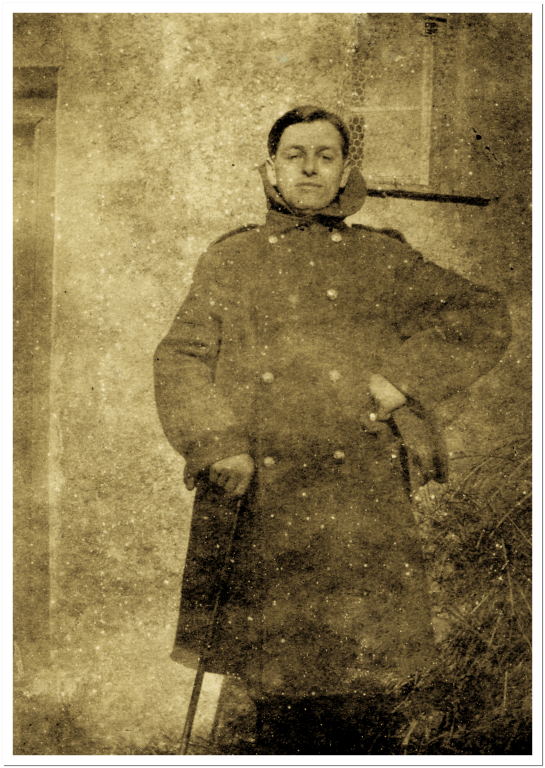
Referring to the last blog on the WW1 experience of Bertie Gillmor, the back of this photograph notes “Jack in Bertie’s Coat”. Jack was Bertie Gillmor’s younger brother, seen here posing in Bertie’s great coat, with his cap and walking cane. The photograph was taken at the rear of their home at Boihy following Bertie’s discharge from the Irish Guards in 1919.

—OO—

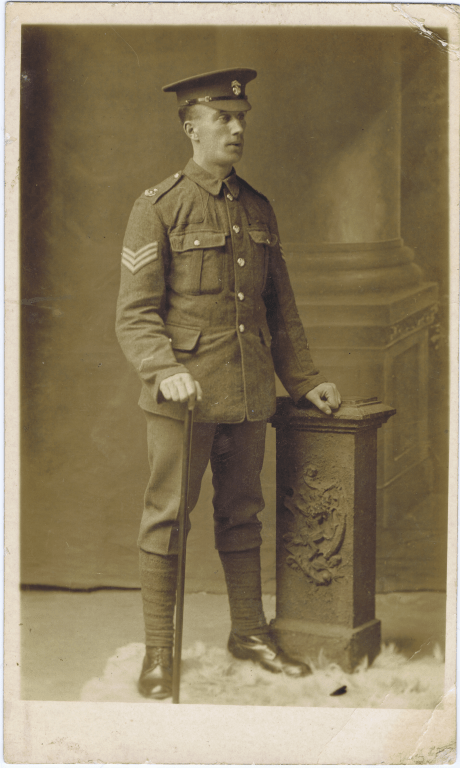
At first this striking WW1 photograph was thought to be that of Bertie Gillmor. However, following a review by volunteers at ‘the great war forum’ it appears that he was a sergeant in the Inniskilling Fusiliers. A search revealed the most likely candidate as John “Jack” Young Foster, a County Cavan relation of the wife of Alex Davis, Margaret née Cartwright. His uniform displayed badges for overseas service and marksmanship. The regiment was sent to Ebrington Barracks, Derry in 1916 after serving in Serbia, Greece and Egypt, and left again for France in December of that year. The photograph was taken by “Frank Coghlan, Carlisle Road, Londonderry”.

The poet Francis Ledwidge was also a member of this regiment and wrote many of his poems during this time in Derry. Neither man returned to Ireland. John Foster died of his wounds in France in April 1918.

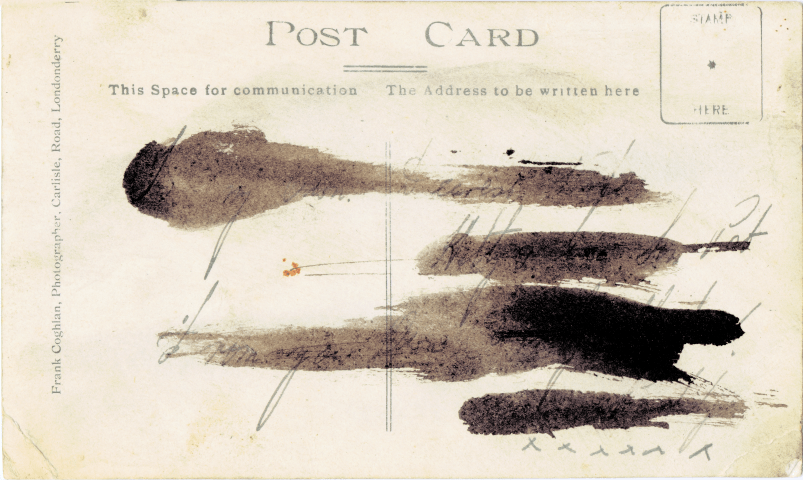
Why the writing on the back has been inked out is a mystery; someone did not want it to be seen or read. The words “To my son and dearest wife Kitty and son Pat” can just about be made out.

—OO—

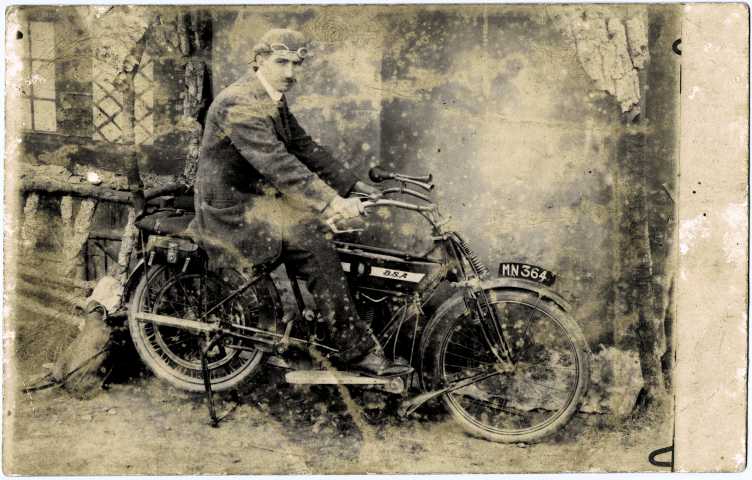
This post card was addressed to Miss Gillmour (misspelling of Gillmor), my grandmother Annie, and was probably sent by an admirer around 1910. The post mark is ‘Sligo’ but the photographer is ‘Josie Roth, The Lady Photographer’ from the Isle of Man. The motor bike has an early Isle of Man registration number.

—000—

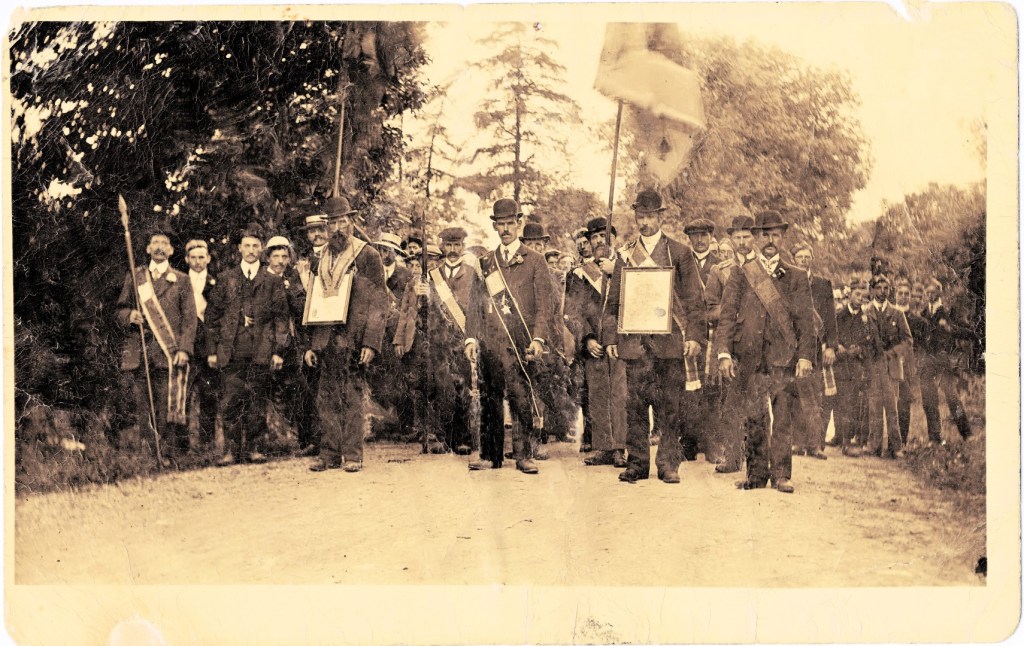
This fascinating picture postcard is of an Orange Lodge march is post marked Newtowngore, south Leitrim, 1909, a time of anti-Home Rule agitation. (Home Rule was intended to give a greater independence to Ireland within the UK but was generally not favoured by the Protestant community in Ireland.) The serious looking men with their Orange regalia are flanked by young men, some wearing pillbox hats like those of the Boy’s Brigade.

The card is signed by “W. T.”, likely to be William Taylor, and addressed to John Davis, referred to “Jas” on the card. John Davis, eldest brother of my grandfather’s generation, had moved from the Newtowngore area of south Leitrim area to Corballis, Dunore in Co Meath around 1906. William followed him and like John built a house there, marrying John’s sister-in-law Margaret Cartwright. When William died John’s brother Alex married Margaret. Living a stone’s throw apart, the Leitrim brothers had a stormy relationship which ended up in court when John sued Alex for damages caused to his prize horse.

—OO—

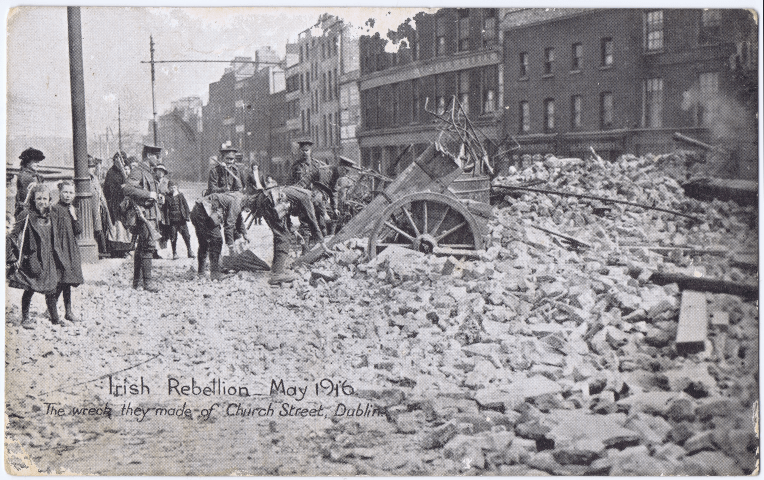
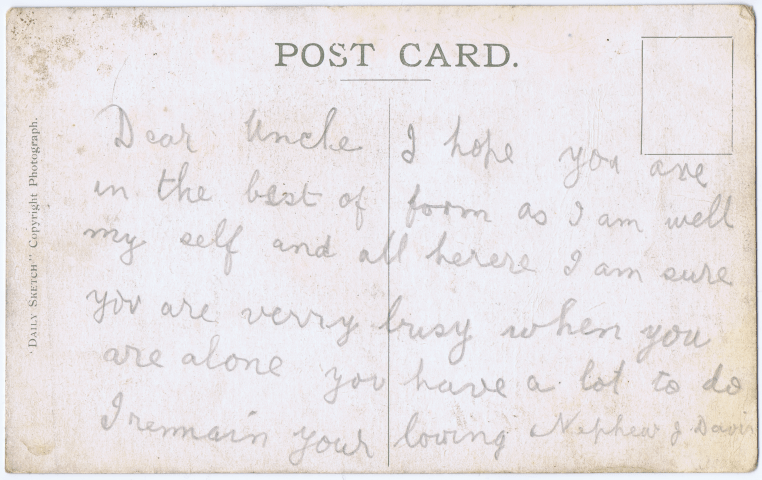
This final post card depicts the aftermath of the Easter Rising or referred to as the ‘Irish Rebellion May 1916. The wreck they made of Church Street, Dublin.’ It was written and sent by James Davis, eldest son of John and Anna Maria Davis, Corballis, Dunore, Co Meath, to his Uncle Alex who lived close by. Sometime after Margaret’s death Alex moved back to his home at Boggaun in County Leitrim and perhaps the card refers indirectly to her recent death. James emigrated to Alberta in Canada with Bertie Gillmor in the early 1920s, and settled in Daysland.

End

Bertie Gillmor, a WW1 survivor, just.

Herbert M. (Bertie) Gillmor, my grandmother’s favourite brother, survived three years with the Irish Guards during WW1. He was born at Boihy near Manorhamilton, County Leitrim in 1893. While in the trenches in France, Annie, his sister worried about him, reading the war poets and poems of that time, following the fortunes of that awful war. Later I often heard her refer to “Poor Bertie”. Hospitalised three times with significant injuries he was finally discharged from the army in August 1918 a few months before Armistice Day. Two years later, as a European settler, he was clearing virgin forest to farmland at Goodfare in northern Alberta.

A formal photograph of Private Bertie Gillmor in the uniform of the Irish Guards.

The second eldest of six surviving brothers and three sisters, Bertie volunteered to join the Irish Guards, an infantry regiment, in November 1915 at Boyle, County Roscommon. A recruitment campaign running since the start of the war was countered by Irish republican activists. In total some 150,000 Irishmen volunteered over the course of the war, and in Ireland and Great Britain combined almost one in four of the male population joined up. The story told here takes place over three years during World War One and is not an attempt to paint Bertie’s hardship and suffering; the facts speak loudly enough for us to imagine the imprint left on a young man in his early twenties.

In July 1916 after completing his training, the tall young soldier travelled by train to Southampton and then by troop ship across the channel to Harfleur, to join the Second Battalion of the Irish Guards at a large base camp near Le Havre. The third phase of the Battle of the Somme was beginning. During the first days of the Battle of Flers -Courcelette in mid-September, his regiment were ordered to attack from their trenches into heavy German machine gun fire. There were many casualties, and Bertie was wounded in his right arm. His injury was complicated by broken bones and with many other casualties he was returned to England a few days later. He spent most of following three months in a South London hospital before being discharged and returned to his regiment.  

His comrades meanwhile had been at the front line of the battle, suffering great loss of life. When he joined them towards the end of the year, they had been withdrawn from the front on a rest period and would not see military action again until the following summer.

One night in April 1917 Bertie was in the company lines shaving. The wash house was dimly lit and while passing his glass to another soldier he cut himself deeply on the hand. He was taken to a field hospital and treated. However, the wound went septic, and he was soon on his way back across the channel to Warley Military Hospital at Brentwood.  This time it was a short stay, and he was discharged a week later. That was not end of it however, and his superiors suspecting that the injury was self-inflicted, summoned Bertie to a Court of Enquiry the following month at Warley Barracks. Two witnesses to the incident, Private J. Maher and Private J. Crilly were also present in Brentwood, and as a result their testimony together with Bertie’s, the injury was judged to be the result of an accident, no fault of his own.

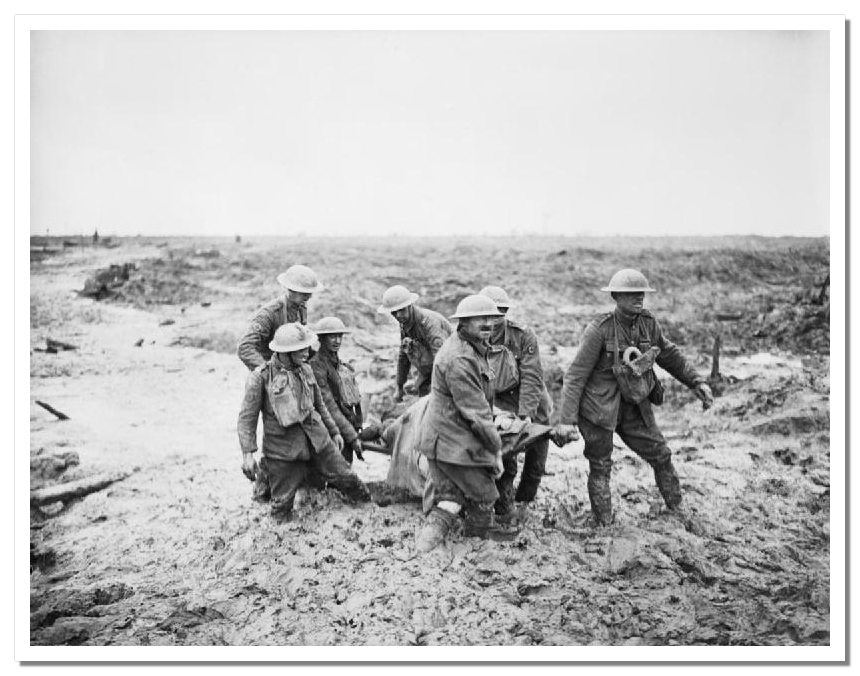
Stretcher bearers in the mud with an injured soldier at Pilcken Ridge, Ypres, Belguim, September 1917.

By the end of June 1917, he was back again with Second Battalion in northern France where they were deployed in the Battle of Pilcken Ridge near Ypres on the Western Front. He escaped this bloody period with only a minor injury.  In August after being appointed Lance Corporal he was sent to Herzeele near Dunkirk for a “bombing course”; possibly his previous injuries coming to bear. The Irish Guards had seen considerable action during first half of 1917 with major losses, and from August to early December they were withdrawn from the front.

In early 1918 Bertie was in action again when was severely wounded in the back, noted on his casualty form as “shell wd back” and “g. s. w. back sev”. After spending two months in a large hospital, the converted Hotel Trianon in Le Tréport in Normandie, he was transported back from a beautiful seaside town to England for the third time. He spent a further two months in The King George Hospital at Waterloo in London from where he was discharged in May and given 10 days leave. He never crossed the Channel again.

While his battalion were involved in the hostilities up until the end of the war a few months later, and continued to suffer high casualties, Bertie he was given a “free warrant” in August 1918 at Shoreham in London and, claiming no disability, his war was over. After some months basic educational training he was demobilized from the Army Reserve in early 1919.

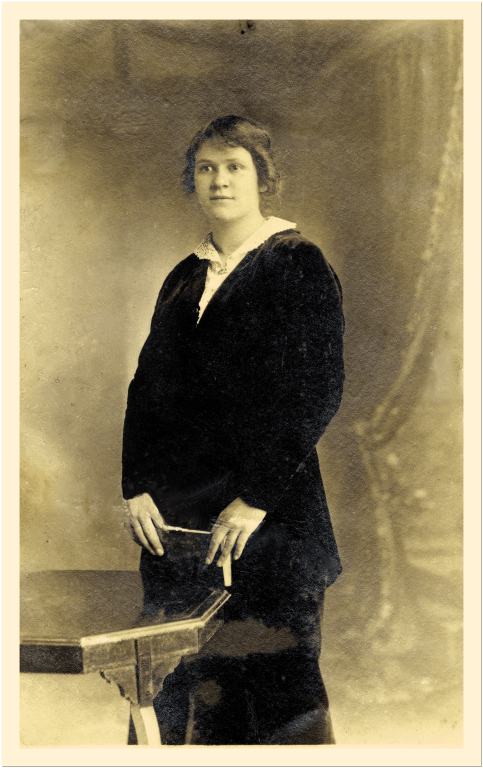
A photograph post card scripted “To Bertie”.

On the back of this postcard of a young woman it says: “To Bertie”. These photograph postcards were popular in the early 1900s. On this one the printed text is in French and English, as was Bertie’s formal photograph above. The handwriting shows a name, possibly “Wyma S Zeare”, the card most likely a keepsake from the young woman he met during his time in hospital by the sea at Le Tréport.

Returning to County Leitrim, the young man of twenty-five, a survivor of trench warfare, may have felt out of place, dislocated.  His Protestant community were still reeling after the Easter Rising and the ongoing War of Independence, and then Sein Féin’s landslide electoral victory. A notice in Irish newspapers offering free land in Alberta, Canada to those willing put their backs into it, would again draw him far from home.

End

Notes:

The photograph of Bertie copied here is from Christine Jordan, Bertie’s niece. There is a similar, less formal one of Bertie in a collection belonging to my Grandmother which includes the young woman shown here. In this collection there are also a number from Alex Davis, who has appeared in previous blogs, including some from his wife. Many of these are interesting in themselves and will be published in upcoming blogs.

Details of Bertie’ army service, uniform and regiment details and were confirmed and sourced with the help of those volunteers at www.greatwarforum.org

Constable William Davis

William was eight years old when the first hostilities broke out between the British and the Boers in 1880 as the Scramble for Africa was underway. At the time he was walking a mile or so over the fields to a very small school near the Bonet river at Cloonaquin. There he heard stories of the ‘valiant’ efforts of the British and their soldiers to ‘civilise’ Africa. The school was funded by a local landlord, John LaTouche for his Protestant tenants.

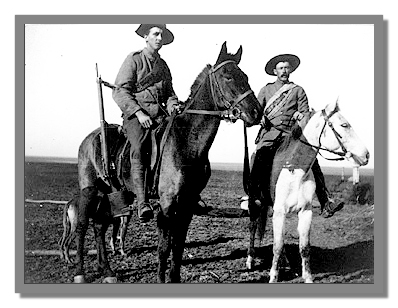
Two members of the South African Constabulary set up in 1900.

The Boers won the initial encounter setting up the South African Republic and the Orange River Colony.  Almost twenty years later conflict broke out again over the same territories in what became known as “The Boer War”. This time the outcome was different, the British won, and William would play a part in the establishment of the new colonies.

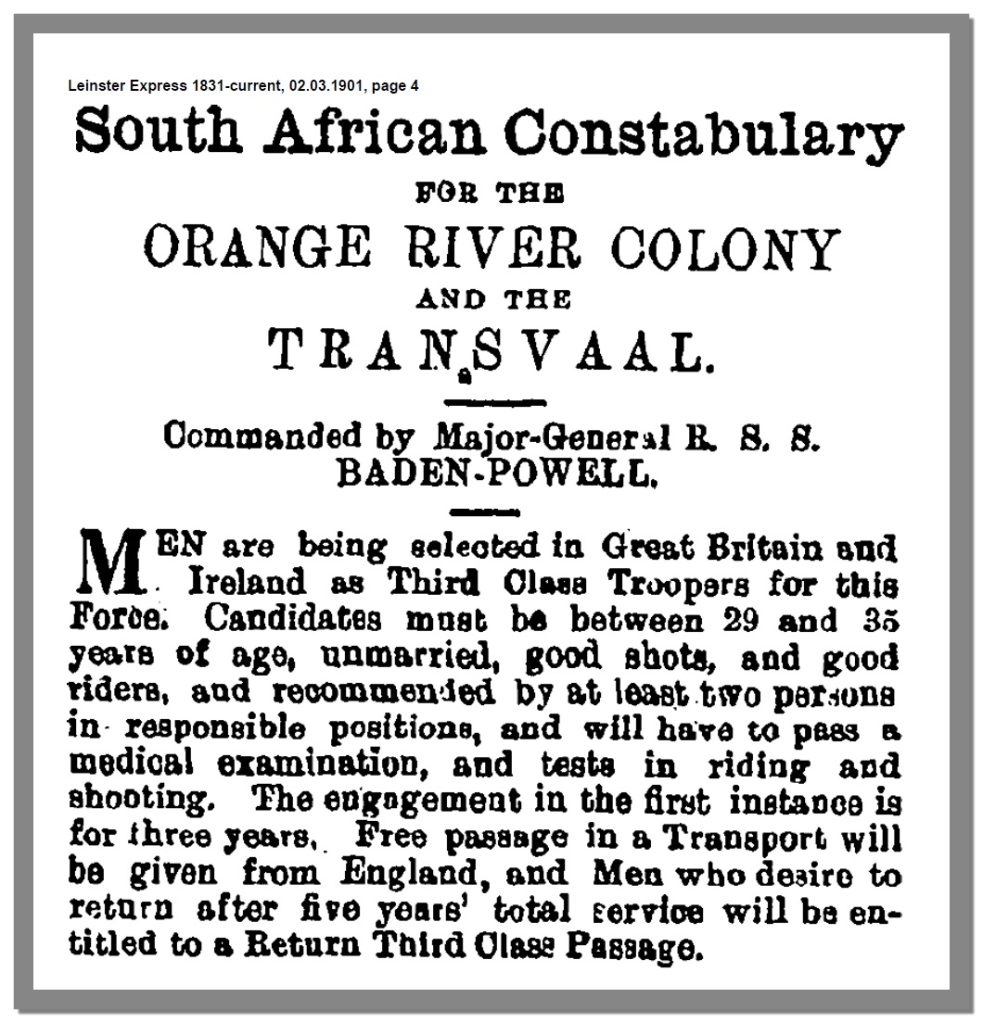
After his bothers Robert and James joined the army William spent the next fifteen years living and working on the farm at Boggaun with his father, James, his remaining brothers Alex and Richard and his sister, Mary Jane.  What prompted him to leave after this time? There had been adverts in the local newspapers recruiting for the South African Constabulary (SAC) with the promise of assisted settlement for those who wished to stay after their term was over. Recruitment to Irish-based regiments had stopped at the time due to fears of rebellion in Ireland; a concern that the Irish would take an example from the defiant Boers. Given that there had been a number of difficult years with low farm incomes, coupled with the family’s unease at the Nationalist campaign for change and the growing clamour for Home Rule, perhaps William was drawn by the opportunity of a life elsewhere; as had many others before him from the Boggaun farm.

Leaving behind the love of his life, perhaps with vows already made, William set off on the long journey by train across Ireland, down through England to Southampton where the assembled recruits boarded troop ships to South Africa.  The steamer had about 200 men, small by comparison to the larger and more frequent army ships, taking men, horses and heavy equipment to the southern Africa. The last batch of recruits for the South African Constabulary left England in June 1902, likely with William onboard. He arrived in Cape Town over two weeks later, the sea voyage initiating him to a new life with new friends. But he was ill-prepared for the experiences of Africa in the aftermath of the Boer War.

An advert placed in the Leinster Express in Mrach 1901.

When they landed in Cape Town the war had ended a few months earlier. The new recruits to Baden-Powell’s police force travelled for days northwards by train to the newly named Transvaal Colony. Conditions here were grim. Two years previous a “scorched earth” policy was instigated by Kitchener, a Kerry-born General, destroying food supplies, animals and crops, housing and infrastructure, and brought the various populations in the Boer colonies to their knees with starvation and desperation. Before Williams’s arrival the SAC recruits had been used as a military force to help defeat the Boer campaign of guerrilla warfare.

Concentration camps had been established by the army, one for Boers and one for Africans.  While the vast majority of the Boer men were sent overseas, some 27,000 women and children died in these camps, the vast majority under sixteen. Control of the camps was removed from the army in 1901 after a humanitarian outcry and political pressure at home.  Conditions improved in the Boer camps but not in those holding black Africans; however, it would be some decades before institutionalised apartheid was established.   

When William began his training at their base at Modderfontein, the South African Constabulary were acting more as a regular police force operating in the conquered territories – previously the South African Republic and the Orange River Colony. There was a policy to recruit large numbers of farmers in a belief that they could better deal with the rural Boers.  Historian Albert Grundlingh stated that a “considerable number of ploughmen, farm workers and other members of the rural underclasses in Britain thus found their way into the SAC.” While most of the Constabulary were British some 11% were Irish with others recruited from far flung colonies of the Empire. As a police force, their task was challenging “Mostly unfamiliar with the customs of the country and unable to speak Dutch, they had to manage the subjugated and ill-disposed Boers, many of whom had lost homes and possessions in the war, and who spoke only Dutch.”

William’s post card to his brother Alex in 1925 on his return voyage to South Africa.

William returned home to Ireland in 1907 after completing his term, and married Elizabeth Ellen Henry from Derrynoveagh, a small townland about a mile from the Davis farm. The Henry family had a shop there, near the present day Manorhamilton GAA pitch, and traded in various agricultural goods at a time when these townlands had significant populations. William’s youngest brother, Richard, my grandfather, was a witness at their wedding in Manorhamilton Parish Church. The couple returned to South Africa shortly afterwards intending to settle there. It is likely that he availed of a return passage at the end of his term in the Constabulary.

The SAC disbanded by 1908 with many joining the Transvaal and Orange River Colony Police.  William was in Ireland again during 1924 and was on his way home by ship in February 1925, according to a post card to his brother (Aleck) Alex. There is no record of any subsequent contact over the intervening years.

Among the many Irish men who fought in colonial campaigns in Southern Africa was Belfast-born James Craig who became the first Prime Minister of Northern Ireland. Bertie Gillmor, my Grand Uncle, joined the Irish Guards in 1915 (see the next and previous blogs). The Irish Guards were established by Queen Victoria in 1900 to commemorate the Irish contribution to The Boer War, ironically the regiment recruited many more Irish men who would perish in World War One.

End

Notes

  • William Davis was born at Boggaun, County Leitrim 1872 and died in Pretoria 1950.
  • Text on back of post card addressed to Mr and Mrs Aleck Davis, Corballis, Donore, Drogheda, Meath Ireland: Dear Bro and Sister. On board ship on opposite side moving towards Canary Islands which we are due to reach tomorrow morning. Having pleasant voyage and weather. Had very cold snow storm on leaving England on Friday morn. Crossed the Bay of Biscay without mishap. Hope all are well. From Wm 30 Feb? 25
  • “Poor South Africa! Will no nice English people ever come out here?”—The South African Constabulary of the Second South African War, by Johan Fourie, Albert Grundlingh and Martine Mariotti. Stellenbosch Economic Working Papers: 04/15. An informative paper on the SAC, Pdf copy here

Recruited brothers, James and Robert Davis.

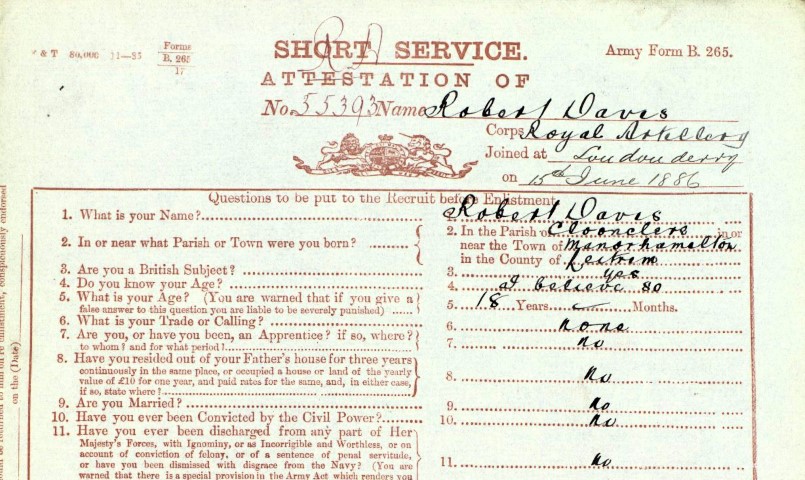
James Davis joined the Army in 1885. Searches of the military archives throws up no record of him. It is likely that he enlisted in the Royal Artillery in Derry, as did his younger brother the following year.

Robert Davis attestation form.

James appears to have been discharged a few years later after he developed tumours on his knee. He died at the young age of 26, in the winter of 1894 in the new farmhouse at Boggaun, having suffered from bone cancer for a number of years. My Grandfather, Richard was only three or four years of age when the brothers enlisted and had little recollection of them. James is buried in Manorhamilton Parish Church.

Robert signed up to the Royal Artillery in Derry a year after his brother. Elward Burnside recorded my grandfather, Richard’s recollections of Robert as “on police force, twice married, died County Sligo”. A little research shows that although he died relatively young at 47, his life was considerably more tortuous than these few brief words suggest; in fact, his colourful life may in have led to the rather abridged recollection of him.

When the brothers enlisted the rural economy was shrinking with a general collapse in farm prices, and their large family would have been under some considerable stress. Looking through police recruitment records for their Uncle, Thomas Davis, who joined the Dublin Metropolitan Police thirty years earlier, it is interesting to see the number of men from surrounding townlands who were recruited at the same time, neighbours among them.  It is likely that there was a similar pattern when the brothers signed up.

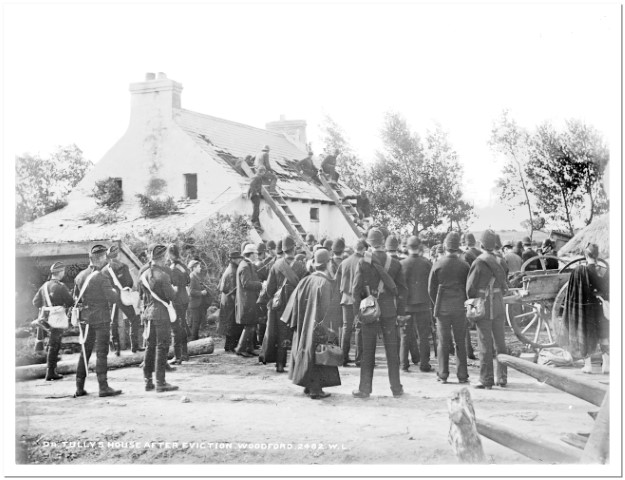
As part of their training, the brothers would have gone on long route marches, their presence an attempt to control the ‘lawless countryside’ eager for land reform.  Evictions in Ireland remained high throughout the 1880s, running as some three and half thousand per year, until land reform legislation was enacted towards the end of the decade. These evictions saw the army and police back up the landlords and their bailiffs in what the Nationalists saw as an ‘unholy trinity’.

Eviction at the house of land activist ‘Dr’ Tully 1916.

For whatever reason Robert did not remain in the army for his twelve-year enlistment and after three years moved to the police force, the Royal Irish Constabulary (RIC). His RIC’s service records show that he was posted to Longford in 1889, Belfast 1890, Cavan 1901 and Armagh 1905, from where he retired as ‘medically unfit’ with TB in 1911 at the age of 42. These probably indicate administrative regions as the constable was stationed in Castleblaney barracks in December 1900 when he married Mary Draffin.

Mary, a Presbyterian, was born in the Castleblaney workhouse where her father, Samuel was the Master.  On the night of the 1901 census Mary records herself as being ‘head of the family’, and a ‘married farmer’ living at Corfad near Ballybay; her husband was probably stationed in Castleblaney barracks that night. At that time, she had a large, thatched cottage with many outhouses suggesting a sizable farm. Mary died suddenly of a heart attack in 1904. It appears that the farm was not left to Robert.

Robert remarried in 1906 in Lurgan. His second bride was Anna Maria McTernan from County Sligo, suggesting he kept up regular contact to the north west of the country. Anna Maria was Roman Catholic. They were married in the Church of Ireland parish church in Lurgan. When he was discharged from the police, they retired to Easkey in County Sligo where he farmed on his wife’s family lands until his early death from TB in 1915. There were no children.

Robert is buried in Manorhamilton Parish church.  Anna Maria died in 1922 and she willed her estate for the repair of her local Roman Catholic churches and for ‘masses to be celebrated for the repose of the souls of the said deceased, her husband, parents, brothers and sisters’.  She is buried in County Sligo.

End

Notes

 Counter Recruiting in Parnell’s Ireland 1880-1892, Alan Drumm, UCC. An informative study on army and police recruitment during the period of James and Robert’s enlistment.

Brothers James (1867-1894) and Robert Davis (1868-1915) were born at the original cottage at Boggaun, County Leitrim.