A Ballymena Coachbuilder

Hugh and Lizzie Mc Williams were my paternal grandparents. They were born in Ballymena about 1879. I recall little of them or their lives; they are in shadow, I am unable to see them. Working on this series of stories has thrown up regular surprises and no less so here where I discovered another family that faced financial ruin in times of change.

My grandfather and namesake Hugh McWilliams died when I was a toddler. With his wife Lizzie they lived in a 2-up-2-down terrace house on the hill on Princess Street in Ballymena. The house, near the train station, became my second home where my Aunts, Lily and Martha doted on us children. To my mother, a stranger to the town, this came as welcome family support. These regular visits to 45 Princess Street established an order that would run into my teenage years.
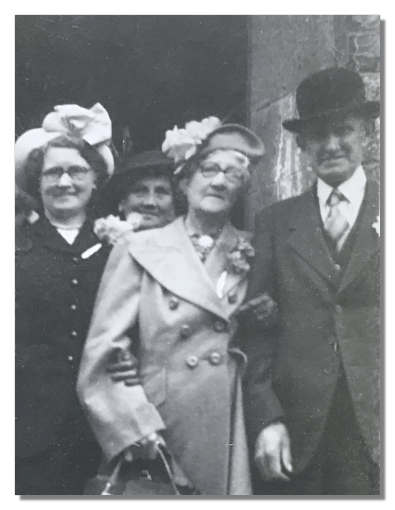
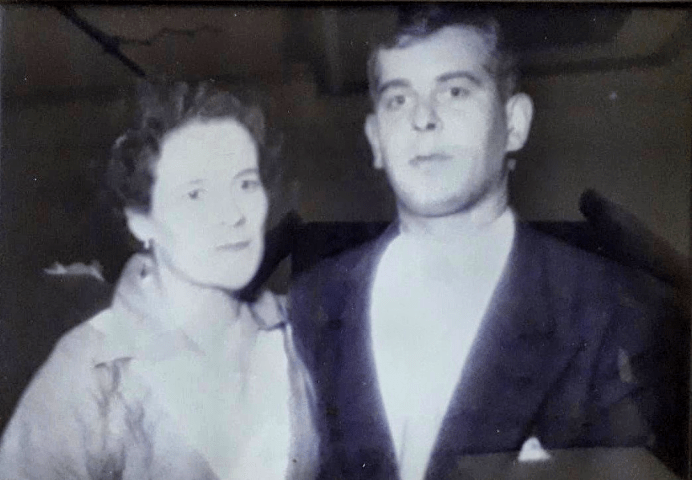
Lily and May with their parents Lizzie and Hugh McWilliams in 1950.

Although my grandmother Lizzie died when I was ten, I have little sense of her, my memory unyielding. If pressed, she is a ghost-like figure, standing at the return on the stairs, dark in her long blue pinafore over a woollen skirt, her grey hair tied back in a bun, an aged face masked behind large round glasses. She looks at me without expression, yet stern, comes down towards me, heavy black shoes ring hollow on the lino-covered treads. At the bottom of the stairs she turns and goes into the back room and scullery. I’m on my own in the dark hallway.

Hugh was born in 8 Alexander Street one of 5 children. When I was running about the town the street was ready for demolition to make way for a new road, a few occupants left. We thought it a slum, called it Clabber Street.

All his siblings had a trade; he was a coachbuilder, James a shoemaker, Elizabeth a spinner, Catherine a dress maker, James a cabinet maker, while his father Robert was a labourer.

Hugh and Lizzie Logan and were married in Kells Presbyterian Church in 1908, five miles from their home church on Wellington Street in Ballymena. They were strongly religious, enforcing regular bible study, believing in strict Sunday observance and regular church attendance. Hugh was an active Orangeman in the Galgorm Parks Lodge; its Lambeg drums often beating their practice rhythms across the green countryside on a warm June evening.

This Kells Church had been at the epicentre of the Ulster Revival with the first convert in late 1857. The following two years it spread to Ahoghill, Ballymena and beyond claiming over 10,000 converts; those who with deep personal conviction, repented their former sins, claimed Jesus as their Lord and Saviour and were “born again”.

At the Revival’s height prayer meetings and bible studies, taken mostly by lay preachers were running from morning to night. The conversions were marked by prostrations, visions, and speaking in tongues – scenes not typical of the dour Ulster stereotype – and resulted in disruptions to ordinary work and business, frowned upon by some traditional Calvinists. Hugh’s parents, certainly influenced by the Ulster Revival, were likely converts at one of these meetings. The influence of the Revival was felt for decades to come and is still viewed as a highwater mark of Christian renewal; in Ulster most converts swelled the Presbyterian congregations.
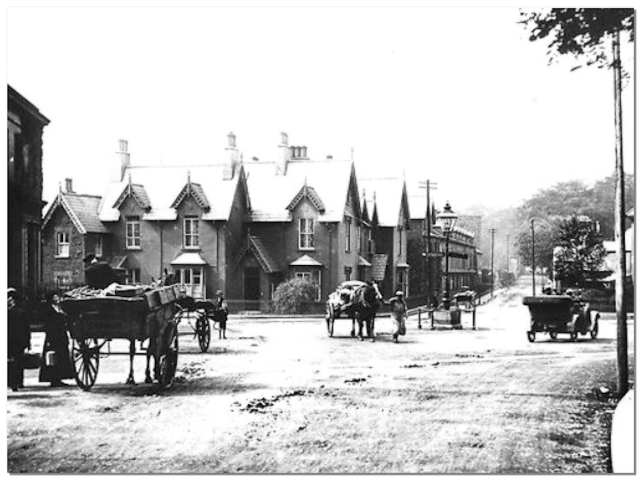
The Pentagon, Ballymena, reputedly with its first motor car circa 1900.
Hugh’s workshop is about 200 yards from here.
(Old Photos of Ballymena on Facebook)

By the age of thirty Hugh had a successful business and the couple had their first two children, Mary called May and Lizzie called Lily. He had an established coach building enterprise with several employees, operating out of a workshop behind his home in Albert Place.

Misfortune befell him with the introduction of the motor car. Challenged by a reduced demand for coaches and carts his business collapsed. With his employees gone he took whatever work he could get, maintaining a small workshop until he retired. By 1915 the family had moved to a rented house in Princess Street where my father was born. These events may have affected Hugh’s health; in his later life he was a very shy man, uncomfortable in company, particularly female company.

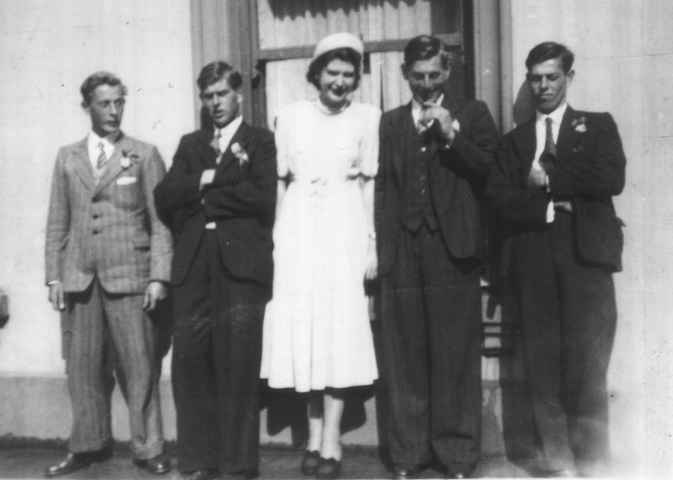
Hugh and Lizzie were at my parents’ wedding in Manorhamilton Parish Church and after in Sligo Town in 1950. In an informal wedding picture outside the church they look frail and slightly out of place.  Hugh died a few years later in 1954. His coffin was appropriately placed in a carriage drawn by two black horses. In his honour the Galgorm Parks Orange Lodge with its Lambeg drums and band would, for some years, stop in respect outside his Princess Street home, on their way to the annual 12th of July celebrations.  My Grandmother, Lizzie died in February 1961 and they are buried together in Ballymena Cemetery.

Ends.
Revolution and change

The years 2016 to 2022 are the 100-year anniversaries of a period of revolutionary change in Ireland covering the Easter Rising to Irish Independence and partition, the establishment of Northern Ireland. In these stories I have tried to imagine how this often-violent time influenced the lives of my grandparent’s generation, the Davis and Gillmor families in north Co Leitrim; firstly, to look back a few generations.

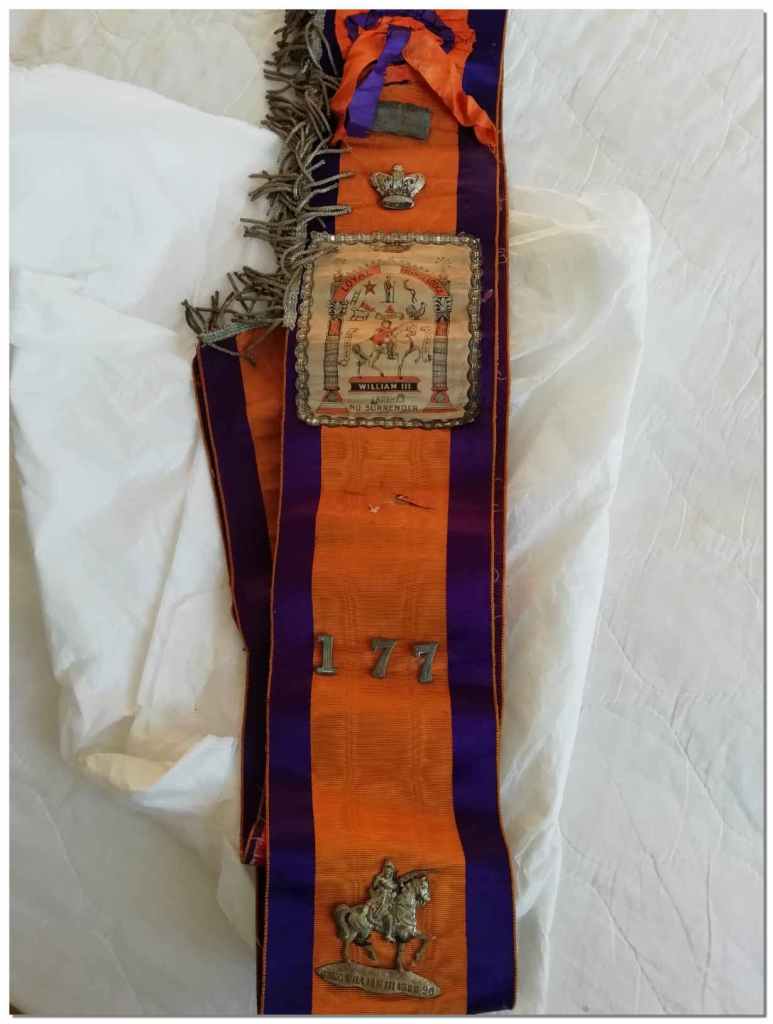
Sash believed to have been worn by Thomas Davis.

In 1782 and 1798 John Davis from Glenboy and Robert Davis from Lurganboy were signatories on two letters to Lord Clements, the local landlord.  The first requested help to alleviate the declining fortunes of Manorhamilton including the rights to re-establish distilleries, the need for an annual and quarterly court sittings and support for the linen and yarn trade.

The second letter asked Lord Clements to influence the government to build a proper barracks for troops in Manorhamilton citing “the frequent robberies and murders committed in these and adjoining parts by people called Defenders and other daring violators of law and peace”.  It was in this year that the Grand Orange Lodge of Ireland was launched to govern the growing numbers of Loyal Orange Institutions set up to counter the perceived threat from the Defenders and others.

As tenant farmers the Davis’s sympathies lay with the Protestant Ascendancy and a continuing link with England, not surprising given they were part of a minority Protestant community, close to Ulster, with roots in the 17-century plantation.

At the height of the Famine, Thomas Davis, born in Glenboy in 1827 joined the Dublin Metropolitan Police leaving the farm he shared with his brother. Thomas was a member of a Cavan Orange Lodge LOL 177, previously the Cavan Militia. In 1861 he emigrated to Canada leaving his pregnant wife Frances and their three young children at Boggaun, circumstances which suggest some haste. Frances and her children made the arduous journey on their own the following year.

In Canada, Thomas claimed a settler’s plot north of Toronto. He Joined the local Orange Order and his obituary tells that “Bro Davis … was connected with the 36th Battalion and served his country during the Fenian raid in 1866.” This is likely to have been at the Battle of Ridgeway, a skirmish in Southern Ontario.

The Famine fuelled the drive for land reform and a vigorous political campaign for Home Rule begun late 1800’s. This was met with general hostility from the Protestant community, opposition focused by Unionist and Orange groups. Significant Protestant emigration out of Leitrim and Ireland began during this time.

In North Leitrim there were 6 orange lodges: Glenboy, Manorhamilton, Bohey, Kinlough, Gortinar, Tullyskearney, Bohey being the largest, reflecting a concentration of Protestant small farmers. Protest meetings against Home Rule were organised throughout the country. In June 1912 a large meeting of farmers in Manorhamilton, which was addressed by the Unionist, Major Crofton, spilled out of the market-house onto the street.  It is most likely that the Davis and Gillmor families were represented.

At the height of opposition in 1914 there were four Ulster Volunteer branches in Co Leitrim, the only ones outside Ulster. The Volunteers were a unionist militia founded to block Home Rule.  The strength of Protestant dissent varied from area to area depending on the makeup of the community and the presence of radical leaders or firebrands.

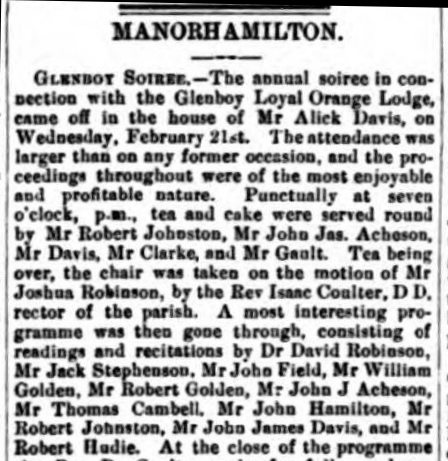
Part of report on Glenboy Soiree 1890. (Full transcript here)

Alick (Alexander) Davis farmed at Glenboy and in 1890 he was Worshipful Master (Chairman) of the local Glenboy Orange branch.  His wife, Sarah’s family, the Mealys (O’Malley) were similarly active in the nearby Tullyskearney lodge. In 1894 the annual Soiree of the Glenboy Lodge was held in Alick’s house and a report of the meeting outlines the tea and cakes, recitations, and opposition to Home Rule. The Parish clergyman Rev Isaac Coulter present at Alick’s house that evening counselled restraint saying that they disapproved to a break with England and not with our Catholic neighbours or their religion, a message he repeated elsewhere.

With the outbreak of WWI in July 1914 all Protestant opposition to Home Rule in the North West ended. Despite many local Unionists travelling by train to Edward Carson’s Ulster Day rally in Enniskillen, few Leitrim Protestants heeded his subsequent call to join Kitchener’s WW1 Army. Meanwhile, Protestant emigration continued but had not yet peaked.

During the War of Independence (1919 – 21) there was sporadic low-level intimidation of Protestants in Leitrim. While the IRA’s target was the British Army and RIC there was no systematic campaign against Protestants. Those with ardent Unionist views or who were suspected as being British spies or informers, drew attention to themselves, and some were shot. In May 1922 seven Protestant farmers at Carrigeencor, near Bohey were put out of their homes to accommodate refugees from Belfast, where open warfare during March, April and May that year had claimed 170 lives, with many more casualties and displaced families. The Carrigeencor families were back in their homes a few days later following political representations, some getting compensation. (One of these farms, at Rockmount was purchased by my brother Nigel in the late 1970s.)

As Independence and partition became a reality in 1921 there was no visible Protestant resistance. A local Methodist minister Revd Walmsley remembered, perhaps with some exaggeration, that ‘Round Manorhamilton there was a regular stampede of Protestants’ – leaving. By then, perhaps there was a sense of the inevitable, that all had been lost; those who felt most aggrieved sold up and left, while those who remained kept their heads down and got on with their lives.

Irish Guards at the Third Battle of Ypres in 1917 (Wikepedia)

My Grandfather Richard’s older siblings had grown up in pre-revolutionary Ireland. His brother James joined the Army and died in Ireland aged twenty-seven, possibly having seen action in an African Colonial war; Robert, at eighteen, joined the Royal Artillery at Ebrington Barracks in Derry in 1886, and on completing his twelve years’ service he joined the RIC, retiring to live with his wife in Co Sligo. William emigrated about 1900 to South Africa to join the South African Constabulary, policing captured Boer republics.

Of the two eldest brothers, Thomas had emigrated to Canada in 1886 while John settled in Co Meath in 1912. Alex was at this time in Co Meath. (see earlier story Alex Davis) Richard as the youngest was eventually the only brother left on the farm. One month before Armistice Day in 1918 he married Annie Gillmor. Richard’s only sister Mary Jane continued to live at Boggaun. (See pervious blog Mary Jane Davis.)

Most of my Grandmother Annie’s siblings were young teenagers during this tumultuous period, 1916-1922. Her eldest brother Herbert, however joined the Irish Guards in 1916 at twenty-three and was discharged as “medically unfit” after two years, having suffered nerve gas injuries in the WW1 trenches. A couple of years later emigrated to Alberta in Canada. (See earlier story “Finding Bertie Gillmor”.) Annie’s two sisters married and remained in Ireland; by 1945 all her six brothers had emigrated or moved to Northern Ireland.

In a young Ireland asserting its independence most remaining Protestant families felt it wise to keep quiet, mourning the loss and separation of partition; Orange sashes were hidden or destroyed, family histories censored and suppressed, under a blanket of silence.

Ends

Notes

Letter 1782 signed by John and Robert Davis is found in the Clements Estate records, Killadoon Papers, National Library of Ireland.

Letter 1798 quoted in A Flame Now Quenched, Rebels and Frenchmen in Leitrim 1793-1798, Liam Kelly, original source National Library of Ireland.

For more details of the Battle of Ridgeway and the Canadian Fenian Wars see https://www.thecanadianencyclopedia.ca/en/article/battle-of-ridgeway-1866

The Protestant experience of revolution in County Leitrim, 1911-1928, Miriam Moffitt, a detailed account of this period. https://www.academia.edu/39614775/The_Protestant_experience_of_revolution_in_County_Leitrim_1911-1928

Thanks to Quincey Dougan for the paper cutting on the Glenboy Orange Lodge Soiree 1890.

Alexander (Alick) Davis, Glenboy 1830-1906, was my Great Granduncle.

Break in. Break out.

“You’re suggesting we break into the school – when we’re about to break out!”

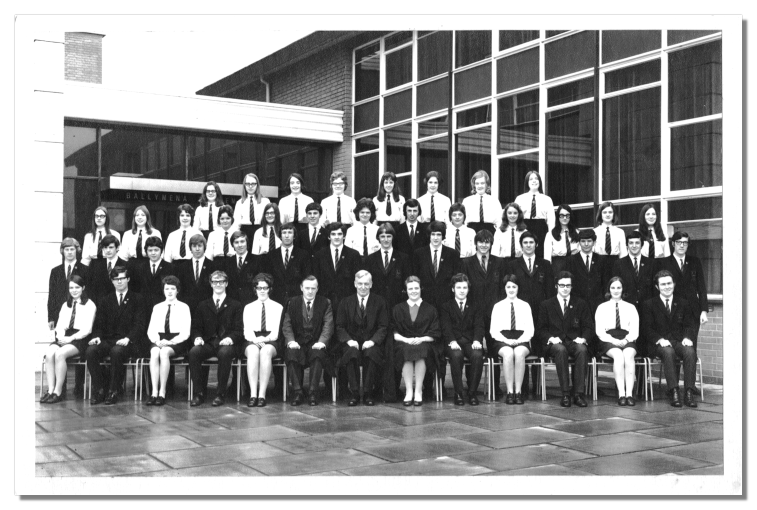
Most of the culprits, but not all, are included in this photograph of Ballymena Academy Prefects 1971. The assembly hall’s large windows are on the right.

We are in the small front room of Joan’s house in Ballymena on a late April evening as the days lengthen. There’s a piano against the wall, we are sitting on the floor around a low table, a record player in the corner plays The Beatles “Let It Be”. The 1971 A-level exams are two months away, the end of classes some weeks before that.  We are planning a stunt at the school, a farewell gesture, but not everyone is sure about it.

A week later and back in Joan’s house, all six of us are now on board with a plan to stage a short performance at morning assembly; the piano is central. We rehearse the piece many times until we are confident we can pull it off. It involves basic physics and electricity. Joan’s mother is never fazed when we regularly take her piano apart.

There is indeed a childish element to the prank, wanting to get our own back in some way. The headmaster of The Academy, Willie Moll, is an uncompromising disciplinarian. He has left a mark on all of us. If we get this right, maybe we can bring a smile to his face.

To set the piece up we must break into the school.  There is a rumour that security dogs patrol nightly after other end-of-school pranks, but a teacher tells us otherwise.

At 2 am one cloudy night in May, with an occasional crescent moon breaking through, five of us gathered in a lane way on the edge of town. We carried the few items we needed over the cross-country track at the boundary, across the pitches and running track, up to the rear of blocky school building, hoping we haven’t been seen.  The night is quiet except for the occasional bark of a distant dog. Climbing in through a changing room window left open earlier, we stepped into the empty school.

Quiet as mice we walked through the dark corridors, familiar yet errie. In the assembly hall we closed the blackout curtains and put on a few lights. We were nervous and a short break for tea and coffee from a vending machine helped settle us to the task.  One of us kept a constant watch on the caretaker’s house some 200 yards away.

Forty-five minutes later we have modified the piano, set up the other equipment and putting everything back in place. We left no trace, no empty coffee cups, no signs of ever being there. Then we went out of the school and across the pitches by the same route, and home.

The Academy had a morning routine of assembly like many schools; a hymn, a prayer and announcements. The teaching staff in their black robes sit in rows behind the headmaster. He stands behind a small lectern out front. To the right of the stage as you looked on is the piano and the pianist. Heavy black curtains frame the stage left and right and students sit facing it.

Assembly should have livened up when the pianist, accompanying the hymn struck Middle C for the first time, but when she did nothing happened. After the hymn she is observed gently nudging the key, aware that something is not right on the piano.

The headmaster finished his announcements, glanced over his shoulder as the staff rise to leave, scanned the assembled pupils, raised himself on his toes and leaned forward to clearly announce “Cla.a..” as the pianist finally liberated Middle C and John Lennon’s guitar intro to “I feel fine” cut through the assembly hall from somewhere above the piano. Teachers still on the stage turned sharply, the pupils about to rise stopped, the headmaster froze.

“Baby’s good to me, you know
She’s happy as can be, you know
She said so
I’m in love with her and I feel fine”

A few seconds after the Beatles launched into “I Feel Fine”, up in the lighting rigging, two small boxes are pulled over by a thread wound around the record player’s spindle. Confetti spilled out in a colourful cloud, falling over the headmaster, over the stage and out onto the students on the floor.

The song played just over 2 minutes by which time the last pieces of confetti have fluttered to the floor. What took place during this time, we can only imagine.

Those of us, including Joan, that planned it and carried it out – and we were never caught – have had to satisfy ourselves with second-hand accounts, and in the story’s regular retelling. What we do know is that assembly that day broke up in a buzz of excitement and noise, never witnessed before.

Ends

The Big Snow 1947

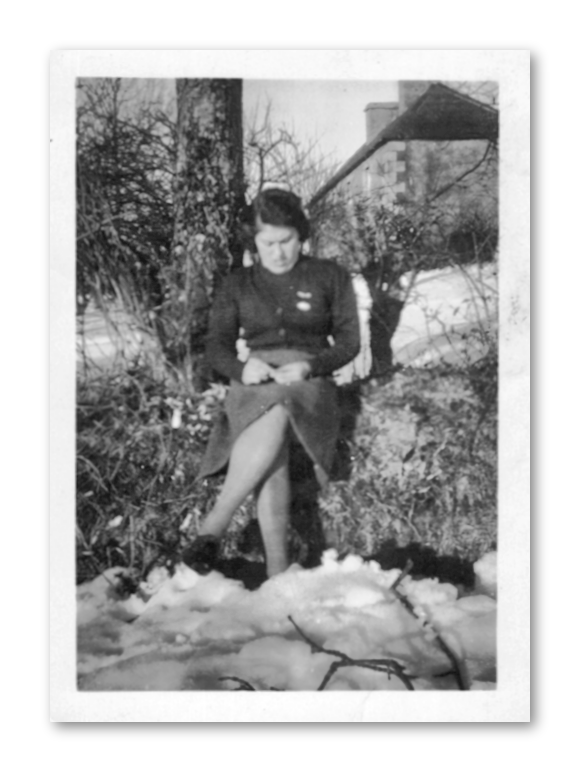
Ena McWilliams, nee Davis (1923-2013), my mother, worked in SJ Gillmor’s shop in Dromahair during The Big Snow of 1947, when she was twenty-four. The Gillmor’s were cousins on her mother’s side. Her memories of that time form the basis of this story.

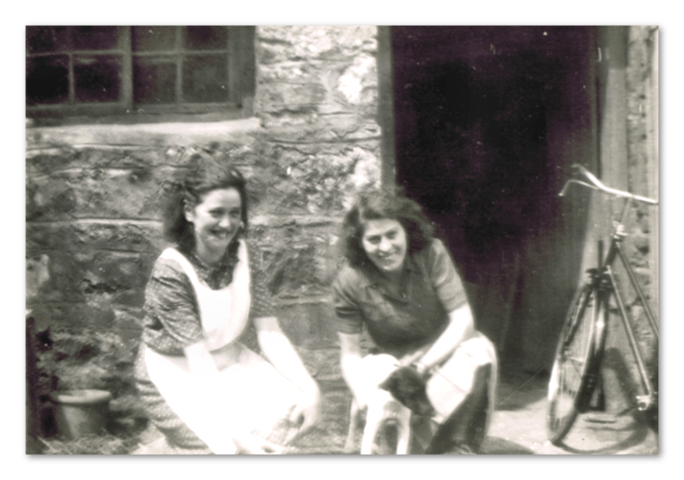
Ena Davis and ? McTiernan in yard at Gillmor’s Shop circa 1947.

“Cassie! Cassie! Come into my bed I’m freezing I can’t sleep. Bring your blankets!” Ena called across the dark room.

It wasn’t the first time I slept in Ena’s bed that winter. Our attic room above the shop, under the slates, the water jug frozen in the basin, the little roof window covered by Jack Frost, and outside the moon lit village deep under snow. And the next day we were going to Ena’s place, if we could make it through.

Ena and I worked in Gillmor’s in Dromahair, in the shop and yard.  Sometimes she looks after the Gillmor childer, she’s well used to it with plenty at home. I come from Fermanagh and had been there for about a year.

Last December, before Christmas the wind came hard from the East and soon everything was frozen and white, day and night.  I thought the turn of the year might bring a change but devil the bit of it! We wore our heavy coats all the time, often two pairs of stockings, warm tea in the kitchen was always bliss.

Then in the middle of February the snow came. There was a blizzard for a full two days. Everything stopped. The shop stayed closed. The roads and railway were blocked. No one ventured out at all, you couldn’t. The day after it stopped a few hungry souls started to move about, dug their way out probably, came in for what supplies we had. It was another 2 weeks before we got deliveries again, the train was the first to bring bread from Coyle’s bakery in Manorhamilton a few miles away.

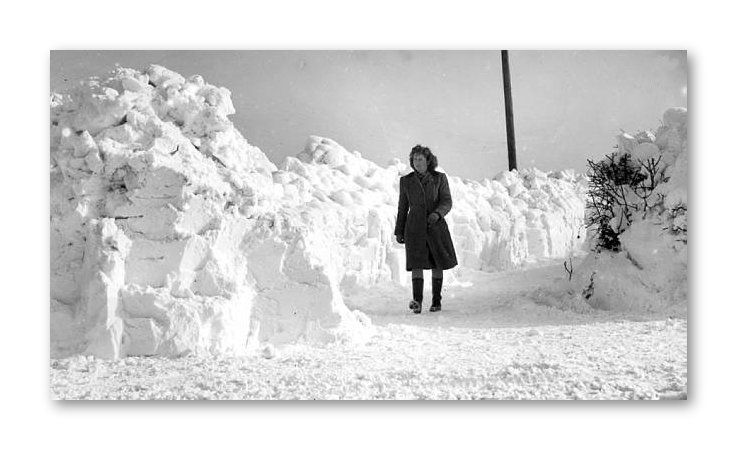
I went out after the blizzard, but I couldn’t get far.  There was a wind that would cut you to the bone and I didn’t recognise the village in the dazzling light, deep snow everywhere. Drifts were 10 foot high, up to the eaves of the bigger houses.  Some cottages were completely smothered, a chimney’s wispy smoke rising above the snow.

Mr. Gillmor kept us busy clearing snow to keep the front and back doors open, in case anyone came, each night a good deal of it would be blown back again. In the yard, the snow was up to our waists, that took a couple of days to clear but the work kept us warm, and we had fun in it when the old man was out of the way. We were lucky having the electric light, it came from Jeiter’s mill on the river, it rarely went out. In the evening we stayed in the kitchen listening to the radio for as long as we could, and then went off to our cold beds.

A scene from 1947 The Big Snow – Donegal Weather Channel.

After a good breakfast eaten in the warm kitchen, we put on plenty of clothes and set out to Ena’s on the snowy roads.  Ena filled her pockets with sweets for children and neighbours met along the way, a regular Wednesday routine when she would cycle home on the shop’s half day. I had met some of her brothers in Dromahair, big handsome fellas they were. We sent a message on the bus that we would be there for the 1 O’Clock dinner on Saturday and we’d stay the night. I was excited but fretting about the six mile walk through the snow. Ena told me not to worry, she’d cycled home many’s a time in the pitch dark. Still, it wasn’t like this, I thought at the time.

The day was bright, no snow had fallen for a few days, the sharp wind had dropped. We left the village, passed the castle and crossed the bridge over the Bonet River, thrilled to be away from the shop and the village where we’d been cooped up for so long. A few wee boys threw snowballs at us from behind the walls of the bridge, but we ran past them not wanting to delay.

Two long weeks it had been, waiting for the roads to open, with the men’s constant work clearing the drifts, many to appear again by the next morning. We met few cars that day, those we did zig zagging around the drifts trying to keep on the hard road. Near the railway station we helped push out of a drift. Warm work it was but some sweets helped us recover.

We thought about going a longer way past Carrigeencor lake. It had long frozen over and there were usually a crowd of young people playing there. Some of the boys were now walking all the way across it. But we decided to stick to the main road.

Along Sox Line the drifts were deeper, and we pushed each other down into the soft snow, shouting and laughing. The few houses along the road heard us coming and came out to greet us and exchange news, Ena knew them all. The offers of hot tea were sadly refused, we were taking longer than we’d expected. Our supply of sweets running low, the first signs of tiredness set in as our feet dragged in the deeper snow.

“The Bonet runs deep and dangerous just over the hedge there.” Ena said as we walked on. 

“A few have drowned in there.”

“I can see nothing, hear nothing. Don’t be scaring me.” I replied, the silence now eerie, on such a beautiful day.

Another mile or so on we stopped to rest at Ena’s old school at Mullaghduff and sucked the last of the sweets. The black summit of O’Donnell’s Rock stood stark against the white landscape, the snow blown to drift on the lower slopes.

“Only another mile now.” Said Ena as we saw a group of five children playing on the road ahead.

“It’ll be the Giblins and Kellys – trouble.”

“Here comes Ena with the sweets!” they shouted when they saw us.

“No! No! I have none today!” she called as we got closer.

“Ye are not getting through if we don’t get sweets!” they chanted over and over.

We stopped a short distance off. Snowballs are thrown at us. Half-heartedly we threw a few back, but we’re very tired now, so in the end we made a dash through them, taking a good few hits as we did.

They heard the ructions up at the Larkfield farmhouse, they told us later.

“Ye better have sweets on the way back or yo’ll get the same!”  They shouted after us.

“We’ll be waiting!”

“Póg mo Thóin!” Ena shouted back at them.

We stopped briefly, taking off our coats to shake out the snow, then trudged on, the house now in sight.

Ena at her home spring 1947

Turning off the road onto the lane, it comes to us, stopped us in our snowy tracks, a waft of wonderful cooking smells drifting over the snowy field, from the house above on the hill.

We are laughing, giggling, with relief mostly, two silly girls, when Ena pushed me over in the into the deep snow at the side of the lane. I gasped as snow’s rubbed in my face and I hear her laughing.

“Come on! The dinners ready! Don’t forget to wash your face first.”

And she is running up the lane towards the house, towards the best dinner of my life.

Ends

Notes

The first picture is taken from the Donegal Weather Channel facebook site. For more see   https://www.facebook.com/DonegalWeatherC/posts/the-big-snow-of-1947-ireland-in-pictures/763021333807618/

The Black and Tans

Reco Davis (1921-2011) is my mother’s eldest brother, my uncle. In 1957 he married Dorothy McElroy (1925-1993) and they lived at Woodhill, Bunnanadden, Co Sligo, Dorothy’s home, where they had a mixed farm. We are on Christmas holidays at my Grandparent’s farm at Boggaun in Co Leitrim and make a yearly visit to Woodhill.

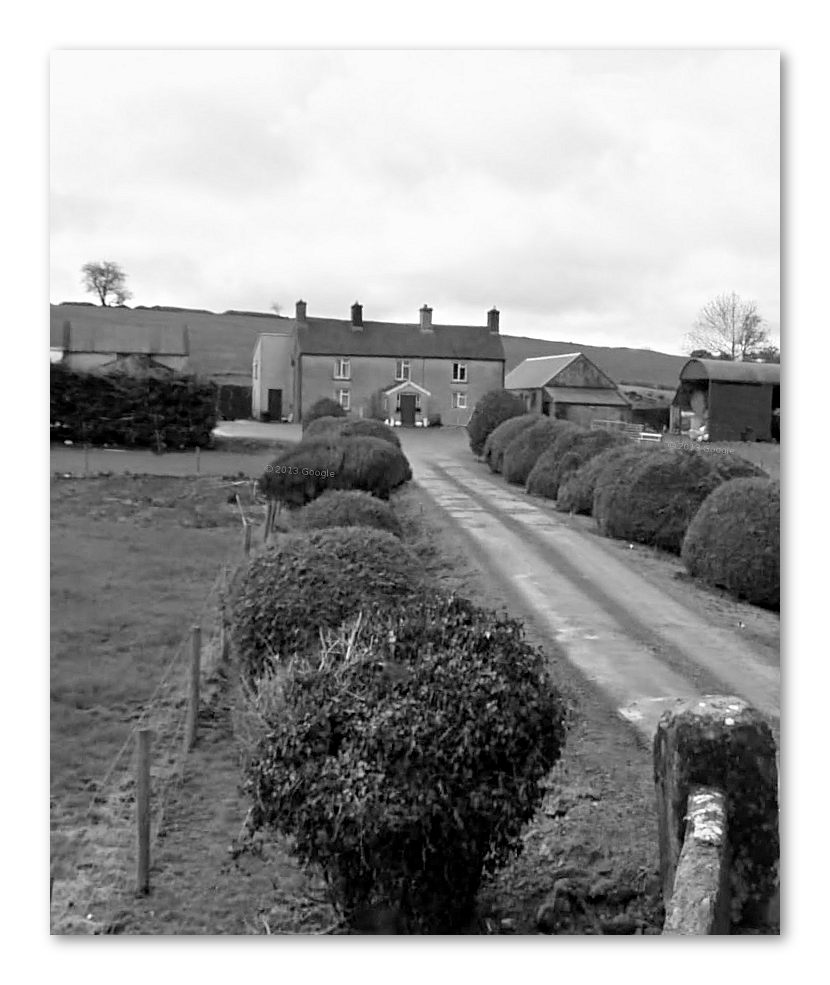
Reco and Dorothy Davis’s home Woodhill. Bunnanadden, Co Sligo.

On a Christmas visit to Bunnanadden in Co Sligo I first hear of the Black and Tans.

The days are short and the 25-mile journey from Boggaun in Co Leitrim is not one my father likes. We are visiting my Uncle Reco and Aunt Dorothy at Woodhill in Co Sligo. It’s always a journey with some winter hazard. The roads are often icy.  There’s fog or sometimes floods. By the time we return to our Grandparent’s farm that night we are fast asleep in the darkness of back seat, some of us lying across my mother’s lap.

Dorothy puts on a tremendous spread in the dining room, another Christmas dinner complete with a roast goose, ham, cold meats and all the trimmings, Christmas pudding and custard, mince pies and offerings of juice, sherry and wine.  She has lots of nervous energy and can’t do enough to make us welcome; when he’s not working Reco is easy going and draws on a regular Sweet Afton. Dorothy is very affectionate towards us; they have no children. Ned, hired by the previous generation as a farm labourer, is now part of the family but is away for the evening.

When we can eat no more, we go down to the lower room where a log is thrown on the fire to raise a flame. The room is warm and a single shaded-bulb casts a low soft light. Occasionally the wind moans in the chimney. I know a 2-fingered version of Chopsticks and I tentatively play it on the old piano.

Reco and Dorothy circa 1988

Dorothy comes into the room and quietly says

“I haven’t heard that tune for so long.”

Standing with her back to the piano and with a serious look on her face Dorothy tells her mother’s story of a Black and Tan search of the farmhouse, on a night just like this, a couple of years before she was born. This is Dorothy’s mother’s story.

**

I was the first to hear the motor coming up the lane and ran to look out.

“It’s the police. It’s the police!” I shouted.

My father opened the door to be told that they were searching for guns. They ignored his mild protest that we have no guns and anyway why would they be looking here. The house and sheds would be searched.

The rest of us were huddled in the kitchen, not knowing what was happening.  I heard the heavy boots clumping up the stairs, going from room to room, opening and closing doors, knocking on the walls. We were shocked and scared.

It was a few days after Christmas Day and my sister and her family were coming over that night, the lamps and fires were lit in the good rooms.

After they gave up searching, the six of them gathered in lower room, where the piano is, warming themselves around the fire. We were all more relaxed by then. Really, they hadn’t given us too much trouble and had stacked their rifles up against the end of the piano, hanging their caps on the muzzles.

“You play the piano luv?” one of them asked me in a strong London accent, but I just looked shy and when I didn’t answer he said.

“No? Well, some hot tea would be nice then.”

Daddy nodded at me and I went to make them tea. From the kitchen I heard them laughing, then somebody started to play a rough version of Chopsticks.

“Common Joey boy give us something to dance to!”

He just played it faster.

As I came in with the tea they pretended to dance, the floor and room swaying.

“Georgie! stop dancin your too fat, you’ll bring down the floor!” The loud one, Sam, says.

“Sorry luv, we don’t often get a chance to have some fun.”

“Cept when we’re shooting chickens, Sam, eh?” One of them says, raising a laugh.

Before taking up their mugs of tea I see some of them put their cigarettes down on the piano keys.

“Ahh, nice tea luv. U married yet?”

“In a few months.” I said, and with my heart beating fast I turned stiffly and left them to my father and brothers.

When I came in with fresh tea the cigarette butts had burned out on the ivory keys. I wanted to cry seeing the piano I played on, practiced my church music on, desecrated.

**

“There now!” says Dorothy in conclusion, pointing to the heavy brown stains on the keys.

“That’s what they left behind. Weren’t they the terrible blackguards?”

My eyes are fixed on the cigarette burns. A log crackles in the hearth. The wind rises suddenly, growling in the chimney as a gust passes, and then settles.

Ends

Note

For an informative article on the Black and Tans and historical the context see Diarmaid Ferriter’s Irish Times, 7th Jan 2020, Black and Tans: “Half-drunk, whole-mad and” and one-fifth Irish. https://www.irishtimes.com/culture/heritage/black-and-tans-half-drunk-whole-mad-and-one-fifth-irish-1.4113220

Wallace and Rita

Rita Mulvey (nee Keher) was left with two children, Eleanor and Jim and two stepchildren when her husband Garda William Mulvey died in 1952. They lived in Garda accommodation on Boley Hill in Manorhamilton. Rita, from Manulla in Mayo met Wallace and they fell in love, and shortly afterwards decided to get married.

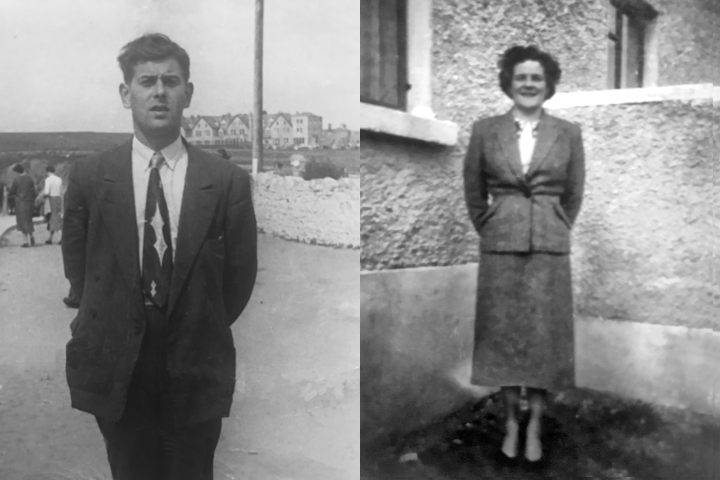
Wallace and Rita circa 1954

Wallace was about to strike out on his own path again, but this time there would be a life-changing collision with his parents.  

Rita and Wallace were married by Fr. Young in a small church beside the Creevelea parochial house. This was originally a Protestant church built in the 1850s by the Scottish operators of the local ironworks. All the requirements of the Ne Temere decree were met, solemn promises willingly given as Wallace converted and became a Catholic. There were few present, any of Wallace’s siblings would have attended under severe threat.  

Maybe the split with his family had been coming for years or perhaps it was his mother’s opposition to the marriage, seemingly absolute and final. I have little sense of their leaving Manorhamilton: the turmoil, the anxiety of moving the young family to a strange city, Rita leaving a stepson and daughter behind. Who saw them off? Who wished them well? Who would missed them?

In my Grandmother’s old bible there was a Happy Birthday Card from Wallace, Rita and his family in Stockport, kept perhaps as a connection to her son, a hope of reconciliation.

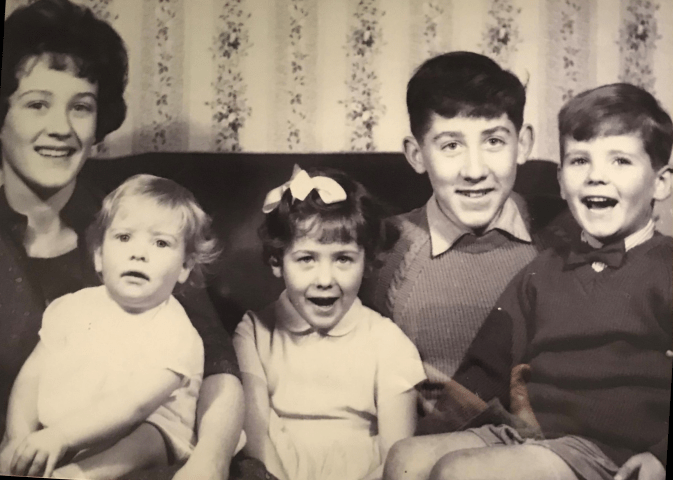
Eleanor and Jim Mulvey with Julie, Margaret and Sean circa 1965

One summer years later Wallace was back in Leitrim with his family, they stopped into a local hostelry in Manorhamilton for some sustenance. Discovering who the party was a musician in the bar at the time, took up guitar and sang a song for them which included the lyrics:

“The night was so windy,

the road was so far,

sure we’ll call Wally Davis,

for he has a new car.”

I met Wallace about 1995 when he had bought an end of terrace house in Tobercurry in Co Sligo. He lived a bachelor-life there and was well known around the town. At a family event shortly afterwards it was suggested to him that he might have been a bit of a wild lad in his youth.  He drew himself up to his full height and with a devilish smile replied

“In my youth?”

ENDS

Notes

Leitrim’s Republican Story 1900-2000, by Cormac O Suilleabhain, 2014. A definitive well researched publication on the republican campaign in Leitrim including the impact on and involvement of the Protestant community. See Page 173 for reference to Michael Sheridan’s internment.

Wally Davis taxi man

Wallace was born in 1927 the sixth of eight children, into a family deep in financial crisis. With all of the children seven or under it’s unlikely that he got too much individual attention.

Jack, Wallace, Dora Armstrong, Reco and Cecil at my mother’s wedding in Sligo 1950

To recap: after Wallace’s father, Richard was swindled out of the proceeds of a cattle shipment to England in the early 1920s, he took the principled decision to pay farmers for their stock first. With no reserves to pay off a business loan, the bank, holding the farm deeds put it up for sale, and would do so annually for over 10 years. The family were ultimately saved from eviction by the goodwill of neighbours and farmers who refused to buy the Boggaun farm; no one would move against them.  The strength of goodwill towards the Protestant family is put into relief by the upheaval of the previous decade, the War of Independence and the following Civil War, with the accompanying rise in tension between the Protestant and Catholic communities.

When Wallace’s brother Herbie died at 19, there was an expectation on Wallace and the others to take up the slack after his death.

From a young age Wallace proved to be a free spirit; his father would often lose his temper with him particularly when Wallace dared to row with him. After one of these spats Wallace ran away and lived for a month with the Sheridan family on The Rock, about half a mile up on the mountain. He knew the family well and many of their children were friends from Mullaghduff National school. An older brother Michael Sheridan had been interned as an Anti-Treaty activist during the Civil War some years earlier.

About 1945 his parents arranged a year’s work experience for him on a farm in Co Antrim, hoping that he would return settled, to join their agricultural effort. He spent the year in the North but didn’t come back with any greater love of farming.

Wallace circa 1945

A growing number of motor cars were appearing on Leitrim’s roads and Wallace wanted to drive one.  There was no test, you just learned by trial and error. When my father came to Larkfield with his first car, Wallace took the opportunity to slip away for some practice. He hadn’t gone far when the car ended up in the ditch, luckily with only minor damage.

In the early 1950s Wallace, or Wally as he was known outside the family, joined the ESB rural electrification programme, working on the transmission line from Ballyshannon to Carrick-on-Shannon. At that time most workers stayed in digs as daily travel to work was impractical. Wallace’s workmates Paddy Harte and Ray Devine from Sligo boarded in the Davis home for a time and shortly afterwards when construction moved south to Mohill, Wallace boarded there.

As Larkfield farm finances improved Richard helped his son buy a car, a black Ford Prefect, reg number IT 2501, hoping he would settle into a taxi business. Wallace, in his mid-twenties, was now his own master; he could work when and where he wanted.  The Ford Prefect proved too small as a taxi and was changed for a larger Ford Pilot V8. However, it came to an unfortunate end when he crashed coming home from a wedding. As the sole occupant in the car he came off lightly enough, an injured heel in plaster for some months, but the car was a write-off. 

This was the wreck that I was to play in at the Larkfield farmhouse, its leather back seat used as the sofa in the house. Before disappearing under weeds and briars the rusting wreck was a secluded spot for laying hens and storage for broken tools and implements.

Wallace got a third car and resumed taxiing, unfortunately becoming involved in another accident just outside Manorhamilton. A young Dominic Rooney cycling at the tail end of a group of friends on the Glenfarne Road thinking the road behind was clear pulled out into the path of the oncoming Wally. He was knocked to the ground, broke his leg and spent the following three months in traction in Our Lady’s Hospital, Manorhamilton. Dominic would not run into this family again until we met last year researching these and other local stories, discovering the Wally Davis connection.

To be concluded in next blog.

Wallace Davis (1927-2008)

When I met my Uncle Wallace for the first time, he had retired and was moving from Stockport to Tobercurry in Co Sligo. His wife Rita (1922-1983) had died about 12 years previous. He was a big man with a warm smile, a colourful personality and history. These next two blogs tell a little of Wallace’s story. Firstly, from Wallace’s daughter Julie and myself writing from different vantage points.

Rita and Wallace Davis circa 1965

My cousin Julie writes:

“Wallace, ye need to take these childa to see your mother.”

“Aragh ”

Wallace came to Stockport, England in 1955 with his wife Rita (nee Keher) and two stepchildren, Eleanor and Jim.  They went on to have three more children, Margaret, Sean (John) and Julie.

We never knew much about our Dad’s family, “The Davises” other than he was born in Manorhamilton in Co Leitrim, came from a large family, and grew up on a farm.

I suspect life must have been tough for Rita and Wallace; immigrants with a young family, neither of whom had their own family around them for support. This was not untypical of the times; many fled their homestead for one reason or another.

We grew up not knowing of Aunts, Uncles, Grandparents or cousins. The reason for this was never spoken about.

My only memory of my Grandmother Davis was sitting in the back of a car outside Larkfield, the family home, with Margaret and Sean (I was probably only about 4 years old.) Mum had persuaded Dad that he should visit his mother and let her see her Grandchildren.  Although I was very young, I will never forget how we were left sitting in the car, and not invited into the house.  Our young innocent faces excited to see the Granny we never knew we had. She spoke to us through the car window with cold politeness and sent us on our way. The air of hurt and disappointment to my Dad lingered.  Needless to say, the rest of the journey was silent and shrouded with sadness, for everyone.

It was only years later I learned the very sketchy story of the hostilities that surrounded the family.

Many years later I was lucky enough to visit the “Homestead” as my Dad would call it and to meet some of my Aunts and Uncles for the first time. 

I have attached a photo of me with my Dad meeting my Aunt Phylis and Uncle Cecil for the first time. There were many Aunts and Uncles that, unfortunately, I never got to meet.

Cecil, Julie, Wallace and Phyllis circa 1`990

Stan writes:

On our visits to the Larkfield farmhouse, my brother Ivor and I shared a small double bed with a big hollow in the middle. A hollow in the bed is not really a problem when you are very small, and I guess I’m about 4 at this time. Cecil used the other bed in the room, sometimes coming in the early morning hours. A night time candle in the hallway casts moving shadows on the bedroom wall and ceiling, keeping me awake, the soft mummer of voices from the kitchen below, comforting.

One morning we’re dressed and leaving the bedroom when a young man runs in, whoops and jumps into the warm bed that we have just left. I didn’t know who he was at the time and never saw him again at the farm.

Forty years later I would meet my Uncle Wallace again, and only at his funeral in Stockport some years later would meet some of my cousins for the first time.

When Wallace jumped past us and into his bed that morning it was a short time before he married Rita in 1955, and when he was subsequently banished from the family, his mother telling him that she did not wish to see him again. Tragically she stuck to her decision, and as Julie recalls, turning her grandchildren away from the farmhouse some years later. Occasionally Wallace met up with some of his siblings on visits back to Ireland, unbeknownst to their mother.

In marrying a Roman Catholic widow with 2 children and 2 stepchildren, becoming Catholic himself and committing to the children being raised Catholic – required under the Church’s Ne Temere decree – he put himself beyond what his parents could accept. My Grandfather’s attitude to the affair was softer but it was my Grandmother who was the final arbiter.

The Ne Temere decree on the validity of marriage, enforced by the Catholic Church since 1907 had a severe impact on the minority Protestant community in Leitrim and contributed to their declining numbers. My Grandmother’s attitude was common and reflects a desperate attempt, albeit with tragic consequences, to limit its impact on her family and her community.

Continues next blog.

Herbert James William Davis (1920 to 1939)

Almost eighty years ago to the day, Herbie Davis died from diphtheria at the age of 19.  

He was born into the Larkfield household on the verge of bankruptcy, struggling with the shame and hardship of losing almost everything when his father’s, Richard’s, cattle business collapsed. On leaving nearby Mullaghduff National school he worked on the farm, his extra labour helping to provide for the growing family.

Herbie to the left of his mother Annie. His siblings back row Ena and Reco. Front row Cecil, Phyliss, Alf, Wallace and Jack.

When Herbie was about 16 and Reco 15, they went out to work. With their horse and cart, they would draw stone from Bird’s Quarry to nearby council road works. This was the first regular money that came into the farm in a number of years; neighbours said it marked a turning point in the family’s fortunes.

It started as a simple cold and sore throat in the early autumn of 1939, just as the 2nd World War was declared, and petrol rationing was introduced. But it got progressively worse as a fever set in and he could no longer go off to work. Their Manorhamilton doctor treated him with a tonic, but it had little effect. Sometime in late September he was confined to bed, his face and neck swelling, a continuous barking cough heard throughout the house.

His siblings saw their big brother laid low, weak and suffering. They could see the worry and distress of their parents, Richard and Annie. Reco, his younger brother and work mate took on extra chores on the farm. All but Jack were teenagers and felt the anxiety and upset, missing Herbie around the house and farm.

Diphtheria is a bacterial infection of the mouth, throat and nose. As the illness progresses untreated a growing mucus closes the airways and produces high levels of toxins. The illness can be cured with a course of simple antibiotics, which were widely available 5 or so years after Herbie’s illness. Today diphtheria is an extremely rare illness with all children being vaccinated at an early age.

Neighbours and relations came to the farmhouse in the evening to sit with Herbie and support his parents. William O’Malley, my grandfather Richard’s cousin from Tawnymanus sat with Herbie near the end. Later William could not bring himself to visit his own son, Wills, when in hospital with acute appendicitis. The young Wills, very confused by this, would years later understand his father’s behaviour in light of the traumatic experience sitting with the dying Herbie.

Herbie Davis circa 1939.

As the winter deepened and the nights grew longer Herbie’s condition worsened. Their doctor visited again but there was little he could do for him.  He was slowly choking, toxins poisoning his body. On the 30 November his father sent Reco to Manorhamilton on the horse and cart to summon the doctor again, with the express instruction, not to return without him. But the doctor refused to come, saying that he could do no more. Reco returned to Larkfield alone, and Herbie died a short time later.

I look at the last picture taken of him, dressed for church, a haunted look about him, photographed for posterity, the energy gone from him – a young man, my Uncle, never to meet.

Richard and Annie had experienced the death of a previous child when Herbie’s younger sister Maureen died at the age of two on 9th December 1923.

Ends.

There’s a ferret on the loose.

The hen shed is dark and quiet. I like going there. The hens are friendly and cluck as I walk through them, most are outside.  I look in the boxes along the wall for eggs Mammy will collect, clean and pack later. I help her take care of the hens. There’s one that’s clocking. It’s in deep tea chest and sitting on dummy eggs. Funny, it’s furry today, I lean in and stroke it. It’s very soft.

The brown hen in that box is furry, Mammy.

Feathers, hens have feathers, son. Says my mother, busy in the kitchen.

Soft and furry, I was stroking it.  

We’ll go up and have a look, and collect any eggs.

Ivor and author with our mother, Ena and father, Tommy at Carniny Road at a garden birthday party. circa 1958

The wooden house for about 150 hens is on higher ground at the rear of the bungalow, its floor covered in loose peat. Carrying a basket for eggs we go in and over to the clocking hen.

When a ferret’s head appears from under the dead hen, Mammy screams and drops the basket.

I’m swept from the ground and she rushes back into the house, the eggs now forgotten.

Did it bite you? Did it bite? Mammy cries urgently.

I’m speechless.

Did it bite?

I shake my head slightly, unsure of what the right answer is.

Frantically my hands and arms are inspected, my clothes quickly taken off, looking for any sign of a bite.

This goes on for some time and I’m crying now wishing I’d never seen a furry hen.  Ivor stands close by taking in it all in.

There is always a story going around of a rat biting a baby in a buggy or in bed and it scares the wits out of any parent, that must have been it.

I am hugged and soothed, and with no bites to be found we all settle.

Mammy goes down to Sammy’s house, a neighbour who keeps ferrets and greyhounds, we know him well. He lives at the end of our lane a short walk away. Ivor is in a buggy.

The cottage, behind a rough privet hedge, has a corrugated tin roof and small cobbled yard in front. There are a few of low outbuildings. Sammy is a general handy man, particularly helpful to Daddy who is still new to rural living, even though he was raised in a terrace house not a mile away and tended an allotment garden. Sammy has all the tools, knows how to mend and fix things, he’s our first call when there’s a problem; but now his bicycle is missing from its usual place against the wall of his house.

Sammy Linton (?) with Mrs Kerr, Aunt Martha and author at garden birthday party. circa 1958

Sammy! Sammy! One of your ferrets is up in our hens! My mother calls as she wraps on the door.

His brother Michael greets us brightly.

Hello Misses. Sammy’s not here.

Mammy hurriedly explains the death and panic of the past hour.

The cottage is dark and smells of a mild sweet mould, though not unpleasant. There’s never any sign of heat from the black range but neither is it cold.

Sammy’ll be back soon. I’ll send him straight up. says Michael as we leave.

An hour later Sammy comes up to the bungalow on his bike with a small box strapped behind the saddle.

Sorry Missus. Sorry about the hens. Says Sammy at the back door.

Aye it’s one of mine, been on the loose since yesterday.

He’s a small, capped man with a hunched back, but agile all the same.

A hope there’s not too many kilt. Michael says it’s killin all around it.

Mammy laughs.

He’s havin you on Sammy. Just the one, I hope. Let’s go up and you’ll take care of it.

Ends