This is the first landing for my writing. The regular posts cover a variety of subjects and styles: fiction and family and social history. A few have been published elsewhere. Why the curlew or crotach? Known for its long, elegantly curved bill and its haunting call, the curlew’s call, once common on wetlands a generation ago, is now is seldom heard – like many of the subjects in this blog.
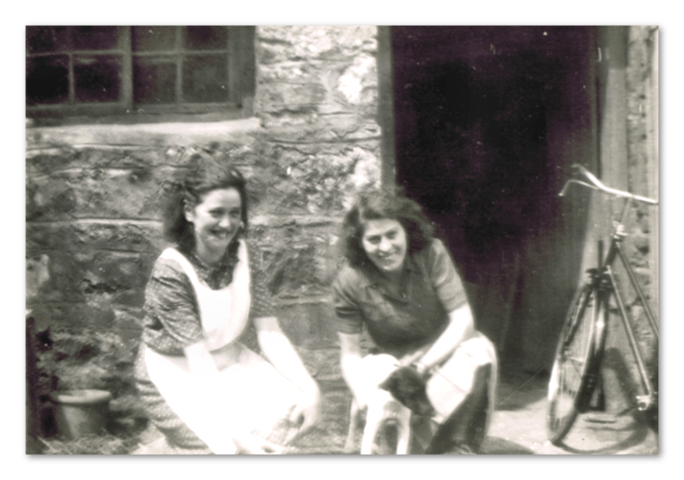
Rita Mulvey (nee Keher) was left with two children, Eleanor and Jim and two stepchildren when her husband Garda William Mulvey died in 1952. They lived in Garda accommodation on Boley Hill in Manorhamilton. Rita, from Manulla in Mayo met Wallace and they fell in love, and shortly afterwards decided to get married.
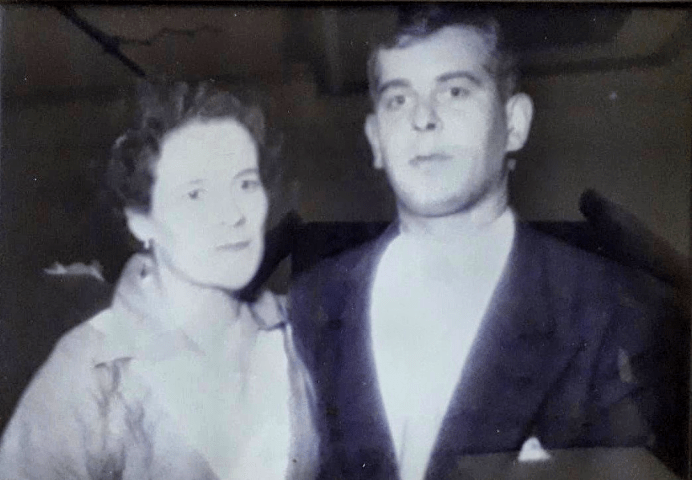
Wallace and Rita circa 1954
Wallace was about to strike out on his own path again, but this time there would be a life-changing collision with his parents.
Rita and Wallace were married by Fr. Young in a small church beside the Creevelea parochial house. This was originally a Protestant church built in the 1850s by the Scottish operators of the local ironworks. All the requirements of the Ne Temere decree were met, solemn promises willingly given as Wallace converted and became a Catholic. There were few present, any of Wallace’s siblings would have attended under severe threat.
Maybe the split with his family had been coming for years or perhaps it was his mother’s opposition to the marriage, seemingly absolute and final. I have little sense of their leaving Manorhamilton: the turmoil, the anxiety of moving the young family to a strange city, Rita leaving a stepson and daughter behind. Who saw them off? Who wished them well? Who would missed them?
In my Grandmother’s old bible there was a Happy Birthday Card from Wallace, Rita and his family in Stockport, kept perhaps as a connection to her son, a hope of reconciliation.
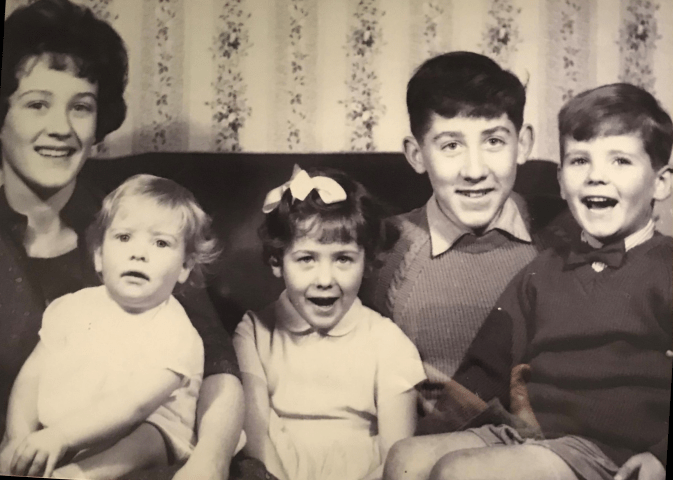
Eleanor and Jim Mulvey with Julie, Margaret and Sean circa 1965
One summer years later Wallace was back in Leitrim with his family, they stopped into a local hostelry in Manorhamilton for some sustenance. Discovering who the party was a musician in the bar at the time, took up guitar and sang a song for them which included the lyrics:
“The night was so windy,
the road was so far,
sure we’ll call Wally Davis,
for he has a new car.”
I met Wallace about 1995 when he had bought an end of terrace house in Tobercurry in Co Sligo. He lived a bachelor-life there and was well known around the town. At a family event shortly afterwards it was suggested to him that he might have been a bit of a wild lad in his youth. He drew himself up to his full height and with a devilish smile replied
“In my youth?”
ENDS
Notes
Leitrim’s Republican Story 1900-2000, by Cormac O Suilleabhain, 2014. A definitive well researched publication on the republican campaign in Leitrim including the impact on and involvement of the Protestant community. See Page 173 for reference to Michael Sheridan’s internment.
Wallace was born in 1927 the sixth of eight children, into a family deep in financial crisis. With all of the children seven or under it’s unlikely that he got too much individual attention.
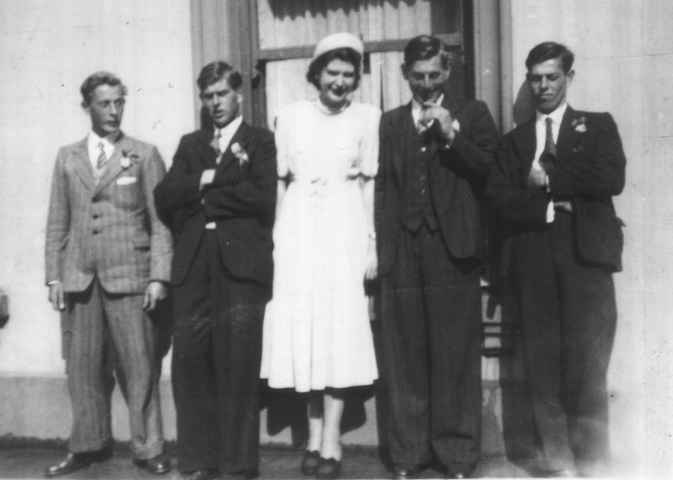
Jack, Wallace, Dora Armstrong, Reco and Cecil at my mother’s wedding in Sligo 1950
To recap: after Wallace’s father, Richard was swindled out of the proceeds of a cattle shipment to England in the early 1920s, he took the principled decision to pay farmers for their stock first. With no reserves to pay off a business loan, the bank, holding the farm deeds put it up for sale, and would do so annually for over 10 years. The family were ultimately saved from eviction by the goodwill of neighbours and farmers who refused to buy the Boggaun farm; no one would move against them. The strength of goodwill towards the Protestant family is put into relief by the upheaval of the previous decade, the War of Independence and the following Civil War, with the accompanying rise in tension between the Protestant and Catholic communities.
When Wallace’s brother Herbie died at 19, there was an expectation on Wallace and the others to take up the slack after his death.
From a young age Wallace proved to be a free spirit; his father would often lose his temper with him particularly when Wallace dared to row with him. After one of these spats Wallace ran away and lived for a month with the Sheridan family on The Rock, about half a mile up on the mountain. He knew the family well and many of their children were friends from Mullaghduff National school. An older brother Michael Sheridan had been interned as an Anti-Treaty activist during the Civil War some years earlier.
About 1945 his parents arranged a year’s work experience for him on a farm in Co Antrim, hoping that he would return settled, to join their agricultural effort. He spent the year in the North but didn’t come back with any greater love of farming.
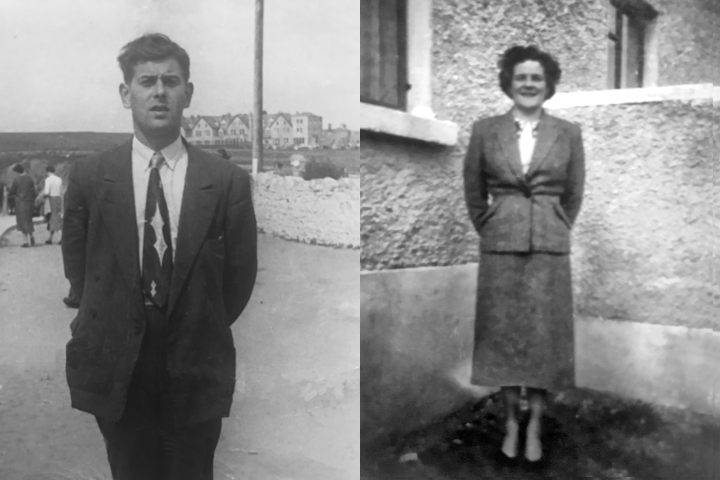
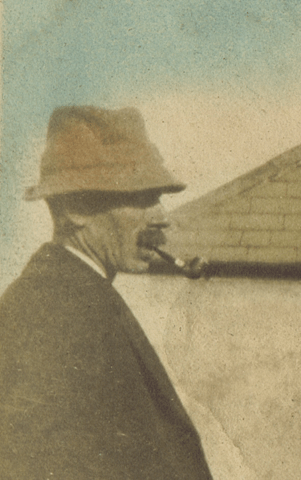
Wallace circa 1945
A growing number of motor cars were appearing on Leitrim’s roads and Wallace wanted to drive one. There was no test, you just learned by trial and error. When my father came to Larkfield with his first car, Wallace took the opportunity to slip away for some practice. He hadn’t gone far when the car ended up in the ditch, luckily with only minor damage.
In the early 1950s Wallace, or Wally as he was known outside the family, joined the ESB rural electrification programme, working on the transmission line from Ballyshannon to Carrick-on-Shannon. At that time most workers stayed in digs as daily travel to work was impractical. Wallace’s workmates Paddy Harte and Ray Devine from Sligo boarded in the Davis home for a time and shortly afterwards when construction moved south to Mohill, Wallace boarded there.
As Larkfield farm finances improved Richard helped his son buy a car, a black Ford Prefect, reg number IT 2501, hoping he would settle into a taxi business. Wallace, in his mid-twenties, was now his own master; he could work when and where he wanted. The Ford Prefect proved too small as a taxi and was changed for a larger Ford Pilot V8. However, it came to an unfortunate end when he crashed coming home from a wedding. As the sole occupant in the car he came off lightly enough, an injured heel in plaster for some months, but the car was a write-off.
This was the wreck that I was to play in at the Larkfield farmhouse, its leather back seat used as the sofa in the house. Before disappearing under weeds and briars the rusting wreck was a secluded spot for laying hens and storage for broken tools and implements.
Wallace got a third car and resumed taxiing, unfortunately becoming involved in another accident just outside Manorhamilton. A young Dominic Rooney cycling at the tail end of a group of friends on the Glenfarne Road thinking the road behind was clear pulled out into the path of the oncoming Wally. He was knocked to the ground, broke his leg and spent the following three months in traction in Our Lady’s Hospital, Manorhamilton. Dominic would not run into this family again until we met last year researching these and other local stories, discovering the Wally Davis connection.
When I met my Uncle Wallace for the first time, he had retired and was moving from Stockport to Tobercurry in Co Sligo. His wife Rita (1922-1983) had died about 12 years previous. He was a big man with a warm smile, a colourful personality and history. These next two blogs tell a little of Wallace’s story. Firstly, from Wallace’s daughter Julie and myself writing from different vantage points.
Rita and Wallace Davis circa 1965
My cousin Julie writes:
“Wallace, ye need to take these childa to see your mother.”
“Aragh ”
Wallace came to Stockport, England in 1955 with his wife Rita (nee Keher) and two stepchildren, Eleanor and Jim. They went on to have three more children, Margaret, Sean (John) and Julie.
We never knew much about our Dad’s family, “The Davises” other than he was born in Manorhamilton in Co Leitrim, came from a large family, and grew up on a farm.
I suspect life must have been tough for Rita and Wallace; immigrants with a young family, neither of whom had their own family around them for support. This was not untypical of the times; many fled their homestead for one reason or another.
We grew up not knowing of Aunts, Uncles, Grandparents or cousins. The reason for this was never spoken about.
My only memory of my Grandmother Davis was sitting in the back of a car outside Larkfield, the family home, with Margaret and Sean (I was probably only about 4 years old.) Mum had persuaded Dad that he should visit his mother and let her see her Grandchildren. Although I was very young, I will never forget how we were left sitting in the car, and not invited into the house. Our young innocent faces excited to see the Granny we never knew we had. She spoke to us through the car window with cold politeness and sent us on our way. The air of hurt and disappointment to my Dad lingered. Needless to say, the rest of the journey was silent and shrouded with sadness, for everyone.
It was only years later I learned the very sketchy story of the hostilities that surrounded the family.
Many years later I was lucky enough to visit the “Homestead” as my Dad would call it and to meet some of my Aunts and Uncles for the first time.
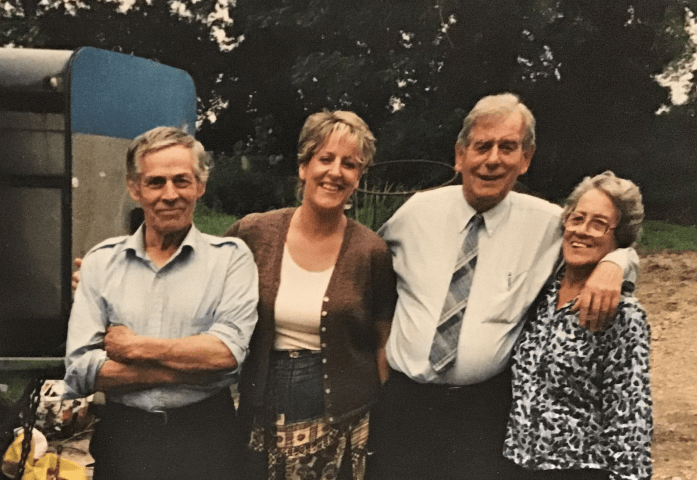
I have attached a photo of me with my Dad meeting my Aunt Phylis and Uncle Cecil for the first time. There were many Aunts and Uncles that, unfortunately, I never got to meet.
Cecil, Julie, Wallace and Phyllis circa 1`990
Stan writes:
On our visits to the Larkfield farmhouse, my brother Ivor and I shared a small double bed with a big hollow in the middle. A hollow in the bed is not really a problem when you are very small, and I guess I’m about 4 at this time. Cecil used the other bed in the room, sometimes coming in the early morning hours. A night time candle in the hallway casts moving shadows on the bedroom wall and ceiling, keeping me awake, the soft mummer of voices from the kitchen below, comforting.
One morning we’re dressed and leaving the bedroom when a young man runs in, whoops and jumps into the warm bed that we have just left. I didn’t know who he was at the time and never saw him again at the farm.
Forty years later I would meet my Uncle Wallace again, and only at his funeral in Stockport some years later would meet some of my cousins for the first time.
When Wallace jumped past us and into his bed that morning it was a short time before he married Rita in 1955, and when he was subsequently banished from the family, his mother telling him that she did not wish to see him again. Tragically she stuck to her decision, and as Julie recalls, turning her grandchildren away from the farmhouse some years later. Occasionally Wallace met up with some of his siblings on visits back to Ireland, unbeknownst to their mother.
In marrying a Roman Catholic widow with 2 children and 2 stepchildren, becoming Catholic himself and committing to the children being raised Catholic – required under the Church’s Ne Temere decree – he put himself beyond what his parents could accept. My Grandfather’s attitude to the affair was softer but it was my Grandmother who was the final arbiter.
The Ne Temere decree on the validity of marriage, enforced by the Catholic Church since 1907 had a severe impact on the minority Protestant community in Leitrim and contributed to their declining numbers. My Grandmother’s attitude was common and reflects a desperate attempt, albeit with tragic consequences, to limit its impact on her family and her community.
Almost eighty years ago to the day, Herbie Davis died from diphtheria at the age of 19.
He was born into the Larkfield household on the verge of bankruptcy, struggling with the shame and hardship of losing almost everything when his father’s, Richard’s, cattle business collapsed. On leaving nearby Mullaghduff National school he worked on the farm, his extra labour helping to provide for the growing family.
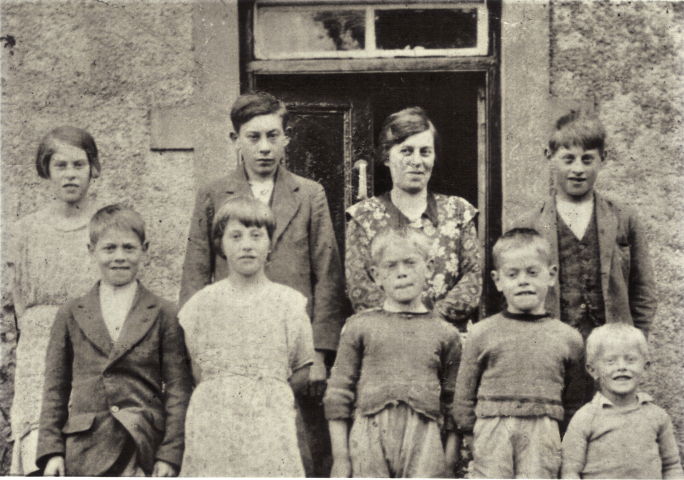
Herbie to the left of his mother Annie. His siblings back row Ena and Reco. Front row Cecil, Phyliss, Alf, Wallace and Jack.
When Herbie was about 16 and Reco 15, they went out to work. With their horse and cart, they would draw stone from Bird’s Quarry to nearby council road works. This was the first regular money that came into the farm in a number of years; neighbours said it marked a turning point in the family’s fortunes.
It started as a simple cold and sore throat in the early autumn of 1939, just as the 2nd World War was declared, and petrol rationing was introduced. But it got progressively worse as a fever set in and he could no longer go off to work. Their Manorhamilton doctor treated him with a tonic, but it had little effect. Sometime in late September he was confined to bed, his face and neck swelling, a continuous barking cough heard throughout the house.
His siblings saw their big brother laid low, weak and suffering. They could see the worry and distress of their parents, Richard and Annie. Reco, his younger brother and work mate took on extra chores on the farm. All but Jack were teenagers and felt the anxiety and upset, missing Herbie around the house and farm.
Diphtheria is a bacterial infection of the mouth, throat and nose. As the illness progresses untreated a growing mucus closes the airways and produces high levels of toxins. The illness can be cured with a course of simple antibiotics, which were widely available 5 or so years after Herbie’s illness. Today diphtheria is an extremely rare illness with all children being vaccinated at an early age.
Neighbours and relations came to the farmhouse in the evening to sit with Herbie and support his parents. William O’Malley, my grandfather Richard’s cousin from Tawnymanus sat with Herbie near the end. Later William could not bring himself to visit his own son, Wills, when in hospital with acute appendicitis. The young Wills, very confused by this, would years later understand his father’s behaviour in light of the traumatic experience sitting with the dying Herbie.
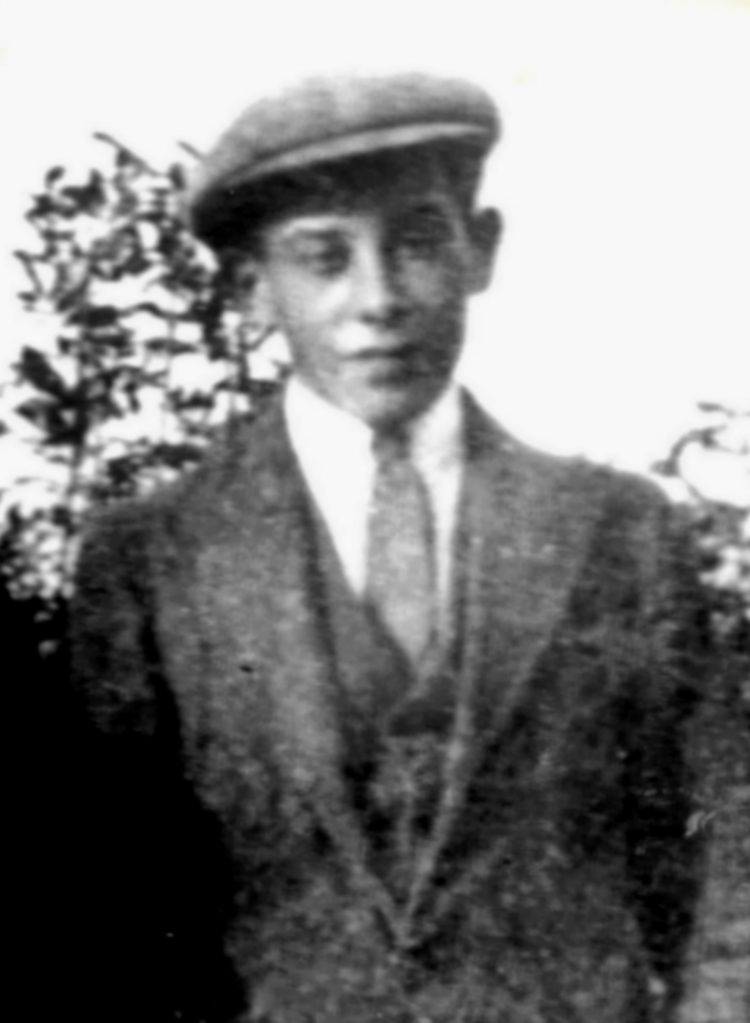
Herbie Davis circa 1939.
As the winter deepened and the nights grew longer Herbie’s condition worsened. Their doctor visited again but there was little he could do for him. He was slowly choking, toxins poisoning his body. On the 30 November his father sent Reco to Manorhamilton on the horse and cart to summon the doctor again, with the express instruction, not to return without him. But the doctor refused to come, saying that he could do no more. Reco returned to Larkfield alone, and Herbie died a short time later.
I look at the last picture taken of him, dressed for church, a haunted look about him, photographed for posterity, the energy gone from him – a young man, my Uncle, never to meet.
Richard and Annie had experienced the death of a previous child when Herbie’s younger sister Maureen died at the age of two on 9th December 1923.
The hen shed is dark and quiet. I like going there. The hens are friendly and cluck as I walk through them, most are outside. I look in the boxes along the wall for eggs Mammy will collect, clean and pack later. I help her take care of the hens. There’s one that’s clocking. It’s in deep tea chest and sitting on dummy eggs. Funny, it’s furry today, I lean in and stroke it. It’s very soft.
The brown hen in that box is furry,
Mammy.
Feathers, hens have feathers, son. Says my mother, busy in the kitchen.
Soft and furry, I was stroking
it.
We’ll go up and have a look, and collect any eggs.
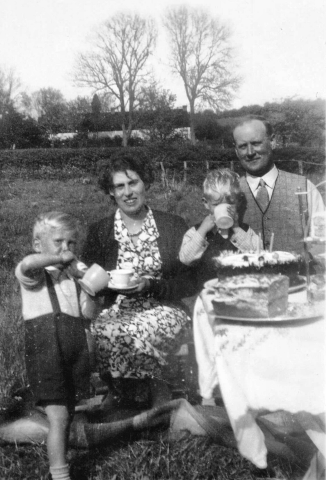
Ivor and author with our mother, Ena and father, Tommy at Carniny Road at a garden birthday party. circa 1958
The wooden house for about 150
hens is on higher ground at the rear of the bungalow, its floor covered in loose
peat. Carrying a basket for eggs we go in and over to the clocking hen.
When a ferret’s head appears from under the dead hen, Mammy screams and drops the basket.
I’m swept from the ground and she
rushes back into the house, the eggs now forgotten.
Did it bite you? Did it bite? Mammy
cries urgently.
I’m speechless.
Did it bite?
I shake my head slightly, unsure
of what the right answer is.
Frantically my hands and arms
are inspected, my clothes quickly taken off, looking for any sign of a bite.
This goes on for some time and
I’m crying now wishing I’d never seen a furry hen. Ivor stands close by taking in it all in.
There is always a story going
around of a rat biting a baby in a buggy or in bed and it scares the wits out
of any parent, that must have been it.
I am hugged and soothed, and with no bites to be found we all settle.
Mammy goes down to Sammy’s
house, a neighbour who keeps ferrets and greyhounds, we know him well. He lives
at the end of our lane a short walk away. Ivor is in a buggy.
The cottage, behind a rough privet
hedge, has a corrugated tin roof and small cobbled yard in front. There are a few
of low outbuildings. Sammy is a general handy man, particularly helpful to Daddy
who is still new to rural living, even though he was raised in a terrace house
not a mile away and tended an allotment garden. Sammy has all the tools, knows
how to mend and fix things, he’s our first call when there’s a problem; but now
his bicycle is missing from its usual place against the wall of his house.
Sammy Linton (?) with Mrs Kerr, Aunt Martha and author at garden birthday party. circa 1958
Sammy! Sammy! One of your
ferrets is up in our hens! My mother calls as she wraps on the door.
His brother Michael greets us
brightly.
Hello Misses. Sammy’s not
here.
Mammy hurriedly explains the death
and panic of the past hour.
The cottage is dark and smells
of a mild sweet mould, though not unpleasant. There’s never any sign of heat
from the black range but neither is it cold.
Sammy’ll be back soon. I’ll send him straight up. says Michael as we leave.
An hour later Sammy comes up
to the bungalow on his bike with a small box strapped behind the saddle.
Sorry Missus. Sorry about the
hens. Says Sammy at the back door.
Aye it’s one of mine, been on
the loose since yesterday.
He’s a small, capped man with
a hunched back, but agile all the same.
A hope there’s not too many
kilt. Michael says it’s killin all around it.
Mammy laughs.
He’s havin you on Sammy. Just
the one, I hope. Let’s go up and you’ll take care of it.
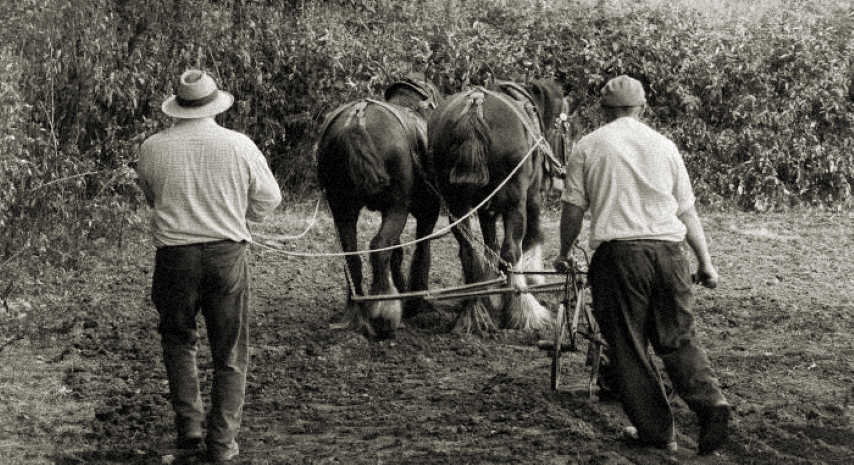
Paddy Gilbin (1912- 1995) was from Lisgorman and a close neighbour of my Uncle Cecil. They worked together on meitheals. Cecil’s older brother Reco was also a ploughman but by this time he had married Dorothy, nee McIlroy and was living Wood Hill, Bunnadden, Co Sligo. Easter time 1965 was my only experience of ploughing on the Davis farm. It was a dry spring and a late Easter. My brother Ivor and myself follow Cecil around the farm and on this occasion, we get a surprise.
A two horse plough setup. Source Connacht Tribune.
It’s past ten o’clock on a late spring morning, the chill seeping away with the rising sun, as Paddy Giblin comes up the lane on a horse. We’ve heard him from a distance, the rhythmic clip-clop of a heavy trot, the ploughman with the second horse.
How ya men! He shouts loudly to one and all when he arrives
in the yard.
Lock up yer lassies Davis, the randy ploughman’s
about!
Now sliding heavily to the ground off the jute-bag-saddle,
his boots crunch on the yard, his horse harnessed for the plough. He walks
towards us with his peculiar lurching style, as the horses snicker at one
another, familiar plough partners.
Easy Paddy there’s childer about! Do ye want a suppa
tae before we start? Says Cecil.
Divil the hate, let’s keep movin while the sun shines.
He sees my Grandmother at the back door of the farmhouse.
Fine weather Mrs Davis. Great for the Easter. He says in a more
subdued tone raising a hand. She salutes him and goes back inside.
Paddy is a grey, solid-built man in his fifties: a belt-and-braces
man, a bachelor and renown bread-maker, a man with loud earthy humour, never
stuck for a wise crack.
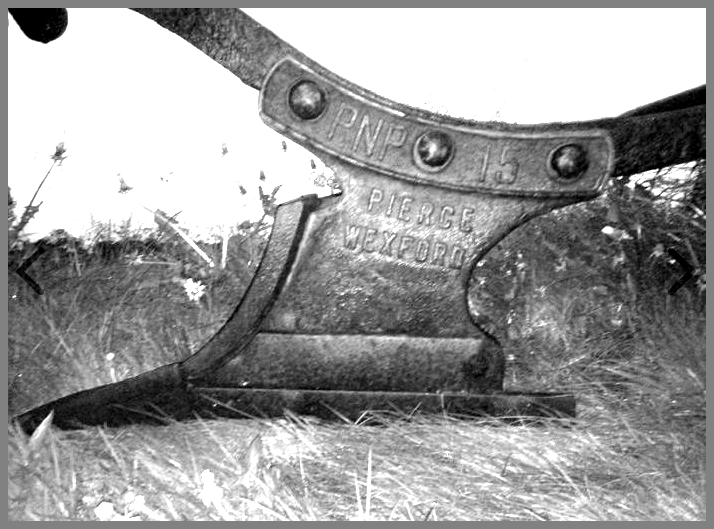
When the horses are harnessed to the Pierce plough, Paddy
takes handles, Cecil the reins and the pair urge the horses forward to pull the
plough over the top of the ground.
We head to a relatively flat field above the Long Acre, a few hundred yards away from the farmyard. An area of about an acre is marked out by a heavy scattering of dung. This land is unfamiliar to the plough, no deep friable soil here, a challenge for horses and men alike.
Detail of Pierce horse plough.
Paddy lines up the plough and with a shout of – Go an boys! – and a flick of the reins from Cecil the horses strain, hooves bite into the grass as the chains tighten and the plough jerks forward. It tears into the grass, pulled forward and deeper as the sod is turned skyward. Paddy wrestles with the plough to keep a line as the horses find a rhythm.
We need it deeper men! he shouts.
Boys! Lie down there on the bar!
He nods urgently indicating the draw bar.
We look at each other hesitantly. There is only one
bar, directly behind the horses.
Comm an boys! Down on it! He shouts.
Cecil, alongside, laughs, and with little option, we
move right and left to lie down on the moving plough, the horses back hooves no
distance from us, the turned sod just below us, our legs and feet trailing.
Lane on it boys! Com an lane on it! He shouts urging
the plough into tight earth, the horses driven harder.
Christ, Davis! Are ye feedin these bucks atall?
There’s no mate on them.
We lie squeezed together on the narrow draw bar, not
looking forward, hearing a metallic click as the hooves catch a stone, smelling
the musty soil turned upwards.
Paddy guides the plough, stumbling as he struggles to keep it
straight. Occasionally, too deep, the plough turns up a skin of blue daub. When
we near the edge of the plot we get off and the plough is dragged around, lined
up, and we plough another furrow, the coarse ridges closed behind us, ready for
the seed.
Suddenly, Paddy lets out a shout.
Ger up! Ger up boys! He’s about to phish!
The plough stops, and we spring up and out of the way. Paddy’s horse arches his back and releases a
jet of piss onto the grass where it pools in a foamy circle.
When he’s done Paddy nods to us.
Onto it again boys, if we want yer dinner! He says with a laugh.
And with a flick of the long reins the plough strains and cuts
forward again, as a smell of beery horse piss wafts over us.
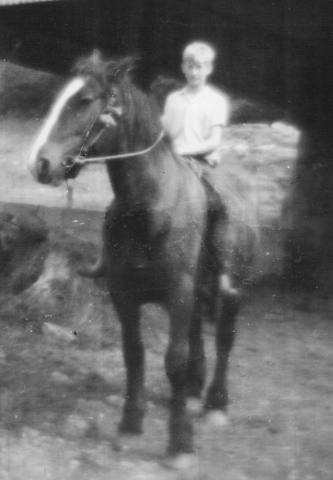
Author on the Davis plough horse, circa 1965.
In the summer we will help Cecil mix a large barrel of blight spray,
stirring in the liquid soda, watching the deep blue liquid swirl milky.
Cecil with the back-sprayer, floats in a sea of green, the mist
settling in his wake, as he walks backwards up and down the ridges, while we,
kneeling, weed two long row of turnips, little chat, thinking of a break, food
and escape.
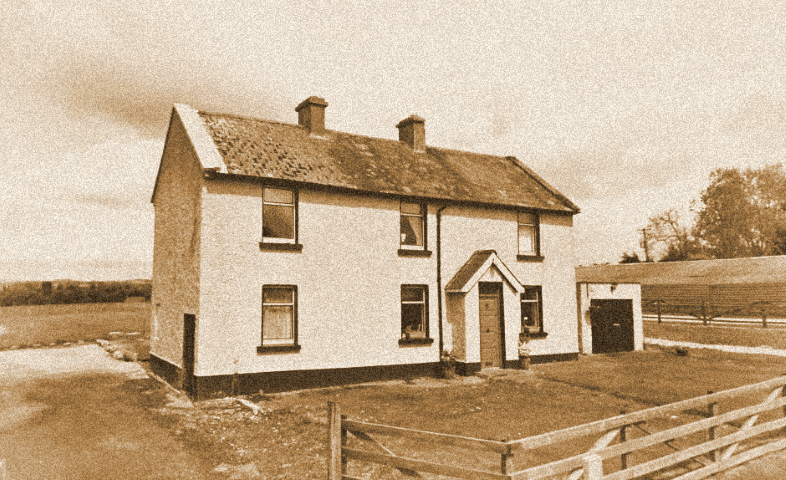
Bertie (Herbert Charles Gillmor 1893-1960) was my Grandmother’s brother, born at Boihy House near Manorhamilton. He emigrated to Alberta, Canada. Over the years I heard snippets of conversations about him when Granny would express her concerns about “Poor Bertie”, garnered from his letters. I remember mention of a big farm on the Prairie, living with a local woman but not married, things not being good, about some sort of conflict, and finally that he had tragically died in 1960, and that a gun was involved. She later believed that much his money had been taken. The distance between the siblings meant that communications had been very sketchy.
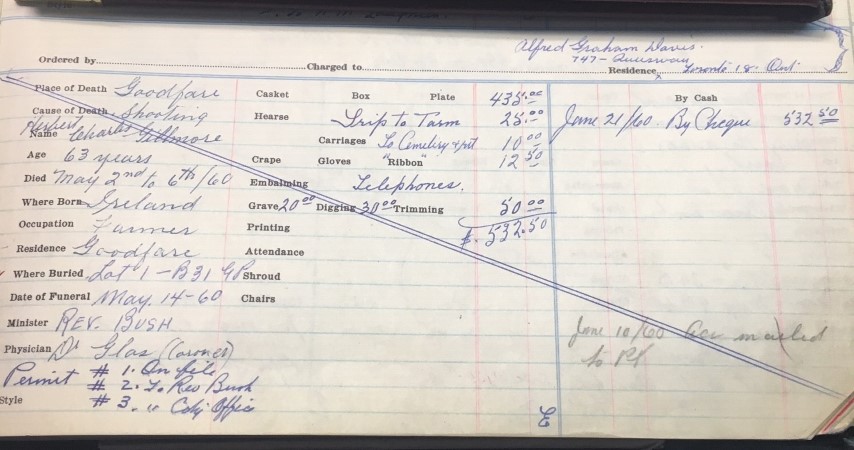
Bertie died intestate. Very recently his niece Etta Kerr sent me a copy of the distributions from his small estate. From it I gathered that he lived in Goodfare, Alberta. Yesterday afternoon I typed “Goodfare, Alberta” into Google maps and then looked for a possible burial location, the search brought me to Oliver’s Funeral Home in Grand Prairie. With no clear intent I sent message to them on their Contacts page and the following email conversation ensued.
Time 15:00
Hello
This is a long shot from Ireland!
My grand uncle Herbert Charles Gillmor, Goodfare, Alberta
died on 5th May 1960. We have no idea where he is buried. He had no
family. Any suggestions where we might find this out. Any suggestions would be
most welcome.
Best Regards
Stan
AT 15:56
Good day
Stan. Thank you for your inquiry regarding your late Grand Uncle. I
checked our files and we did indeed do the funeral arrangements on May 14,
1960. Date of death is listed as May 2-6, 1960 in our files.
I have
attached what I have in our records and it appears he was buried in Lot 1,
Block 31 of GP cemetery. I should be able to get an opportunity to be
near the cemetery in the next few days and will stop in to see if it the site
is marked or not. Let me know if there is anything else we can help with.
Best
Regards,
Steve Logan,
Oliver’s Funeral Home,
10005 107 Ave, Grande Prairie, AB, T8V 1L8, (780) 532-2929
At 16:29
Good Morning Steve
Wow, you were fast with that! Thank you very much.
Where is the GP Cemetery? We knew that there had been a
shooting. What newspaper should I look at to try and get a report on the incident?
I see my Uncle Alf is noted at the top, probably as the next
of kin.
Thanks again.
Stan
At 17:17
Sorry
Stan…that is local lingo. GP Cemetery is short for Grande Prairie
Cemetery. An internet search will come up with that for sure but it is
run and managed by the City of Grande Prairie and you can contact them phone at
1-780-538-0372 or by email at parks@cityofgp.com
I have also
left a message with the manager of the cemetery (Caroline) to confirm what
their records say regarding the interment and will advise when I hear back.
The most
likely newspaper to contact is the Daily Herald Tribune. They were
probably just the “Herald Tribune” that far back as I don’t believe they became
a daily paper until later on. Website link: https://www.dailyheraldtribune.com/
Let me know
if you run into any roadblocks and I will try and help out in any way I can.
Take care
At 17:18
Thanks Steve
You’re very helpful, given that you’re unlikely to get any
of my business!!
I’ll follow up on the Tribune.
I’ve started writing a family history blog a few months ago
and Herbert (Bertie) was my Grandmother’s brother. I heard her mention him many
times but never know the real story. So now he might be in one of the future
blogs.
All the best.
Stan
At 17:28
From
Steve:
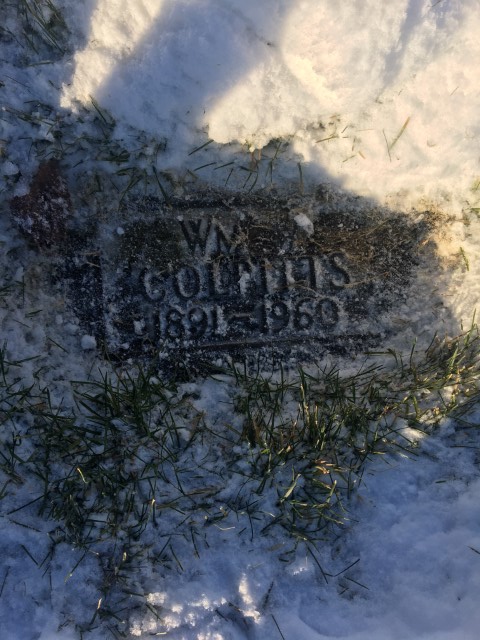
I visited the site he was buried and it is an unmarked graveside. I confirmed the plot immediately next to his from cemetery records online and will attach pics. His “neighbour” would be William Colpits. See below:
And
you can see the records that he is confirmed in Block 31 Lot 2
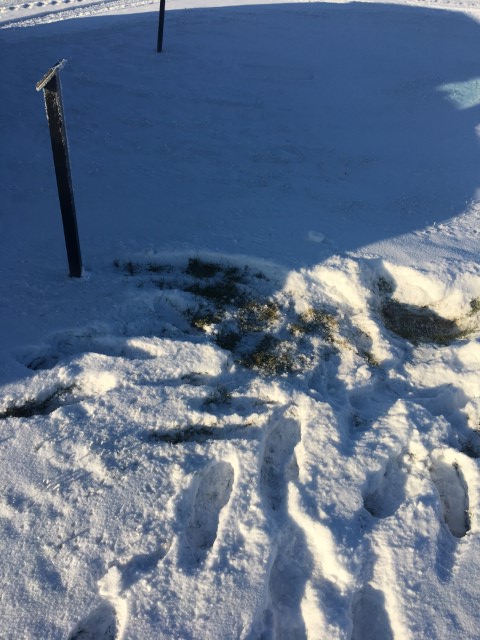
The following picture would be where Herberts remains are currently resting.
Basically,
the snow kicked away was me looking for his headstone which is not present. By
way of an option, I could direct you toward the sale of a headstone if that’s
something you feel you would want.
Hope
this brings some light to your curiosity.
Steve Logan
At 21:34
I emailed Steve asking for a quote to provide some simple mark for Herbert’s grave. Bertie’s story will be continued at a later date.
I was at the school beyond in Cloonaquin for a few years. A small school set up by the Dromahair landlord, Mr LaTouche for his Protestant tenants. It was all right, I learned more outside of it than in, from newspapers or books that I could get my hands on. There were no more than eight of us there. Arragh, I was always getting in trouble, either fallin asleep or asking too many questions. I got top marks all the same.
Alec Davis on an ass and cart circa 1934. This is most likely the transport that took my mother’s generation to Masterson National School.
The memory
is a great thing and mine has always been sharp. I just need to see or hear something
wanst and I have it for good, a story, song, whatever. From when I was small the
neighbours loved me coming in. They would question me up and down about what I
knew. Maybe from the last paper I’d seen I would tell them how the army was
fairing against the Boers, or about some strange part of the Empire. But divil
the hate I knew what I was telling them. That’s where it all started.
I was working the farm here with Daddy for over 20 years, my brothers leaving one by one all the while. Richard and myself got the farm after Daddy died, we owned it for the first time then. Richard would have been a landlord himself if he could, starting with old Frank McLaughlin up there. Oh, he was smart like his father and was always hatching some new plan. Maybe cause I was older or that I’d already helped to build this place up, with the new house, I let Richard get on with it. I’d been a few times up to John in Meath then, and met Margaret.
Before I left,
I fixed up the wee toilet for Annie. I gathered the water off the yard in a big
drain, dug it down to the bottom of the haggard and built the toilet over it
there. And sure as not, once or twice a
year some flood or other would clear all the dirt down into the meadow below,
never blocked once that I remember.
I always had a feel for water. I could look at a farm of land or a field and knew which way it should be drained. Where to catch the water or where the springs were rising. I set up the big tank at the top of the yard, found a good flowing spring not too far away, it rising not two yard from a ditch, runs the year round.
Alec and Margaret Davis’s home Corballis, Donore, Co Meath. Image Google maps circa 2015
Home Rule troubled us at the time. We depended on England for everything, sure we were the one country. Richard and myself went to a few of the meetings that were opposing it. One of them in the market-house in Manorhamilton was packed to overflowing, we had to stay out in the street. The Orange lodges were active here too but there was nera one in Boggaun. I think my Uncle Thomas was the only one of us in it, we have his sash somewhere in the house, or I believe it’s his.
Everything changed after the Easter rebellion, it was never the same again. We didn’t get boycotted here but John did earlier, beyond in South Leitrim when he took that evicted farm, before he moved on to Meath. I heard some big houses around the country were being burned out then. And when I was at Corballis we heard the big – BOOM! – when the Boyne monument was blown up by the IRA, not more than a mile away from us. With all the changes and turmoil going on you couldn’t help but think the odd time, that they might come for us too.
Then Independence and a Border came. During those times some of our family and friends sold up and left for the North or went across the water. How and ever the sun kept rising, the cows were milked, dinners made to feed hungry bellies and the childer kept on growing. At Boggaun, after the blaggard ran off with our money, they had their own troubles without looking beyond the gate. We worked with neighbours like we always had, worked the mayheals, and the hired man got a fair day’s pay. Before I knew it, the worst seemed to be past and I suppose looking back at it now, it caused us no real bother.
Alec’s brother Richard circa 1930
The radio’s the new thing now, even Mary Jane listens to it. And at last Annie and herself have made their peace. The young ones grow up around me like nettles in spring, always wanting a story or a few riddles before bedtime. And sure, I’m more than happy to oblige.
Ends
Notes
1. Alec and his sister Mary Jane are buried in Manorhamilton Parish Church Graveyard. Their names do not appear on the family headstone.
2. Alec Davis features significantly in the Davises contributions to the Masterson National School addition to The Schools Collections. Many of his contributions of stories, riddles, lore and song can be seen at the link – Alec Davis in The Schools Collection
4. Thanks to Padraig Fitzpatrick for his recollection of Boggaun neighbours recounting of Mary Jane’s rows with Annie Davis including her comment to the effect – Twas my mistake to let ye in atall!
5. Alec, like a few others local story tellers, appears a number of times as a source to the stories and recollections in local school contributions to The Schools Collection. Alec is likely to have been the source of much of the very extensive contribution of his sister in-law Nan Gillmor living at Bohey House which is sourced to her. Nan Gillmor was a principal at Carrigeencor National School. Generally, these story tellers recorded in the Schools Collection, represent the final era of the oral tradition in Ireland. The School Collection can be searched and browsed at https://www.duchas.ie/en/cbes
7. The Boyne Obelisk, not far from the Davis home at Corballis was blown up by the IRA on 23rd May 1923.
8. The “Maytheal” I’ve used is an imagined Anglicised term used by Alec for the more proper “meitheal”. The word meitheal describes the old Irish tradition, current in Leitrim until the 1970’s, where people in rural communities gathered together on a neighbour’s farm to help save the hay, some other crop, or urgent or significant farm task. Each person would help their neighbour who would in turn reciprocate. They acted as a team and everybody benefited in some way. This built up strong friendships, social cohesion and respect among those involved in the meitheal. Modified from http://www.giy.ie
It is 1934, Alec now 65, has returned to Boggaun after the death of his wife Margaret six years previous. He has spent the ten years of his married life at Corballis, Donore in Co Meath farming beside his brother John. Mary Jane, his older sister is 70 years old. At Boggaun his brother Richard, aged 52, and Annie have eight children (Herbie, Reco, Ena, Cecil, Phyliss, Wallace, Alf and Jack, ages ranging from 19 to 2 years) The collapse of the cattle business some ten years ago still impacts on the family. Richard continues to pay off the debts as the bank attempts to sell the farm. This is part Alec’s imagined story, in two parts.
Alec Davis at Boggaun circa 1934
When I got
back here it was almost settled between them – Mary Jane and Annie – they would
sit side by side in the trap going off to church of a Sunday morning, like they
were the best of friends. I’d been back a good few times and I knew what was
going on between them. I tried to talk to Mary Jane, but it did no good. If ye
ask me, the both of them, too serious, nera laugh or soft smile between them.
One of the
McGoeys on the Rock was working here one summer. He told me that Mary Jane in
the heat of a row would hurl her worst at Annie – Twas my mistake to let ye in
atall! I had to put my head down and
clear off manys a time, he said to me.
But if Mary Jane could be a bit rough, she was a rock here over the years. She helped rear many of our younger ones including Richard, had some of them reading before they went to school. As Mammy got older, she took over the running of the house. When Mammy died and then Daddy all of a sudden, well, it was hers. Until almost ten years later Annie arrives.
Sisters Maria and Margaret married to John and Alec Davis, repectively, circa 1925
I had a new start in Meath, one I never thought I would have. Not long after I married Margaret, we discovered that she had some sort of sickness. We were extending the house then and farming all the while, and with John’s help we were going along fairly well. Margaret was a fighter, but no one could tell us what was the matter, and she struggled on for a few more years. The poor cratur went very quick in the end. Her sister living beside us was a great comfort to her. We had a few good years together at Corballis and travelled to places I only read about, Dublin and down as far as Arklow in Wicklow.
But when I
look back on it, I didn’t quite find my place there. Maybe I was too old when I
got married, as many joked to me. Oh, Margaret and I were happy, we were
comfortable enough. But I missed Boggaun, the welcoming neighbours and hills
around me. I didn’t travel so much about the unfamiliar townlands in Meath. I
never said anything to Margaret, but her sister Maria knew. She said to me one
time that I was too set in my ways when I came to Corballis. We buried poor
Margaret with her mother beyond in Duleek. Meath seems another life to me now.
Arragh what are we at all? Different lives in different places and we all end in the graveyard. And if not in the same graveyard, we’re facing the same way. God only knows the reason for it all. I’m sure I don’t.
John and Maria Davis, left, with others unknown. Behind is Alec and Margaret’s house. Photograph circa 1930.
Well I knew
it was a bad situation here at Boggaun and when my affairs were tidied up at
Corballis, I came back, left what I could to John and Maria, they were very
good to us.
Poor
Richard and Boggaun, ruined by the blaggard, took all we had worked for, our
own kind too, God blast him. Put us back fifty year. Arragh, in spite of it
all, I was glad to be back and helpin out, among the small army of childer
around me. And I was soon back in my old ways. The friends and neighbours hadn’t changed too
much, I got a great welcome home.
It all changed
the year Richard got married. A year of turmoil it was. Sein Fein won the
election, many of our men didn’t vote, a few difficult days with neighbours. I had
to fight for my place here too, after more than ten years of runnin the house. And
Alec was gone, married and livin in Meath. No one to back me up.
A drawing based a poor quality wedding photograph of Richard Davis and Annie Gillmor circa 1930.
Richard and
Annie were married in Dromahair Church a month before the armistice was signed
and the Great War ended. It was only startin here.
She arrived her gosling wings barely gone, thinking it’s hers to run. Reading her books and poems, ways like the gentry, lucky to get Richard at all, she was. Oh, we’ve had it out manys a time, at it hammer and tongs sometimes. I had my ways, knowin the place like I do, she had hers. No Alec to come between us. Richard coming down on her side. Eventually she got her way, when the first childer were born; I suppose it was only right too. Arragh, I can be far too head strong for my own good.
Now they
ignore me. Alec smiles at me, asks am I
alright? What does he think?
It was some shock ten year ago when Richard lost it all, everything, I mean all we had. It seemed to be goin so well. Settin himself up on his own terms, makin great profit from the cattle shippin. Behind his back some said he was too soft, didn’t have himself covered well enough. But that blaggard, the crook, the, may God forgive me, the names I’ve called him, he ruined us.
Days of
turmoil and tears, slowly seepin in what had happened. The loss of the money,
yes, but the debts, God help us, we were finished, the Bank wantin everything. The
Rector called, prayed like it was a death, didn’t make it any better.
Three of us and the childer, when it happened. We had a man as well, Robert, Robert Maxwell, but we had to let him go. The days passed and we learned to live with less, the childer knew nothing. A felt sorry for Annie now, a baby arriving almost every year. And fair play, she fell to it, what else could she do. Worked harder, made all our clothes, nothin too low for her now. Look at us, in our big slated house, puttin a brave face on it; sold what we could, worked ourselves harder, bought little. We ate so much salted herring in them first years, I’m sick of the sight of it.
And the
bank keeps chasin us for more, putting the place up for sale every year, we
could be on the road, God help us. But Richard dug in, his faith behind him. He
would pay it all back, he said, the farmers, shippers, John in Meath, all of
them, get going again, he said. God help us.
I always
kept the garden, you know, the big one up beyond the White Field. Loved my time
up there, grew fine rows of cabbages, carrots and beans in the peaty loam, damp
in the driest of years, I could be lost there. I often sung to myself. In bad
times pleadin, and prayin to God. I still have a seat up there, although I
don’t keep the garden. In the warm summer sun, I’ll go up there sit for a while,
get away it from all here and thank God for the life I’ve had.
Ends.
Mary Jane’s brother Alec will feature in the next blog.
Notes
1. I never knew my Grandaunt Mary Jane Davis. This
imagined monologue is based on the circumstances and events surrounding her life
and a few mentions my mother made of her. It does not reflect the complexity,
vitality and colour of her life and I make apologies to her memory for any
gross errors in her portrayal.
2. The first note on the Valuation Office
records in 1862 shows John Davis with 47 acres at Boggaun. Patrick McKay is
noted as living here as a tenant in the haggard but not by 1880 valuation, it
is presumed he had died. The valuation of
1880 shows a significant increase indicating the new house was built by then.
Griffiths Valuation circa 1850 shows John Davis at the same property.
The Valuation Office has a manuscript archive containing rateable valuation information of all property in the state from mid 1850s until the early 1990s; and commercial property only from that time. This archive shows the changes after the revision of properties and is recognised as a census substitute for the period from the 1850s to 1901 (the earliest complete census record for Ireland). The archive may be used to trace the occupiers of a particular property over a period of years. These records are not available online. https://www.valoff.ie/en/archive-research/genealogy/
3. Mary Jane’s father was James Davis born at Glenboy
(1833-1909). Her mother was Elizabeth Jane nee Mealy or O’Malley (? – 1910)
from the nearby townland of Tawnymanus.
4. Mary Jane’s siblings all born at Boggaun
were: John (1861-1931), Thomas (1865-1920) James (1867-1894), Robert (1868-1915),
Alexander-Alec (1869-1941), William (1872-1950), Richard (1882-1961).
5. My Grandparents Richard and Annie were
married on the 23 Oct 1918 in Drumlease Parish Church, Dromahair.
6. Alec Davis married Margaret Taylor (nee Cartwright, a sister of his brother John’s wife Maria) in 1918 in St Kienan’s Church of Ireland, Duleek, Co Meath. Margaret died 30th December 1928 and Alec returned to Boggaun sometime after that.
7. The blog on the boyfriends of Mary Jane is
completely fictious.
8. Neighbours at Boggaun recalled the fiery rows between Annie and Mary Jane and these accounts were recounted by Patrick Fitzpartick to his son Padraig. Thanks to Padraig for this story.
9. I recall there was a large vegetable garden in the location described which had not be worked for several years and finding remnants there including a broken chair. The photograph of the chair above is staged.
10. These blogs on the life of Mary Jane relate to other previous blogs particularly Richard Davis, Swindled.
11. At a later time it is planned to provide a link to related documents where they appear unique, for example, the RIC record of the boycotting of John Davis at Garradice, and various army and RIC records.