This is the first landing for my writing. The regular posts cover a variety of subjects and styles: fiction and family and social history. A few have been published elsewhere. Why the curlew or crotach? Known for its long, elegantly curved bill and its haunting call, the curlew’s call, once common on wetlands a generation ago, is now is seldom heard – like many of the subjects in this blog.
three hundred paces and more stepping out the years to when mud-splattered men fed by their patient women fashioned stone of sluice gate and bridge of nearby lime kiln
already waist-deep in history the Boyne's victory settling at the planter’s mill they dug deep the levelled race their labourer’s mutterings unheard as wet boots shucked to bawdy blether of passers-by
the land’s oats and grain scythed on model fields rid of stones to line the race wait on religious men to grind their daily bread to believe in trade and progress a better place than was given
children shout and run to that first rush of water following the channel muddy at first to the pond and sluice life surges in their place towards a golden heaven
a crowd strains to see as water spills onto the big iron wheel labouring in its first turn hesitant and slow yet relentless now stone against stone
grinding out our future and we are moved in this place to read to write to scratch out words and listen for distant whisperings
River Mill Writer's Retreat, Grange Walls, Co Down.
Then he came to shave my chest. And with him, a chill wind that blew away any remaining nonchalance. Practiced and casual, he talked in soothing Dublin tones; yet held something back, expectant, prepared perhaps, for some unwanted confession.
Not much view from this ward, is there? he asserted as the buzzing trimmer stroked my skin, his breath mint-fresh. We both knew the plans for the next few hours started with heavy sedation. The view would be irrelevant. But would the scalpel make one clean incision? How could I not feel it?
Still, you’re better in here on a day like that. Would the battery of the sternal saw be fully charged? Vibrate? Spit out fragments of my bone?
You’re from somewhere north of the Liffey? he joked, brushing the trimmer’s teeth clean, grey hairs falling, collecting on my sheeted lap. How many green scrubs and masked faces would gather around me? All at their day’s work. Tired perhaps?
I spent a summer in Donegal years ago. What a time. How do they stop, and later, start my heart? Slice it open to reveal the damaged flap of my mitral valve? Will the surgeon hold my heart in his hand?
Primed by furuistic story lines, is it a wonder that I floated back into a disturbing brown dystopia, where comfortless and ghostly shapes watched and minded my vitals, as others lay, similarly wired and tubed, in beds held sloped in the octagonal high dependency room; of a doomed space ship stranded light years from home?
A nurse would later laugh – too many sci-fi books.
From the faint dim walls around me, diamond patterns grew into the form of dark heads and faces. They waited motionless, their distant gaze unconcerned, it seemed. Yet they were waiting. Some atonement or recompense? From me? Then left in their own silent time as they had come, morphing back into shadow. Others were to follow with disturbing regularity. Nothing was familiar. Nothing brought comfort. At night, my bed and I toured the wards, as whispering voices curled into loud and absurd conversations.
Then the opiates, too, left in their own time. And with them, the delusions began to fade into the routine of the ward: first steps tentatively taken, that first taste of Weetabix and cold milk, the stunning freshness of the first shower. Yet a dull echo of those opiate dreams remained; until, with some help, they too were gone.
And now, months later, I can write this – feeling some strange sense of nostalgia – with a steady and strong heartbeat. Restored by the magicians: the surgeons and their team.
all autumn sunshine and chill the Phoenix Park crisp two of us on a Sunday morning run religiously fit and fluid breathing in the moment our worn soles lightening around and between the brunched green revellers families holding back children and dogs grasses bent under strolling figures long departed
a sudden gust cuts across the parkland ducking under trees drawing a wheezy breath shears through an ancient beech it carries a swirling leafy eddy flashed iridescent by low sun then gone spent a shower of twisting gold fluttering to the ground
our stride keeps pace breathing long settled snaking a path back to the car
The very idea of it was a joke to my Ballymena family. An outside toilet. A minute’s walk from the house. At the bottom of the haggard. Flushed by winter rains. I never told them the men rarely, if ever, used it. They headed for the fields – a particular field. But I loved going there.
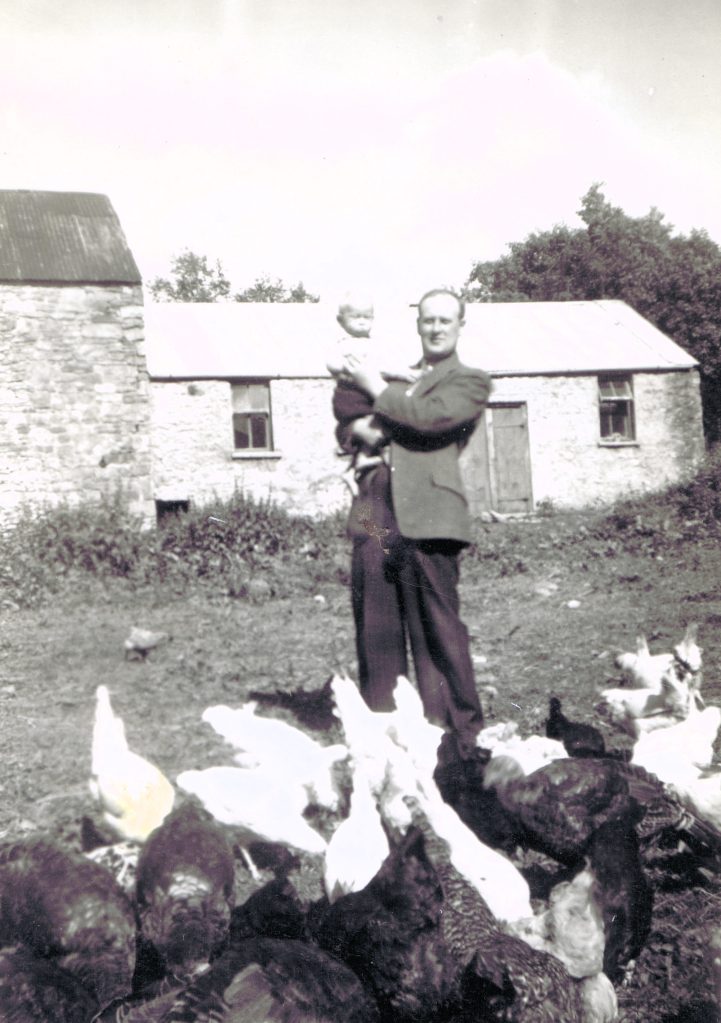
Tommy McWilliams in the Larkfield haggard with Ivor or author, circa 1955.
It was a small wooden structure a little bigger than a roadside phone box. Tin roofed. Always freshly painted by my grandmother and, for a few summers, by me. Painted by left-over colours from some other house job. Surprisingly, it didn’t smell at all bad.
A roughly made lid revealed a dark hole. A long drop to the night soil beneath, if you were interested enough to look. Often a breeze wheezed through the cracks, soughed in the tall sycamore trees. Crows called and wheeled above. Small birds kept me company. Torn and squared newspaper hung from string on a painted nail. Brush strokes against the wood grain of the wall.
As an eight or nine-year-old, when I stepped onto the sloped sandstone slab, entered, and closed the flimsy door with its clumsy catch, I shut out the world. The squabbling between my grandmother and grandfather as he came home softly drunk from some fair, to sit down to a dried-out diner; the bickering between the two of them and their remaining adult son; the edge of my grandmother’s voice as she pulsed with unspoken disappointment at the turn their lives had taken; her sharpening tone when she spoke of her Catholic neighbours, particularly her son’s marriage to one; the whisperings of the IRA raid. All, it seemed, mirroring tensions around my own home. Adult’s lives played out in ways that left me confused, if not scared.
But inside, I imagined a place that was mine alone. Where I was the master and needed none of them: a tiny hinged table in the corner; a folding bed; shelves to store food and put a lamp; everything I needed. Dry and weatherproof on rainy and stormy nights, cosy even. Well, maybe no room for a toilet. But then there were always one or two things that needed further thought. I’d figure them out next time.
Then I’d open the door, watching for that sometimes-slippery sandstone slab, and go back to the waiting farmhouse with all its affection and next-day plans that spun me through those Leitrim summers.
Everything during those couple of days I recall in black and white or tones of sepia. We travelled to Dublin in our first car. A black Austin Seven. It must have been summertime, Northern Ireland’s Twelfth fortnight, the only time my father had a full week off work.While I recall more than my siblings, our common memory is of O’Connell Street.The city was big. And O’Connell Street was as wide as a football field. Flanked by tall grey buildings, the centre of the boulevard was lined with parked cars and bicycles, with Nelson high on his column. At night, weak light from roof-level neon signs spelt out the names of Players cigarettes, of Guinness and Harp beer, facing towards the southside of the river.
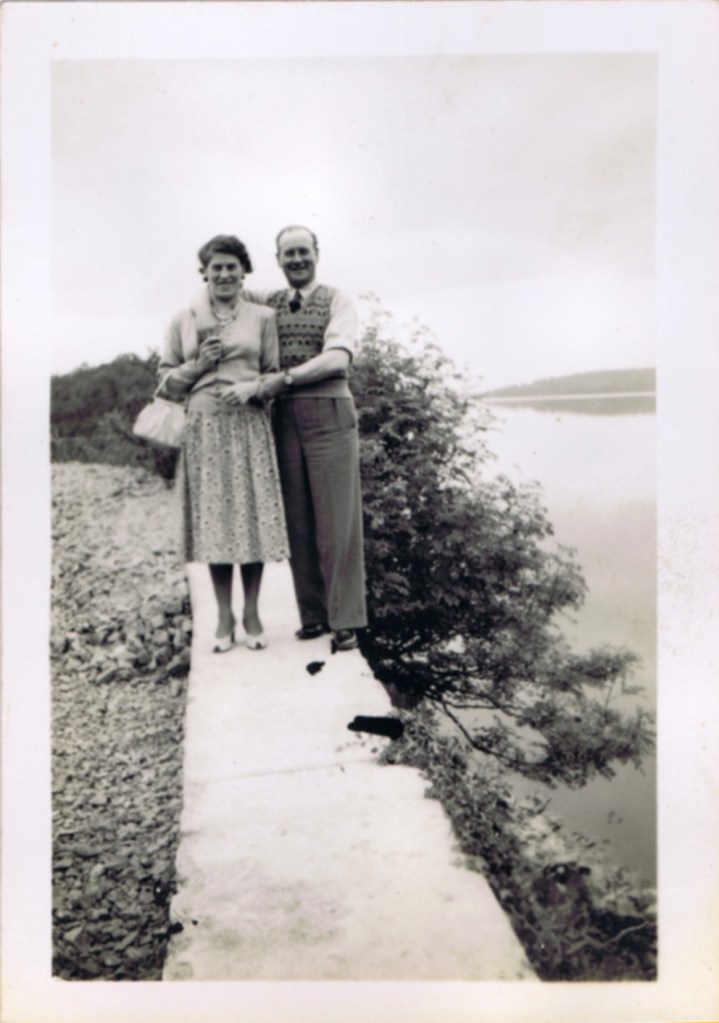
Ena and Tommy McWilliams at Lough Gill, Co Sligo. c 1950
We entered into one of the five-story buildings on O’Connell Street, on the left, less than one hundred yards north of the River Liffey. From the city footpath, we clattered up the lino-covered stairs with our bags and cases to the landing of our guest house. Leaving the parade of pedestrians, bicycles, cars, and buses, to be marshalled by black-uniformed Guards. Little light penetrated far into the building.
Our parents had honeymooned in Dublin just over a decade earlier and probably yearned for those simpler, more romantic times. Now, with four children, the youngest five, life was busy and full. A long car trip, though still a novelty, would have been a fractious affair. My father’s patience would have been sorely tested. I climbed the dark winding stairwell of Nelson’s Column with him, out onto a square platform to dizzying views of the streets below. The scene beyond folded into a low grey cloud. Nelson would stand tall for another five years or so until a maverick Republican took him down to street level.
The woman of the guesthouse offered to mind us for an evening. The younger two slept early, and myself and my brother were parked on straight-backed dining room chairs in the guest’s drawing room, in front of an incredible novelty, a television. We watched a British TV channel, the only ones that could be picked up in the years before the Irish television came on air. A single orange electric bulb backlit the room. We watched a sci-fi episode, ‘Elegy’, part of the US production ‘The Twilight Zone’.
Mesmerised by moving pictures, we saw the crew of a grey US spaceship land on an earth-like alien planet. The three crew were shocked to find all the humans were completely motionless, frozen at their various tasks. They were eventually welcomed by a friendly figure of an old man in his large house. The scenes that unfolded of these rigid, yet realistic people became more and more creepy and scary: a town election, a beauty pageant, a farmyard, where no one moved. The crew were dined, and then poisoned by their host, and died there, right in front of us, on the screen. The final scene saw the old man, accompanied by weirdly bright happy music, dusting the bodies of the three astronauts sitting forever paralysed in their spaceship. My first TV viewing would have been memorable, but the effect of this frightening sci-fi has left its indelible mark. I suspect that sleep that night, in a strange bed, came late.
Tommy at Larkfield, boggaun, Co Leitrim with his first car, c 1960.
Outside, we didn’t see the shadowed holes left by bullets and shrapnel that peppered the walls of the buildings, and particularly the façade and portico of rebel headquarters at the General Post Office a short distance from our guesthouse. The dust had settled on the Easter Rising just over forty years previous, and Ireland was in the early years of Seán Lemass’s leadership. The city was starting to show a growing national confidence and optimism, though the rest of the country was still blighted by dark times of unemployment and mass emigration.
Did I enjoy that first trip to a city I have long since come to appreciate? Judging by these scant memories, probably not. I’ve no recollection of the drive back home. Most likely, we went west to Manorhamilton in County Leitrim. To our grandparents’ farmhouse, without electric light and running water, where we would continue the annual ritual of happy summertime holidays that remained for more than a decade.
Some time ago, I wrote a few blogs about my great uncle Herbert Charles Gillmor. These earlier stories tell of his family near Dromahair in County Leitrim, of his injuries in WW1, his emigration to Canada as a European pioneer, and of his untimely death in 1960. His Goodfare neighbours sent me some of their memories of Bert. One is printed here and there is a link to the others. In Ireland, he was called Bertie and Bert when he emigrated to Goodfare in Alberta, Canada.
Bert’s farmyard after his death. (Raymond Wardill)
I heard my grandmother, Annie Davis, refer to him a number of times as ‘poor Bertie’. As the eldest, she may have carried some sense of responsibility towards him, and indeed Annie and Richard called their first son after him. If Bert’s experiences in the Great War left him damaged or dislocated, he appeared to have lived a full life for over thirty years in his small rural community.
In Goodfare those who remember him described a successful hard-working farmer, tall and muscular, and a good friend to his neighbours. He never married and didn’t like to spend money, though he knew how to have fun, one said. He was also generous to the local school and community. As one of the first wave of European settlers, he was given two sections of virgin forest and scrub on lands taken from native peoples. He cleared these for agriculture and kept cattle and horses. For many years, he used a horse or horse and buggy to get around and was the first to have a motorised truck. One neighbour said he would take off for days at a time and no one knew for sure where he had gone. One woman speculated that he went to town and that as a single man, he had needs that had to be satisfied. However, it was also said that no such rumour had ever circulated in their small community. The nearest town to the rural settlement of Goodfare was Beaverlodge, twenty one kilometres away and there was a First Nations reserve near Horse Lake some six km north of his farm.
What drove Bert to his tragic decision was never clear. In May 1960 he was found in his truck a few days after taking his own life. Raymond Wardill, whose father bought Bert’s place after his death, says they thought that Bert had never paid any tax, and when the tax man finally caught up with him, it drove him to his sad end. Bert, he said, always worked in cash, and as children, they believed there were hoards hidden around the farm. They would often go looking but found nothing.
I recall my grandmother saying that Bertie had accumulated significant lands over his farming lifetime. But when his estate was distributed, the nephews and nieces were surprised that there was so little. The final accounts give no indication of where the bulk of the estate went. She said this could only be explained by the actions of a native woman and her family, which she must have heard about from his letters. But ‘the tax man’ collecting his dues is perhaps a simpler explanation. Interestingly, all these recollections are filtered through the ears of children two generations after Bert.
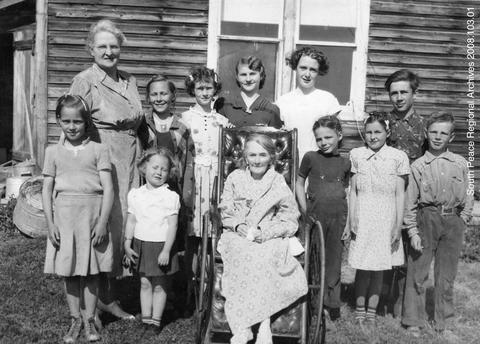
The following story about moving Bert’s horses is one on a number sent to me by Eileen Hommy and her daughter Svea. Eileen’s father was a Norwegian pioneer whose land sections were next to Bert’s. Other stories from Eileen and her sister Evylen can be read here: they include, Bert’s Cattle, Christmas Dinner, Stealing Bert’s Tobacco and Warming up at Bert’s. First, a photograph of Eileen, sister and other characters in the story below, at Southwell School.
Southwell School students and teacher c1949 “In the late 1940s Southwell School District held white elephant sales to raise money for Red Cross. Red Cross matched the money to provide a wheelchair for Mrs. Pretzer who lived beside the school. Back row, l-r: Mrs. Gladys Park, teacher, EileenTollefsrud, Florence Southwell, Mary Olychuk, Gloria Cavanagh, Arthur Tollefsrud. Front Row: Evelyn Tollefsrud, Roberta Weller, Mrs. Pretzer (in chair), Ruth Pool, Jeanette Chandler, Kenneth Pool. Southwell School District 4470 was located north-west of Hythe. Mrs Pretzer died in 1953.” From South Peace Regional Archives
A Daring Adventure with Bert’s Horses
It was June, and my older brother Arthur was still going to Southwell school along with my younger sister, Evelyn and myself. I would have been 8 years old, almost 9, so that would make it 1949.
The only teacher at our one-room log school was Mrs Park. The school was about ½ mile from Bert’s homestead. That day Bert stopped by the school to ask Mrs Park about taking Arthur, who had just turned 12, to come and help him move his horses from one pasture to another. He had 14 or 15 head of horses if my memory serves me correctly. These were wild, unbroken horses. Unfortunately, Arthur had stayed home to help Daddy that day.
Bert, a tallish, muscular man who wore blue overalls and a cap, asked Mrs Park if she thought “The Girl” was up to it. He told Mrs Park that it wouldn’t be too difficult as the horses were up by his house, and she would just need to go around and bring up the rear, to drive them into the gate, which he would close behind them. So, it was decided that I would go.
Bert’s farmhouse was a log cabin of some sixteen feet by fourteen, larger than most, and with a wood stove that kept it cosy even when winter temperatures dropped to 30 below. Sometimes, when it was very cold, Bert brought us in to warm ourselves on our way to school. That was very nice.
By the time I got my horse Betty, out of the barn at the school, Bert was already on his way. I rode Betty bareback. Arriving there I turned sharply left to get around behind his horses. When Betty whinnied Bert’s horses started kicking, biting and rearing up. They were trying to get at Betty who was unfamiliar to them. Then they started to stampede. Instead of going towards the gate, they galloped in the opposite direction towards the creek. Betty raced in hot pursuit. There was no way I could hold her back. I can still see and hear Bert waving his hat and yelling “Girl! Come back!”
In June, the snow is melting in the Rocky Mountains, and our creeks and rivers are swollen. Raging torrents with deadwood and many uprooted green trees are taken downstream. Bert’s horses plunged into the roaring creek and my horse followed. There was nothing I could do. The opposite bank was too steep so the horses swam downstream to a low spot about 200 yards on the far side. I was half sitting, half laying across Betty’s back, holding onto her mane with my right hand and pushing the logs and trees away from us with my left. Betty was panicking and blowing loudly. Her nostrils were flared and I knew as soon as we got to the bank that she would race off again, trying to catch Bert’s horses. They had climbed out of the creek and galloped away.
By the time we got out to the river bank Bert’s horses were out of sight. Betty was running hard and I had to let her go. I figured she would find them. Not that I could have stopped her even if I had wanted to. She ran for about ½ a mile, going through some big poplars, heading towards Eddie Schweitzer’s place to the south. Before I knew it, Betty had turned and was heading back towards the creek. We were now much further downstream. I could see the tracks in the mud where Bert’s horses had crossed. Betty plunged into the creek again. It was a good crossing spot, not so terrifying this time.
When we got back up on the bank Betty galloped towards Bert’s house. His horses had run back into the meadow where they came from, and on out through the gate into the new grass. Bert had been looking for me and Betty and was somewhat panicked. I am sure he had visions of telling my Dad, a big Norwegian and a good neighbour, that his daughter had drowned in the creek, helping him move horses. When he first saw me, he banged his fists on his knees, shouting, “Good job, girl! You’re still on your horse! My God, what am I going to tell your Dad.”
After that, I went back to school because I had to get Evelyn. Bert came with me to explain to Mrs Park why I was soaking wet. Then I guess Bert headed to our farm to explain to Daddy what had happened. When Evelyn and I arrived home he had already been and gone. He had given Daddy $5 saying, “The girl had earned it.” That was an enormous amount of money at that time. With it, I remember getting new shoes and new pants, and I am pretty sure Evelyn did, too. On my Mom’s advice, I told Daddy to keep the rest to buy something for someone else. We were a large family.
In the end, Bert got his horses moved, and I was $5 richer. At school, Mrs Park commended me on a job well done. At home, my Dad told me never to do it again. And I have never had such an exciting afternoon.
End
By Eileen Hommy with minor edits from SMcW.
Eileen and Evelyn’s full set of stories are here. Click.
Thanks to Eileen (nee Tollefsrud) Hommy and her sister Evelyn Harding, in Beaverlodge for the bulk of the stories. And Eileen’s daughter, Svea Isherwood for recording and sending me the stories.
Also thanks to Raymond Wardill for his recollections. Raymond’s father purchased Bert’s farm after his death.
And to Walter and Thelma Pfau, neighbours whose family regularly sold stock to Bert and who clearly had an affection for him.
Finally, thanks to all in the Goodfare community who helped me collect these stories.
It’s the early 1800s. Imagine an elderly Irishman travelling the country’s rough roads, his horse and saddlebags, like himself under his broad-brimmed hat, wet through from the constant rain, each heavy step of his horse taking him closer to market day, where he expected violent opposition to his fiery evangelical preaching, delivered in Irish and from horseback; if he was lucky, a few converts at the end of the day.
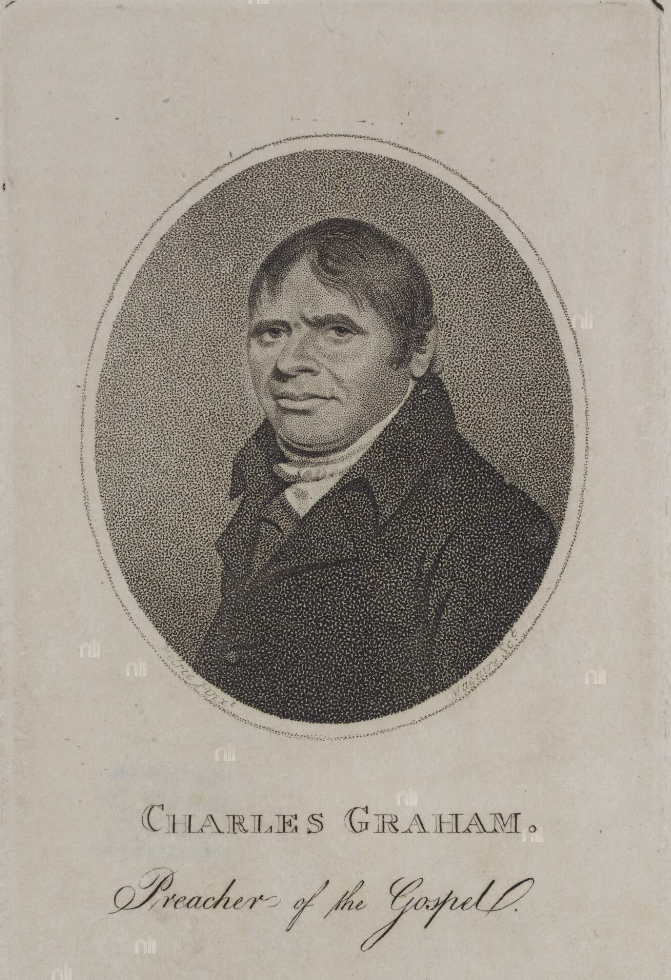
Charles Graham, attributed to Patrick Maguire, (fl. 1783-1820), after an original painting by James Petrie, (1750-1819), held at National Library of Ireland, Dublin.
Such was the life of Charles Graham. He was born near Sligo town in 1750. As a young lad, he laboured with his father on their small farm. Though he had no great education, he could read and write and spoke the languages of the day, Irish and English. During his teenage years he ‘ran with the Sligo bucks’ carousing and causing general mischief. When he was twenty, he was converted, or ‘restored’, when a Methodist friend and preacher challenged his sinful ways. Charles liked the simplicity of the Methodists, with their three rules of ‘no curling of the hair, no gold and no gay clothes’. He said his heart was filled with a ‘holy fire’ and he appeared to have been set on the path of evangelising.
After preaching around Sligo for many years, and at the age of forty, the Methodist Church asked Charles to embark on a wider mission that would take him away from his home for the rest of his life. As a fluent Irish speaker, he had been sought out to further the Methodist’s mission. And so, with his wife’s encouragement, he embarked on an itinerant evangelical journey. He often worked alone and was challenged to build new religious communities among a population that was deeply suspicious of his intent. He was drawn by a crowd, on the street or outside churches, where he proclaimed his hellfire message. Success was measured in new converts; the blacker the sinner the sweeter the victory, he believed.
In 1790, he took up his Church’s request to go to Kerry, which they believed to be a wild and lawless place. His wife and two children travelled with him as far as Limerick while Charles rode on across the mountains into Kerry. He took lodgings in a small hotel in Tralee but word soon reached the local priest of the evangelist’s arrival. The priest, together with a crowd, forced him out, proclaiming him as a ‘false prophet’. Charles found safety in the house of a Protestant farmer outside the town. He spent two years travelling around the county meeting considerable hostility. The Methodists said that his ‘defiance to Romanish opposition was tested in Kerry’ earning him the title of the ‘Apostle of Kerry’. Charles was moved to Fermanagh, Birr, then Longford, Leitrim, South Ulster, Wexford, and finally to Offaly and Westmeath, settling with his family in Athlone.
In 1821, at the age of 71 Charles was still preaching, most of it in the open air. Despite the inclement weather, he seemed to enjoy the atmosphere and challenge of markets and fairs. At the large Enniscorthy pre-Christmas market that year, his hellfire preaching, embellished with many bible quotes, enflamed the crowd who pelted him with anything that came to hand. His journal says that there was uproar and that the town Mayor finally managed to stop the violence. The ‘Romanist incident’, as it was reported, had a positive impact ‘in stirring up ignorant Protestants, lukewarm Methodists and backsliding sinners.’ After his sojourn in Wexford, and in failing health, he moved to Athlone to be with his family, and it was there that he died in 1823 at the age 74.
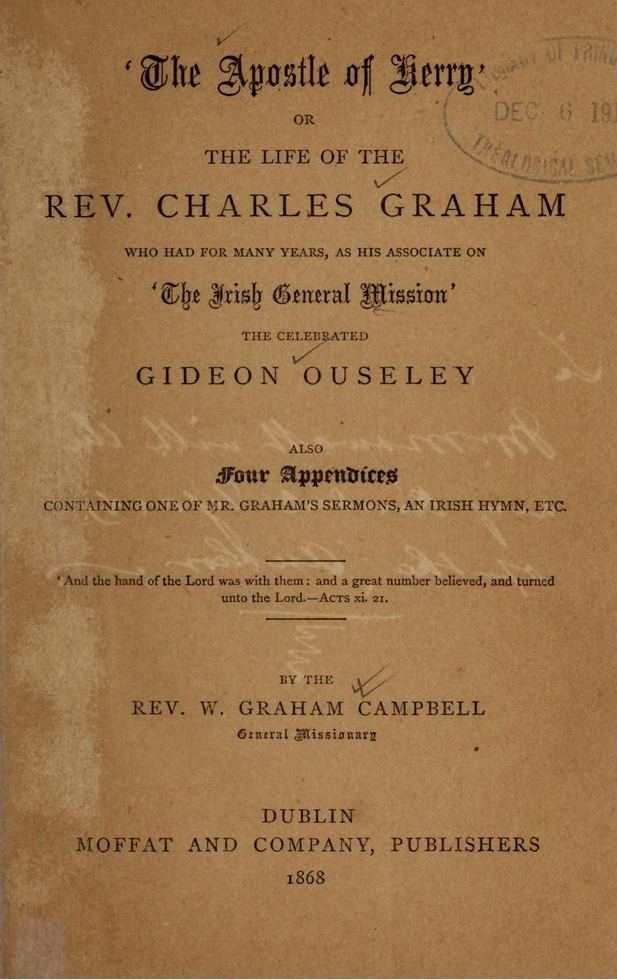
Title page of ‘The Apostle of Kerry’
This story is gleaned from ‘The Apostle of Kerry, the life of the Rev. Charles Graham’ written by his relative William Graham Campbell and published in 1868. The book is evangelical in sentiment and intention and is still available today from religious publishers. The era was one of waves of revivalist movements that swept the Protestant communities across the New and Old World from 1730 onwards. And the Methodist evangelizing in Ireland, initially led by John Wesley, was part of this phenomenon. The most notable in Ireland was the Ulster Revival in the 1850s, still a touchstone for modern-day evangelicals; it brought many converts to the Presbyterian church, particularly in east Ulster. (See previous blog, ‘The Ulster Revival’.)
It’s difficult to know what Charles was like from this religiously focused book. His son, friends and colleagues spoke kindly of him. After his death, as you would expect, there was much praise from the Irish and the wider Methodist community for his resolute religious conviction and unstinting missionary work. St Patrick’s mission is mentioned as if a Methodist one. Charles’s son, also Charles, wrote of his father’s great meekness, and examples of him turning the other cheek when physically attacked were recalled. And there was praise for his preaching in the Gaelic language with ‘commanding sweetness and fluency with which he spoke the Irish language to his benighted countrymen’.
However, my lasting image of Charles Graham is of a man fired by a singular vision of life, death and salvation. A man riding Ireland’s lonely roads for some fifty years, towards another town where opposition awaited, suffering the varagies of the weather, until finally, he could neither travel nor preach any more.
The book is a hard read in the modern era, imbued as it is with a sense of colonial entitlement and condescension, the latter towards the oft-repeated, ‘benighted country’ – the majority of the Roman Catholic population and other sinners. It is based on Charles’s journals and his many letters, yet it offers no commentary or opinion on Ireland at that time. There is no mention of the harsh Penal Laws which cemented the hegemony of the Protestant Ascendancy nor of the widespread dire poverty alongside agricultural exports from the Irish estates to England; nor the resulting terrible famines of the early 1740s and the 1840s which bookend the period of the story. The 1798 rebellion gets scant mention other than the account of a Methodist minister being imprisoned and shortly afterwards released in Wexford as ‘a good man’; and the difficult and dangerous travelling conditions during the rebellion and its repression. The Methodists were Dissenters, and this lack of sympathetic comment is surprising given their initial tacit support for the aims of the rebellion.
When a reader highlighted the book to me, my initial interest was drawn to the likely influence that the book had on a younger Charles Graham born one hundred years later in Knockalass in County Sligo. He was featured in a recent blog, ‘The side saddle and other clues’, and had an unfulfilled ambition to be a preacher, though he did become a political campaigner. The two men are believed to have been related. However, as I browsed the book for this story, it was the character of ‘The Apostle of Kerry’ that rode out from between the lines.
Here is my paternal line, the last blog having focused on my maternal line. Of course, in the broad sense of who we are, this is very simplistic and ignores the genetic mix of generations of spouses and partners – and of our environment – and their various contributions to what ultimately makes us.
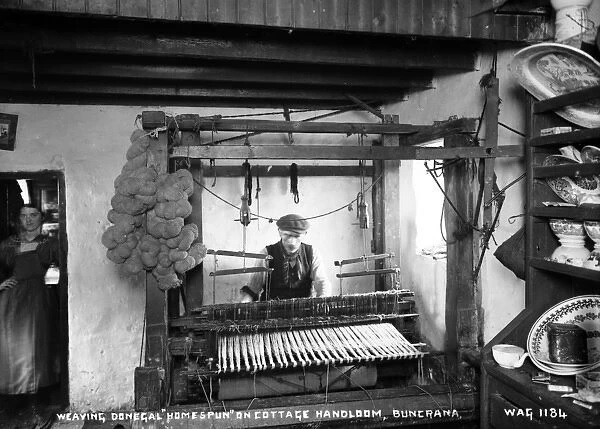
Source: mediastorehouse
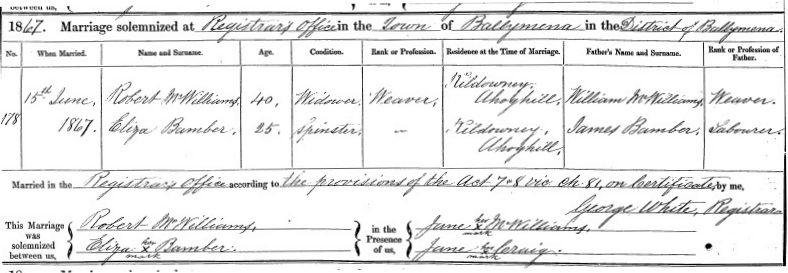
A number of years ago I discovered details of my great grandfather, Robert McWilliam’s second marriage in 1867, and I had expected to come across other records on him or his family. But Robert’s father William, named on this marriage record, remains the furthest back male ancestor I can identify – my daddy’s, daddy’s, daddy’s daddy. I expect, however, that more will be uncovered. For now, it stands:
William McWilliams birth and death unknown, though a guestimate puts his birth date around 1700. William was a weaver from Kildowney, north of Ballymena, Co Antrim as was noted on his son’s marriage certificate.
Robert McWilliams, 1822 – abt. 1905. Married Elizabeth Bamber, 1842 – 1911 in 1867. Both were born in Kildowney and died in Ballymena. Robert was married twice and is described as a labourer on his marriage certificate.
Hugh McWilliams, 1878 – 1955, Ballymena. Hugh married Elizabeth Logan, 1880 – 1961, Ballymena. Married at Kells Church, Connor Parish, Co Antrim, lived in Ballymena. Hugh was a coach builder, and both are buried in Ballymena Cemetery.
Thomas McWilliams 1915 – 2003, Ballymena, Married Ena (Helena) Davis, 1923 – 2015. Lived in Ballymena, Co Antrim, later Dromahair, Co Leitrim and Portrush, Co Antrim. They are buried at Drumlease Parish Church, Dromahair, Co Leitrim.
Robert and Eliza’s marriage record June 1867.
A DNA test widens the family
I took DNA genealogical test about two years ago, to try and discover more. A strong DNA link led me to Canadian ‘cousins’ who emigrated from the Ballymena area and settled in Ottawa in the mid-1850’s. Their family tree is full of Williams, Roberts and James that, at first, appeared to match ours. But on a closer look, the Roberts and James did not match well enough; their birth and death dates were too different to make sense. (This leaves my recent blog Robert Disappears somewhat in need of correction!) So, I’m digging again, for a missing link which may be a generation or two back. Something will turn up.
Every male has Y-DNA which is passed uniquely through his father’s line, from father to son, and so on. Individual Y-DNA analysis, and sharing the results, have provided powerful tools to scientifically investigate our human family: its movements and origins, giving us a better notion of our geographical and cultural journey.
Historical mutations or markers which are locked in my Y-DNA are like a faint trail of breadcrumbs on a hidden path. Each breadcrumb is a mutation and marks a branch on my human tree. In some cases, it can be linked to known men and approximate time periods.
McWilliam’s Y-DNA
So what of the McWilliams Y-DNA? Surnames are only useful tags going back about a thousand years or so, when they first came to be used. My assumption was that a Y-DNA test would show a clear link to Scottish Plantation of Ulster during the seventeenth century. But surprisingly, we carry ‘Niall of the Nine Hostages’ marker, the M222 mutation or breadcrumb. This is a scientific fact. We are of Gaelic origin, on our father’s line anyway.
‘Niall of the Nine Hostages’
Despite the esoteric nature of human genetics, the Niall gene achieved significant public attention. While the M222 marker was originally attributed to ‘Niall of the Nine Hostages’. (Niall was a semi-historical character, assumed to have been real person living in the late 4th and early 5th century AD. Notably, he was the progenitor of the O’Neill dynasty.) The ‘Niall’ moniker now appears to be a misnomer as the M222 mutation has been shown to go back much further into pre-history.
A large proportion of Irish men, almost 25% in the NW, and a significant percentage of Scottish men carry this gene mutation. It appears to cluster around south Inishowen, around Graian Fort it has been suggested – coincidently the area where I have been living for the past forty years. Simply put, at some point in Irish pre-history a very prolific Gaelic male living in this area spread his DNA very widely, and today millions carry the M222 marker.
Gaelic Orangemen?
So how did we end up as Mid-Antrim Presbyterians with many recent ancestors steeped in the Orange tradition? There are at least two possibilities. Firstly, our roots are in the area around Ballinascreen, where the Gaelic McWilliams surname is common. The south Derry area was for centuries was part of the O’Neill kingdom. The Y-DNA evidence and analysis suggest this is likely. During the first half of the 1600s, lands near Ballinascreen were expropriated and given to the the London Company of Drapers – centred on the planted town of Draperstown. For pragmatic reasons, we may have switched allegiances and become Presbyterians, bringing a better chance of employment and family prospects. It is argued this was a common occurrence, indicated by the many Northern Irish Protestant names which have no apparent roots in England.
A search of seventeenth-century records for County Antrim found very few McWilliams, although records are sparse. So, we may have gradually migrated to the better lands and the security of the Protestant majority in County Antrim, becoming drawn into the social and political concerns of this community.
The seventeenth-century Ulster plantation of lowland Scots offers a second possibility. That we were one of the Scottish McWilliams, Presbyterian planters who arrived in Ulster carrying the M222 gene mutation. Centuries earlier Irish raiders and traders had landed in western and southwestern Scotland, some settling and introducing the ‘Niall’ mutation to the gene pool. Scoti is the original Latin name referring to Irish Gaels. In addition, since pre-history, there has been continuous seafaring across the Straits of Moyle (the North Channel) between Ireland and Western Scotland. This centuries-old ebb and flow of human traffic, sometimes seasonal, carried the M222 gene eastwards and then back westwards again, to Ireland. So that’s where our story sits for now.
There is a generation of my father’s family that I have barely mentioned in these stories. His uncles and aunts. They were born in Alexander Street in Ballymena to Robert and Eliza McWilliams between 1871 and 1884. Two of them, Thomas and James were alive when I was a youngster.
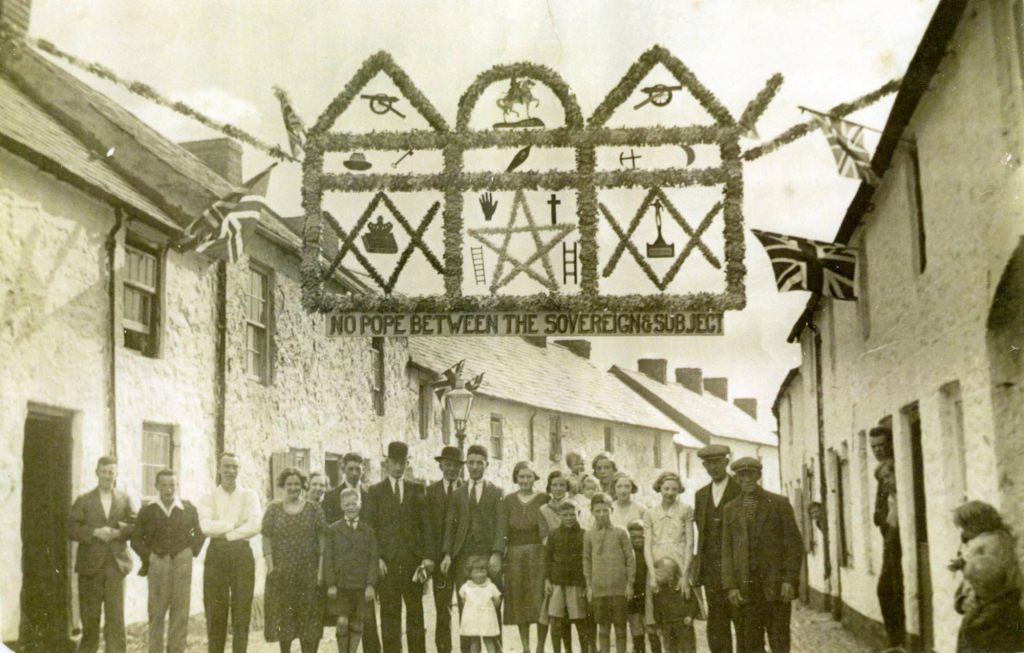
Alexander Street c 1934
Robert, my great grandfather, was born about 1821 and died in 1886. He appears to have done a disappearing act. To have become invisible to the rest of his siblings. For whatever reason contact was lost and as a result I grew up around cousins I never recognised or knew. We had no stories of relatives that emigrated to north America, nor any from those that remained. ‘He was married twice,’ was all we ever heard about Robert. It carried an air of censure.
James, one of Robert’s brothers, had emigrated to north America in the 1850s and settled near Ottawa. Around 2007 Nancy Howard, one of James’ descendants, with her husband Robert researched their family tree. They recorded and detailed hundreds of ‘cousins’ in North America and Ulster – many of them living in and around Ballymena. Robert’s sparse record notes his name, and the year of his birth and death. Nothing else. And none of us.
Robert married for a second time in 1867. To Elizabeth Bamber. Lizzie was twenty-one years his junior. Both were from the rural townland of Kildowney some six miles north of Ballymena. Robert was a labourer while his father William, who died some thirty years earlier, had been a weaver. Robert’s marriage witness, Jane McWilliams, most likely a daughter from his first marriage, his new wife Lizzie and her witness Jane Craig, all signed the marriage documents with an X. They could not write.
A few years before Robert and Lizzie were married, the Ulster Revival of 1859 garnered tens of thousands of converts, mostly into the Presbyterian churches in County Antrim. When their church could not accommodate these converts a new one was built nearby. West Church was completed in 1863, built in dressed, black basalt stone.
While you can only speculate on Robert’s first marriage and his life before it, I have a hunch that he was a convert during the fervent religious times. A reformed sinner, perhaps, with a newfound religious zeal. He certainly had a passion for his faith with its strict Sunday observance and prescribed Christian life. He expected the same from his family.
His son Hugh, my grandfather had a similar strong faith, and all of his children were believers in his Presbyterian mould. Including my father who, as a Faith Mission preacher, spent time evangelising in Scotland and the south of Ireland. Later to become a church elder. And on to the next generation and my own upbringing in the same church, the subject of some earlier blog posts.
Robert had six children by his second marriage, Robert, Elizabeth, Thomas, Hugh, Catherine and James and in 1901 they lived on Alexander Street. Robert junior married Maggie Allen, and in the early 1900s they moved to Belfast. Hugh was the only other one to marry. Hugh was a coachbuilder and has appeared in other stories in this blog.
The other four remained unmarried. After Robert’s death around 1905, the family moved to nearby Greenvale Street. Lizzie was a flax spinner in the Braidwater Mill. Thomas was a shoemaker. Catherine was a dressmaker of some renown, although at the time of her death, she was a housekeeper. James was a cabinet maker. My father never spoke much about his aunts and uncles, although they lived only ten minutes walk away from our home. As far as I know, he had little contact with them.
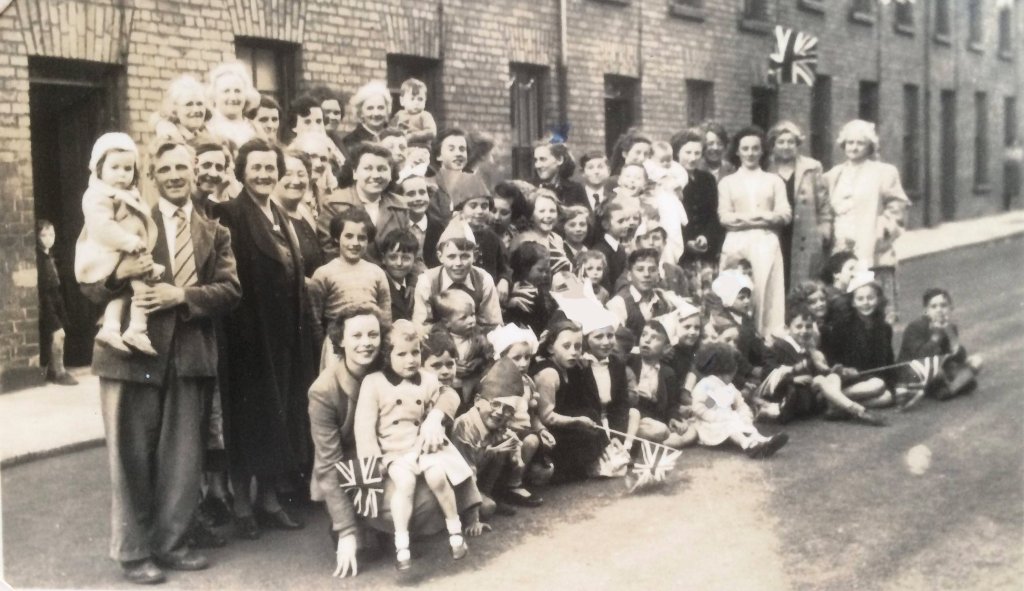
Greenvale Street 1953 Coronation celebrations (possibly some McWilliams are in here)
There is an odd silence from their generation, from their lives. Whether introverted or subdued, they seem to hold few surprises. There are no photographs. No stories, except of the illnesses of their later years. Only a few of Thomas’s shoemaking tools survived.
Their lives appear constrained. By their father’s puritanical influence? By the perceived sharp focus of The Saviour on their daily lives. Lives lived for the prize of eternal salvation. And later, burnished by an evolving northern Protestant culture and its insular love of our ‘wee Ulster’.
In 2020 I took a DNA genealogy test. To my surprise, I made a quick connection with the branch of Robert’s family that had emigrated to Canada in the 1850s. Robert and Nancy Howard gave me a copy of their family tree. It had hundreds of McWilliams with lots of detail. They put me in touch with cousin James McWilliams in Cullybackey. And suddenly our connection was much broader and deeper, with threads of emigration and movement that seemed to be missing.
Their research indicated that Robert had four siblings: James who emigrated to Canada, and the others, Margaret, John and Thomas who remained and married in and around Ballymena. Robert’s parents William and Martha, and grandparents, James and Margaret, were noted, all buried in the Old Graveyard in Ahoghill. And now I can add Robert and Eliza’s family, that quiet generation as I’ve described them, and on down to my grandfather’s family and those of us that come afterwards.
The DNA test would later throw up another surprise, but that’s for a later blog. The next one will include the details from this story.
This is a short blog with supplementary information relating to the last blog. First, my mother’s maternal line. For those interested, these women all carry the same mitochondrial DNA (mDNA) which only transfers along the maternal line – right back to their ‘Eve’.
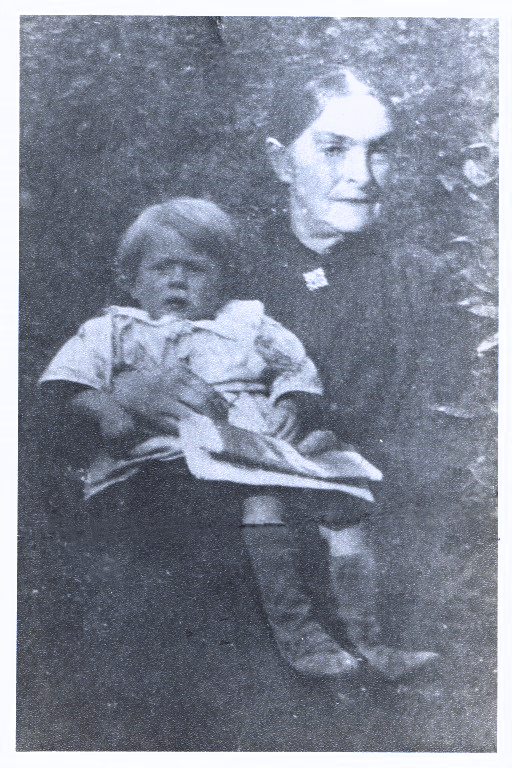
Ena Davis with her grandmother Margaret Eliza Gillmor, Boihy, Dromahair, c 1925.
Jane Taylor (nee ?) 1805-1881, Co Sligo (?), married John Taylor, Clooncunny, Taunagh Parish, Riverstown, Co Sligo.
Margaret Graham (neé Taylor), 1829-1893, Clooncunny, Co Sligo, married Patrick Graham, Knockalass, Emleghfad Parish, Ballymote, Co Sligo.
Margaret Elizabeth Gillmor (neé Graham) c1864-1933, Knockalass, Co Sligo, married William Hunter Gillmor, Boihy, Dromahair, Co Leitrim.
Annie Elizabeth Davis (neé Gillmor), Boihy, Dromahair, Co Leitrim, 1889-1978, married Richard Davis, Boggaun, Co Leitrim.
Annie Helena (Ena) McWilliams (neé Davis), Boggaun/ Larkfield, Co Leitrim, 1923-2015, married Thomas McWilliams, Ballymena, Co Antrim.
***
Thanks to Owen Duffy and Balymote Heritage Group for their research – ‘The Graham family of Knockalass, Co Sligo’, link here, and ‘Jane Taylor’ link here.
Thanks to Michael Farry’s for forwarding his notes on Charles Graham’s application to the Irish Grants Committee seeking reparation from the UK government. These notes detail Charles Graham’s version of crimes committed against him and his losses, some of which were made good by the UK Government. Link here.
 The Curlew's Call