Here is my paternal line, the last blog having focused on my maternal line. Of course, in the broad sense of who we are, this is very simplistic and ignores the genetic mix of generations of spouses and partners – and of our environment – and their various contributions to what ultimately makes us.
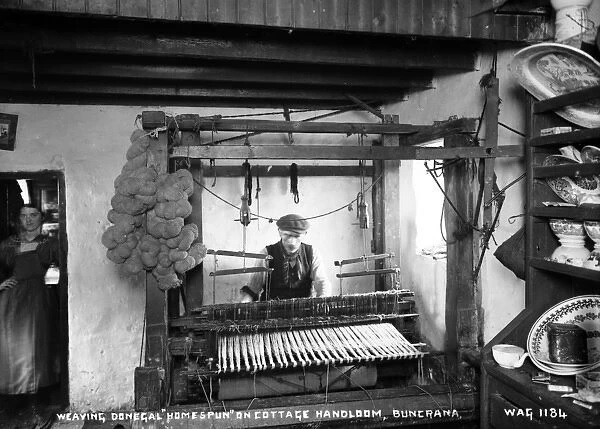
Source: mediastorehouse
A number of years ago I discovered details of my great grandfather, Robert McWilliam’s second marriage in 1867, and I had expected to come across other records on him or his family. But Robert’s father William, named on this marriage record, remains the furthest back male ancestor I can identify – my daddy’s, daddy’s, daddy’s daddy. I expect, however, that more will be uncovered. For now, it stands:
William McWilliams birth and death unknown, though a guestimate puts his birth date around 1700. William was a weaver from Kildowney, north of Ballymena, Co Antrim as was noted on his son’s marriage certificate.
Robert McWilliams, 1822 – abt. 1905. Married Elizabeth Bamber, 1842 – 1911 in 1867. Both were born in Kildowney and died in Ballymena. Robert was married twice and is described as a labourer on his marriage certificate.
Hugh McWilliams, 1878 – 1955, Ballymena. Hugh married Elizabeth Logan, 1880 – 1961, Ballymena. Married at Kells Church, Connor Parish, Co Antrim, lived in Ballymena. Hugh was a coach builder, and both are buried in Ballymena Cemetery.
Thomas McWilliams 1915 – 2003, Ballymena, Married Ena (Helena) Davis, 1923 – 2015. Lived in Ballymena, Co Antrim, later Dromahair, Co Leitrim and Portrush, Co Antrim. They are buried at Drumlease Parish Church, Dromahair, Co Leitrim.
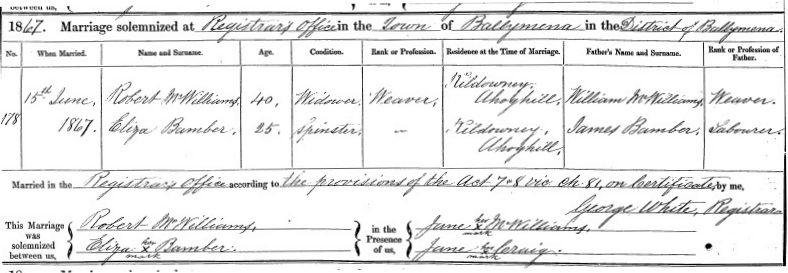
Robert and Eliza’s marriage record June 1867.
A DNA test widens the family
I took DNA genealogical test about two years ago, to try and discover more. A strong DNA link led me to Canadian ‘cousins’ who emigrated from the Ballymena area and settled in Ottawa in the mid-1850’s. Their family tree is full of Williams, Roberts and James that, at first, appeared to match ours. But on a closer look, the Roberts and James did not match well enough; their birth and death dates were too different to make sense. (This leaves my recent blog Robert Disappears somewhat in need of correction!) So, I’m digging again, for a missing link which may be a generation or two back. Something will turn up.
Every male has Y-DNA which is passed uniquely through his father’s line, from father to son, and so on. Individual Y-DNA analysis, and sharing the results, have provided powerful tools to scientifically investigate our human family: its movements and origins, giving us a better notion of our geographical and cultural journey.
Historical mutations or markers which are locked in my Y-DNA are like a faint trail of breadcrumbs on a hidden path. Each breadcrumb is a mutation and marks a branch on my human tree. In some cases, it can be linked to known men and approximate time periods.
McWilliam’s Y-DNA
So what of the McWilliams Y-DNA? Surnames are only useful tags going back about a thousand years or so, when they first came to be used. My assumption was that a Y-DNA test would show a clear link to Scottish Plantation of Ulster during the seventeenth century. But surprisingly, we carry ‘Niall of the Nine Hostages’ marker, the M222 mutation or breadcrumb. This is a scientific fact. We are of Gaelic origin, on our father’s line anyway.
‘Niall of the Nine Hostages’
Despite the esoteric nature of human genetics, the Niall gene achieved significant public attention. While the M222 marker was originally attributed to ‘Niall of the Nine Hostages’. (Niall was a semi-historical character, assumed to have been real person living in the late 4th and early 5th century AD. Notably, he was the progenitor of the O’Neill dynasty.) The ‘Niall’ moniker now appears to be a misnomer as the M222 mutation has been shown to go back much further into pre-history.
A large proportion of Irish men, almost 25% in the NW, and a significant percentage of Scottish men carry this gene mutation. It appears to cluster around south Inishowen, around Graian Fort it has been suggested – coincidently the area where I have been living for the past forty years. Simply put, at some point in Irish pre-history a very prolific Gaelic male living in this area spread his DNA very widely, and today millions carry the M222 marker.
Gaelic Orangemen?
So how did we end up as Mid-Antrim Presbyterians with many recent ancestors steeped in the Orange tradition? There are at least two possibilities. Firstly, our roots are in the area around Ballinascreen, where the Gaelic McWilliams surname is common. The south Derry area was for centuries was part of the O’Neill kingdom. The Y-DNA evidence and analysis suggest this is likely. During the first half of the 1600s, lands near Ballinascreen were expropriated and given to the the London Company of Drapers – centred on the planted town of Draperstown. For pragmatic reasons, we may have switched allegiances and become Presbyterians, bringing a better chance of employment and family prospects. It is argued this was a common occurrence, indicated by the many Northern Irish Protestant names which have no apparent roots in England.
A search of seventeenth-century records for County Antrim found very few McWilliams, although records are sparse. So, we may have gradually migrated to the better lands and the security of the Protestant majority in County Antrim, becoming drawn into the social and political concerns of this community.
The seventeenth-century Ulster plantation of lowland Scots offers a second possibility. That we were one of the Scottish McWilliams, Presbyterian planters who arrived in Ulster carrying the M222 gene mutation. Centuries earlier Irish raiders and traders had landed in western and southwestern Scotland, some settling and introducing the ‘Niall’ mutation to the gene pool. Scoti is the original Latin name referring to Irish Gaels. In addition, since pre-history, there has been continuous seafaring across the Straits of Moyle (the North Channel) between Ireland and Western Scotland. This centuries-old ebb and flow of human traffic, sometimes seasonal, carried the M222 gene eastwards and then back westwards again, to Ireland. So that’s where our story sits for now.
END
Print version here.
Any Davis or McWilliams family member would like to add to this story through a DNA genealogy test please let me know.

 The Curlew's Call